

🇯🇲 Moving to Jamaica from the UK
Jamaica is the largest English-speaking Caribbean island and the third-largest in the wider Caribbean, with the most globally-recognised culture of any CARICOM nation. Independent since 6 August 1962.
No other country in the Caribbean has shaped global culture the way Jamaica has, and no other country in the project has a UK Diaspora on this scale. The UK Jamaican community is the country’s largest single overseas community after the United States, anchored by Empire Windrush in June 1948 and now spanning three and four generations. For that Diaspora this guide gives you what you need to decide honestly: citizenship, real cost of living, healthcare, property, banking and the practical first steps. Jamaica has real strengths: a strong CSME passport, dual citizenship explicitly recognised, the most developed Diaspora infrastructure in CARICOM, and direct UK flights from Heathrow and Gatwick. It also has the honest challenges any returning Jamaican needs to plan for: recovery from Hurricane Melissa (the Category 5 storm that struck the south-west on 28 October 2025, the strongest ever recorded over Jamaica), the active republic transition programme that began in 2023, and a security picture that has improved markedly under PM Holness’s third-term mandate but still earns Jamaica a US State Department Level 3 advisory. We tell you all of it, honestly.
Identity and Culture
Before the practicalities, this is the place. Its symbols, its sound, its flavour. Jamaica is the cultural anchor of CARICOM and one of the most globally-recognised national cultures in the world for its size: reggae, recognised by UNESCO as an Intangible Cultural Heritage in 2018; Rastafari, which originated in Jamaica in the 1930s and spread worldwide; Patois (Patwa, Jamaican Creole), spoken alongside English; and the most decorated track-and-field tradition in the world for any country its size, anchored by Usain Bolt, Shelly-Ann Fraser-Pryce and the long line of Jamaican sprinters. The population is ~92 percent Afro-Jamaican, with smaller Mixed, East Indian (descendants of indentured workers post-1845), Chinese, Lebanese and European communities.
National Flag
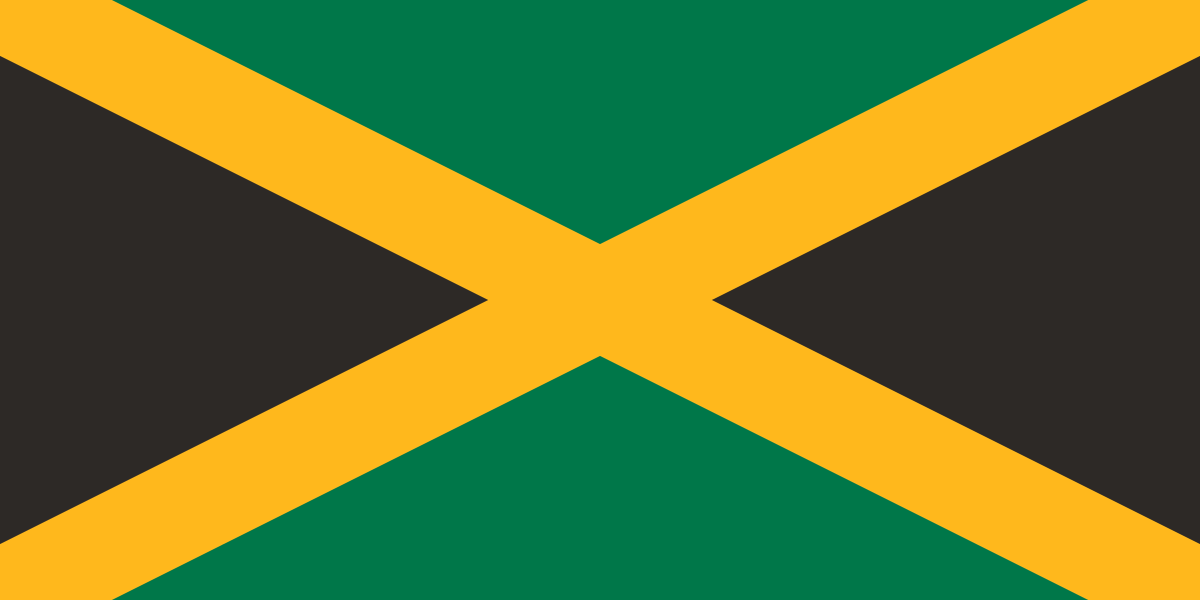
Adopted at independence on 6 August 1962. A gold saltire (diagonal cross) dividing the flag into four triangles, the top and bottom in green and the hoist and fly in black. Designed by a bipartisan committee. The colours encode the national interpretation: gold for sunshine and natural wealth, green for the land and hope, black for the strength and creativity of the people. One of only two national flags in the world (with Mauritania) that does not use red, white or blue.
Coat of Arms

Granted by royal warrant in 1661 (one of the oldest in the Commonwealth), updated in 1962. A red cross with five golden pineapples on a silver shield, supported by a Taino man and woman, with an Amerindian crocodile (the country's native reptile) above on the helm, and the motto on a scroll below. The Taino represent the island's first inhabitants.
National Motto
"Out of Many, One People."
A deliberate affirmation of Jamaica's multi-ethnic foundation, adopted at independence in 1962.
National Anthem
"Jamaica, Land We Love."
Lyrics by Hugh Sherlock, music by Robert Lightbourne. Adopted at independence in 1962. A hymn-form anthem famously sung in churches, schools and stadiums across the country and the Diaspora.
National Dish
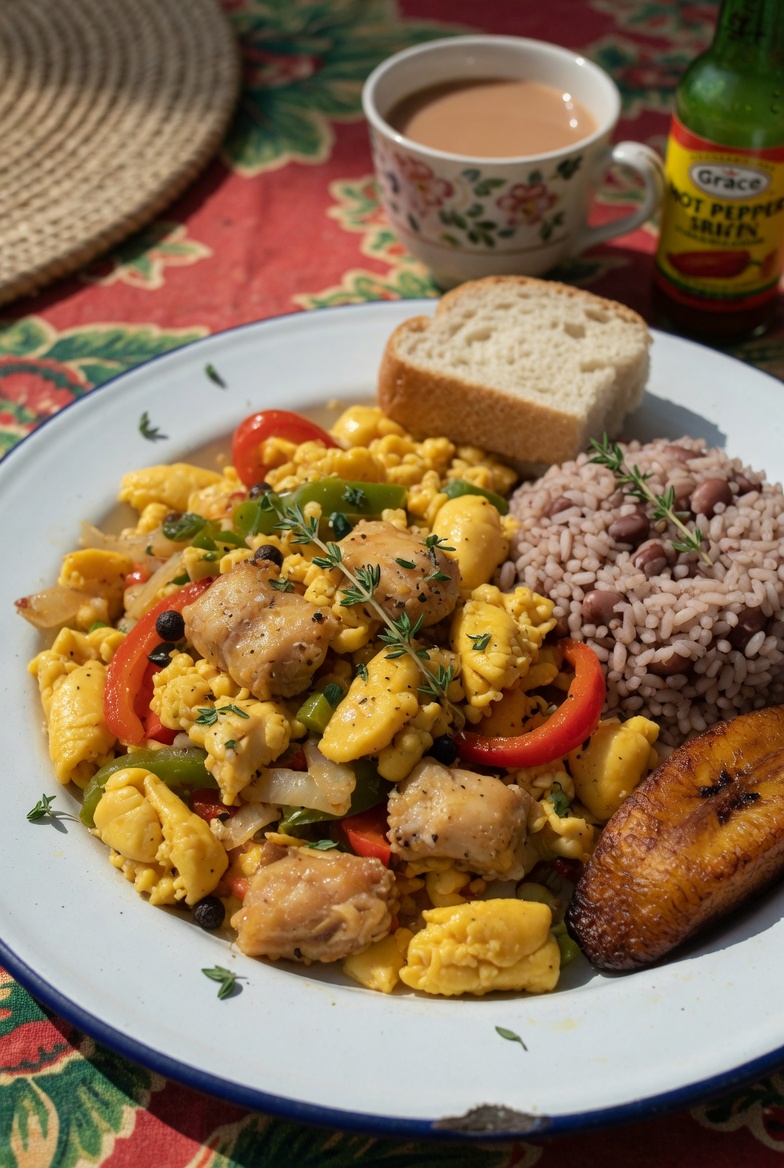
Ackee and Saltfish. The national dish: ackee fruit (the national fruit, brought from West Africa in the 18th century; the genus is Blighia sapida) cooked with salt cod, onion, scotch bonnet, tomato and herbs. Eaten at breakfast across the country and the Diaspora. Other staples: jerk chicken / pork (Maroon-origin spice rub of pimento and scotch bonnet, slow-cooked over pimento wood), curry goat (Indo-Jamaican), oxtail and beans, rice and peas (the Sunday-dinner staple), festival (sweet fried dumpling) and Jamaican patties (the global UK takeaway icon).
Did You Know
Jamaica is divided into 14 parishes, grouped into three historic counties: Cornwall (the west, including St James with Montego Bay and St Elizabeth where Hurricane Melissa made landfall on 28 October 2025), Middlesex (the centre, including St Ann where Bob Marley and Marcus Garvey were born, St Catherine with Spanish Town the former capital, and Manchester with the largest UK and US Diaspora-returnee population), and Surrey (the east, including Portland, St Andrew, the capital parish of Kingston, and St Thomas). The island has hundreds of kilometres of beach; the best-known stretches are Negril's Seven Mile Beach, Doctor's Cave Beach in Montego Bay, Frenchman's Cove and Boston Bay in Portland (the home of jerk), and Treasure Beach in St Elizabeth.
Country Code: the 876
+1 876 (with the +1 658 overlay introduced in May 2018 for new numbers). Across the Caribbean and the global Diaspora, Jamaicans identify themselves simply as "the 876," after the country's telephone area code. You will hear it at Reggae Sumfest in Montego Bay each July, at Champs at the National Stadium, on the dancehall WhatsApp groups, and at any Jamaican gathering in Brixton, Tottenham, Birmingham, Manchester, Brooklyn, the Bronx, Toronto, or Miami. Saying "I’m from the 876" is saying "I’m from home."
Leadership: Who Runs the Country
Jamaica is a parliamentary constitutional monarchy in the Westminster tradition. King Charles III is Head of State, represented locally by the Governor-General. The Prime Minister leads the Government with a Cabinet drawn from Parliament. The bicameral Parliament has a 63-seat elected House of Representatives and a 21-seat appointed Senate. The Cabinet meets at Jamaica House on Hope Road, Kingston; Parliament meets at Gordon House on Duke Street. Jamaica uses the Caribbean Court of Justice (CCJ) for trade-related matters under the Revised Treaty of Chaguaramas; CCJ accession for general final appeals remains an active part of the current constitutional reform programme.

Citizenship and Passport Eligibility 4-Region
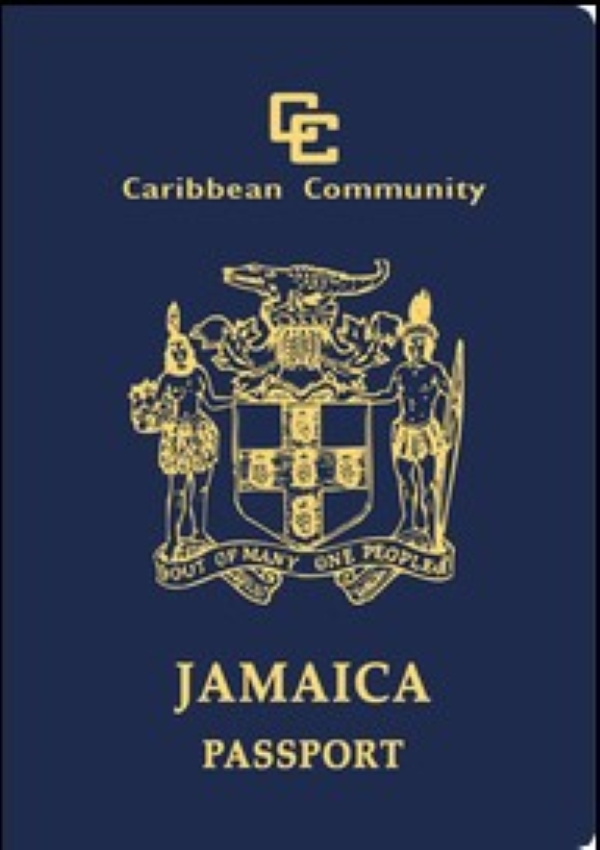
This is the most favourable citizenship picture in the project. Jamaica explicitly recognises dual citizenship for citizens by birth and descent, descent rules cover both parent and grandparent routes, and the Jamaican passport is a strong, fully CSME-participant document with direct UK visa access on the Standard Visitor route for Jamaicans visiting family.
The routes, honestly
- By descent through a parent, the most common Diaspora route. A person born outside Jamaica is a Jamaican citizen by descent if at least one parent was a Jamaican citizen at the time of the birth. Documented through the Passport, Immigration and Citizenship Agency (PICA).
- By descent through a grandparent, the second-generation Diaspora route. Where the qualifying parent was Jamaican-born and you have the unbroken documentary chain, registration through PICA as a Commonwealth Citizen by Descent is the standard path. Documentation is the key.
- By marriage, available to the foreign spouse of a Jamaican citizen, with a residence qualifying period.
- By registration / naturalisation, possible after a qualifying period of legal residence.
- By investment. Jamaica does not currently run a Citizenship by Investment programme. Treat any third-party claim that Jamaica has an active CBI route with caution.
- Dual citizenship is permitted for citizens by birth and descent. Naturalised Jamaicans face restrictions and should obtain explicit retention permission before acquiring a second nationality. A Jamaican-born MP may not sit in the House of Representatives while holding a non-Commonwealth citizenship (the source of high-profile Parliamentary cases in recent years), so the rule matters for those entering political life.
Jamaica was a founding member of CARICOM in 1973 (the Treaty of Chaguaramas was signed in Trinidad with Jamaica as one of the four signatories) and is a full participant in the CARICOM Single Market and Economy (CSME). As a Jamaican national your passport carries the five freedoms of the CSME: free movement of goods, services, capital, the right of establishment, and the free movement of skilled persons.
To live and work in another CSME country, you apply for a CARICOM Skills Certificate, which covers 13 wage-earner categories including university graduates, teachers, nurses, artisans with vocational qualifications, household domestics with CVQ, sportspersons, musicians and others. Processing is typically five to eight weeks, the certificate is recognised across CSME participants, and the right to bring your spouse and dependants travels with it.
Honest note: Jamaica is not in the October 2025 four-country Enhanced Full Free Movement pilot (Barbados, Belize, Dominica and SVG). For those four countries, no Skills Certificate is required. Outside that pilot, Jamaica’s standard CSME rights apply across the other CSME participants. (The Bahamas does not participate in the CSME; Montserrat and Haiti are outside the free-movement framework.)
Where to apply, by region
| From | Where to enquire |
|---|---|
| United Kingdom | Jamaican High Commission, 1-2 Prince Consort Road, London SW7 2BZ. Tel +44 (0)20 7823 9911. Web: jhcuk.org. Consular hours 9.30am to 1.00pm Mon-Fri (passports to 12.30pm). The London HC also covers Ireland and several European postings. |
| USA | Embassy of Jamaica, Washington D.C. Consulates-General in New York (the largest US Jamaican community), Miami and Atlanta. Honorary Consuls in additional cities. |
| Canada | Jamaican High Commission, Ottawa. Consulate-General in Toronto (one of the largest Jamaican communities in the world, anchored in the Greater Toronto Area). Active Diaspora engagement. |
| Europe | Embassy of Jamaica in Brussels (mission to the European Union and EU institutions). The London High Commission handles much of the European consular work. |
| In Jamaica | Passport, Immigration and Citizenship Agency (PICA), 25c Constant Spring Road, Kingston 10. Web: pica.gov.jm. |
For descent applications, the long-form birth certificate of your Jamaican parent (or grandparent for grandparent-route applications) is essential, properly Apostilled if issued abroad. Names and dates must match across generations: a difference in spelling can hold up the application and may require a sworn Statutory Declaration. Reissue any short-form or photocopied certificates through the Registrar General’s Department (RGD) in Kingston before you file. PICA processing times for descent registration vary from several weeks to several months; submit early.
Cost of Living 4-Region
An honest monthly comparison: your home city versus life in Jamaica, in your own currency. Jamaica sits in the middle of the CARICOM cost range. Kingston and the corporate-area parishes (Kingston, St Andrew, parts of St Catherine and St Mary) are more expensive than the south-coast parishes (Manchester, St Elizabeth, Clarendon) or rural Cornwall. Returning Diaspora most commonly settle in the historic Diaspora-returnee parishes of Manchester (Mandeville), St Ann (Ocho Rios and Mammee Bay) and St James (Montego Bay), where US Dollar pricing has become common in the property market alongside JMD.
| Monthly expense | London £ | New York $ | Toronto C$ | Jamaica (USD equivalent) |
|---|---|---|---|---|
| Rent, 1-bed local-standard, Kingston | £2,000 | $3,800 | C$2,400 | ~$600 to $1,000 USD |
| Rent, 1-bed expat-standard, New Kingston / Half-Way Tree | £2,300 | $4,200 | C$2,800 | ~$1,300 to $2,500 USD |
| Rent, 1-bed, Mandeville / Ocho Rios / Mo Bay | £2,000 | $3,800 | C$2,400 | ~$700 to $1,500 USD |
| Single person, modest lifestyle (all in) | £3,000 | $4,800 | C$3,800 | ~$1,500 to $2,400 USD |
| Couple, comfortable lifestyle, Kingston (all in) | £3,800 | $6,500 | C$5,200 | ~$3,200 to $5,800 USD |
| GCT (consumption tax) on most goods and services | 20% | Varies | 13% | 15% |
Hurricane Melissa (Category 5, landfall 28 October 2025) damaged housing stock across St Elizabeth, Westmoreland, Manchester, Clarendon and parts of St James and Trelawny. Rebuilding pressure has tightened the rental market in the southern and western parishes during 2026; building materials prices have risen. The eastern parishes (Portland, St Thomas, St Andrew, Kingston) were affected less directly. Build at least a six-to-twelve-month buffer into your budget for rebuilding-period premium pricing if you are settling in the south or west.
Housing and Property
As a Jamaican citizen you can buy and own land and property freely. Non-Jamaicans can also buy residential property with no special permits required; a more involved process applies for large commercial purchases through Jampro and the Bank of Jamaica. Title is held under the Registration of Titles Act 1889 in a Torrens-style registered system; the National Land Agency (NLA) maintains the register. A proper title search and survey are essential, particularly for inherited rural land where succession may not have been formally registered.
Where Diaspora returnees tend to settle
- Manchester (Mandeville, Christiana, Williamsfield): the historic Diaspora-returnee parish of choice. Cool highland climate (around 2,000 feet elevation), strong UK and US Returning Resident community, established Diaspora-funded housing stock, and the Northern Caribbean University. Often called "Little Manchester" in the UK Diaspora.
- St Ann (Ocho Rios, Mammee Bay, Discovery Bay): the north-coast tourism parish, with significant Diaspora-returnee gated communities at Mammee Bay and a strong Canadian community presence. Bob Marley’s birthplace (Nine Mile).
- St James (Montego Bay, Ironshore, Rose Hall): the second city. The Ironshore-Rose Hall belt east of Montego Bay is the country’s most established expat / Diaspora suburb, with golf, Sangster International Airport, and direct UK flights.
- Trelawny (Falmouth, Duncans, Silver Sands): the Georgian sugar-port town and a quieter Diaspora option on the north coast.
- St Mary and Portland (Port Antonio, Boston Bay): the rainy north-east, with a quieter and historically literary expat scene (Errol Flynn, Ian Fleming, Noel Coward all settled here).
- Kingston and St Andrew (New Kingston, Hope Road, Cherry Gardens, Norbrook, Stony Hill): the corporate area. Hope Road, the Cherry Gardens / Norbrook belt and the Stony Hill foothills are the established middle-class and Diaspora-returnee neighbourhoods. The Blue Mountain foothills offer cool elevation within easy reach of the city.
- St Elizabeth and Westmoreland (Treasure Beach, Negril, Bluefields): the south and south-west coast, historically quieter and more affordable. Significant Hurricane Melissa damage in October 2025; rebuilding is a real factor in any 2026 housing decision in these parishes.
- St Catherine (Spanish Town, Portmore): the historic capital and the Portmore commuter belt to Kingston; large Diaspora-returnee population in newer Portmore developments.
Jamaica is squarely in the Atlantic hurricane corridor. The defining recent event is Hurricane Melissa (Category 5), which made landfall in St Elizabeth on 28 October 2025 with sustained winds around 175 mph, the strongest hurricane to directly strike Jamaica since record-keeping began in 1851 and stronger than Hurricane Gilbert in 1988. PM Holness declared the entire island a disaster area; the UN team in Jamaica described damage assessments at levels "never seen before". When buying or building in any of the southern or western parishes (St Elizabeth, Westmoreland, Manchester, Clarendon, St James, Trelawny), verify the property’s post-Melissa repair status, construction standards and elevation honestly. Eastern Jamaica (Portland, St Thomas, St Andrew, Kingston) was affected less directly. Building back to Category 5 standards is now the practical baseline for serious property decisions.
Healthcare
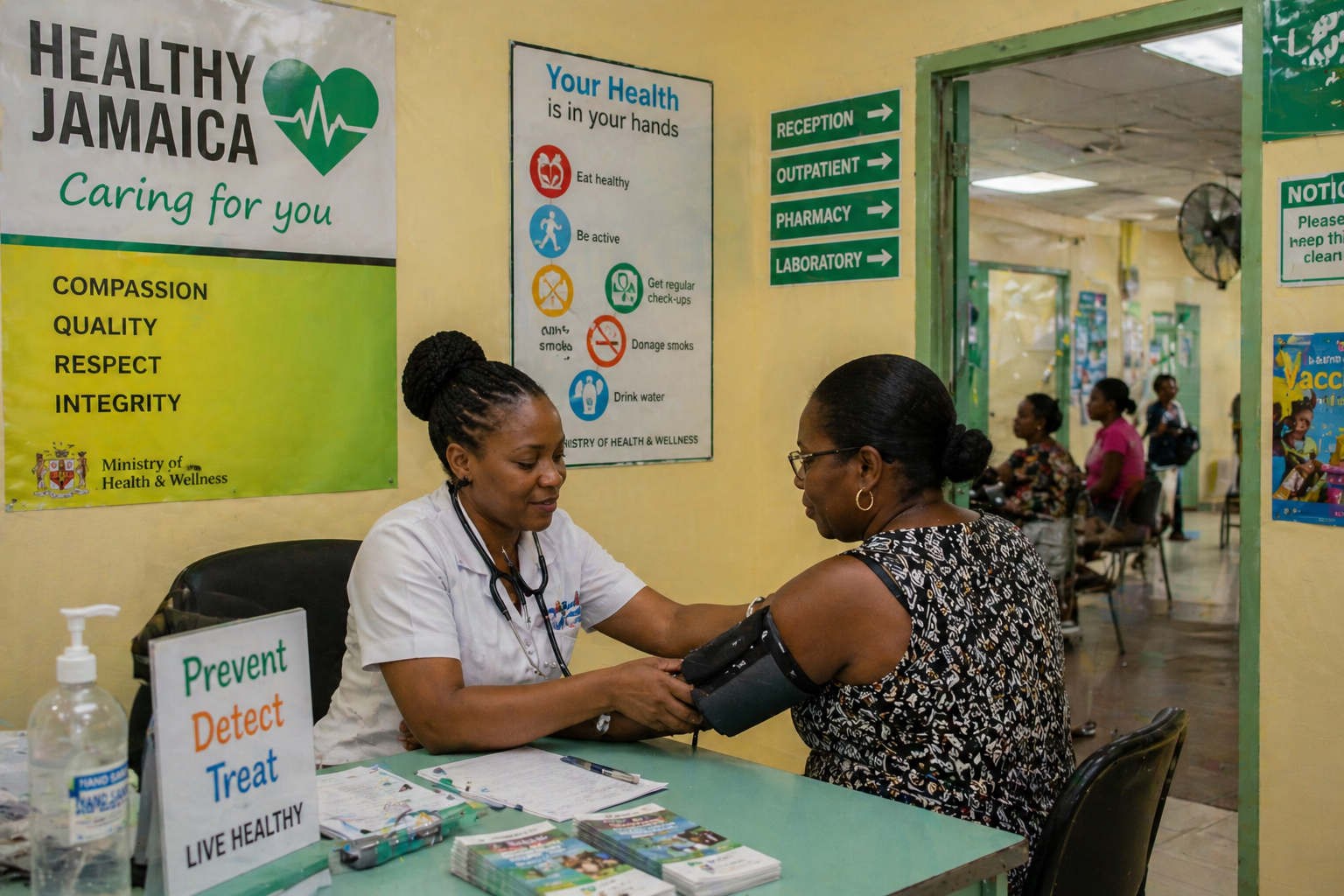
Healthcare in Jamaica is run by the Ministry of Health and Wellness through four Regional Health Authorities (South East, North East, Western, Southern), with public hospitals, regional health centres and a growing private sector. The public system has been free at the point of use for citizens since 2008 (the user-fee abolition reform), though most returnees layer a private policy on top because the public system is genuinely stretched and complex specialist care still often means a flight to Miami, Trinidad, Florida or the UK.
Main hospitals and facilities
- University Hospital of the West Indies (UHWI), Mona, St Andrew: the country’s leading teaching hospital and the regional UWI hospital, on the Mona campus. The most advanced public-sector specialist care in Jamaica.
- Kingston Public Hospital (KPH): the largest public hospital in the English-speaking Caribbean, on North Street, central Kingston. The country’s main trauma centre.
- Bustamante Hospital for Children: the country’s national paediatric hospital, Arthur Wint Drive, Kingston.
- Victoria Jubilee Hospital: the historic maternity hospital, central Kingston (one of the largest maternity hospitals in the English-speaking Caribbean by deliveries).
- Cornwall Regional Hospital, Montego Bay (St James): the leading regional referral hospital in the west. Refurbished in 2025.
- St Ann’s Bay Hospital (St Ann), Mandeville Regional Hospital (Manchester), Spanish Town Hospital (St Catherine) and May Pen Hospital (Clarendon): the major regional referral hospitals.
- Private hospitals: Andrews Memorial Hospital (Hope Road), Medical Associates Hospital (Tangerine Place), St Joseph’s Hospital (Deanery Road), Hospiten Jamaica (Mo Bay) and the University Hospital of the West Indies Private Wing are the leading private options. Shorter waits and a wider specialist range; the natural first stop for returnees with private cover.
For older returnees
If you are returning at retirement age, plan three things before you travel. Arrange private health cover with strong medical-evacuation cover before arrival, since cover taken out later costs more and access to specialist care often means travel to Miami or the UK. Bring a full written record of your medical history and current prescriptions so a local doctor can continue your care without gaps. And check that any long-term medication you depend on is reliably available locally; build redundancy through a UK pharmacy if needed.
For complex specialist care (advanced cardiac surgery, complex oncology, neurosurgery, advanced neonatal), Jamaicans have historically travelled to Miami or, increasingly, Trinidad (Port of Spain) and the UK. UHWI Mona has built genuine capacity in cardiac, oncology and renal care over the last decade, so the gap has narrowed. Build medical evacuation into your insurance from day one, particularly if you settle in the rural parishes where the nearest regional hospital may be 60 to 90 minutes away.
Education and Schools
Education in Jamaica is free and compulsory between ages 6 and 16. The system is British-modelled in structure: early childhood (3 to 6), primary (6 to 12), secondary (12 to 17) and sixth form (17 to 19). At the end of secondary, students sit Caribbean Examinations Council (CXC) qualifications: the Caribbean Secondary Education Certificate (CSEC), broadly comparable to GCSE; sixth-form students sit the Caribbean Advanced Proficiency Examination (CAPE), comparable to A-levels. The Primary Exit Profile (PEP) at age 12 streams pupils into secondary schools and is a significant national event each year (the successor to the historic Grade Six Achievement Test).
Well-regarded schools
- Campion College (Hope Road, Catholic Jesuit, co-educational), the country’s highest-ranked secondary on national exam metrics for many years.
- Immaculate Conception High School (Constant Spring Road, Catholic girls’), the leading Catholic girls’ school.
- St George’s College (North Street, Catholic Jesuit boys’, founded 1850), the country’s historic Catholic boys’ secondary.
- Wolmer’s Boys’ School and Wolmer’s Girls’ School (Heroes Circle, founded 1729): the historic Wolmer’s Trust schools.
- Kingston College (KC) (North Street, founded 1925, Anglican), legendary for athletics (the home of the "Purples"), and Calabar High School, the other Champs powerhouse.
- Hampton School (Malvern, St Elizabeth, girls’ boarding, founded 1858) and Munro College (Malvern, St Elizabeth, boys’ boarding, founded 1856): the country’s historic highland boarding schools.
- Manchester High School, Mannings School (Westmoreland), Cornwall College (Mo Bay), Glenmuir High School (May Pen), Ardenne High School, Holy Childhood: leading regional and Kingston-area secondaries.
- The University of the West Indies (UWI) Mona Campus, the regional university’s historic Jamaica campus (founded 1948), serving the wider English-speaking Caribbean. Plus the University of Technology, Jamaica (UTech), the University of the Commonwealth Caribbean (UCC), the Northern Caribbean University (NCU, Mandeville), and the Edna Manley College of the Visual and Performing Arts. International schools include the American International School of Kingston (AISK).
Public schooling is free but families typically pay for uniforms, books, lessons and a small voluntary contribution. The traditional secondaries (Campion, Immaculate, KC, Wolmer’s, Calabar, St George’s, Hampton, Munro, Manchester) have competitive admission via PEP results; UK Diaspora returnee families with children of secondary age often plan around PEP timing if the move is reversible. Sixth-form-aged children commonly progress to UWI Mona, UWI Cave Hill (Barbados), UWI St Augustine (Trinidad), UK universities, or US / Canadian institutions; the strong Diaspora networks in those countries are a real advantage.
Banking, Tax and Money
A few registrations matter for every returning resident settling in Jamaica.
The tax picture, honestly
Jamaica’s tax system is moderate and well-administered. Personal income tax is charged at 25 percent on chargeable income up to JMD 6 million per annum (around US $38,000); a higher rate of 30 percent applies above that. General Consumption Tax (GCT) is charged at 15 percent on most goods and services (with a higher 25 percent rate on telephony services and zero-rated / exempt categories). Property tax is charged on the unimproved value of land by Tax Administration Jamaica on behalf of the parish councils, on a banded scale. Corporate tax is 25 percent (for regulated companies) or 331/3 percent (for unregulated). The Jamaican Dollar is floating against the USD, managed by the Bank of Jamaica.
PM Holness campaigned in the 2025 election on a proposal to reduce the headline income tax rate from 25 percent to 15 percent over the third-term mandate. As of 2026, the staged implementation of that promise is part of the third-term programme; confirm current rates against the latest TAJ guidance before relying on this.
Inheritance tax: an honest comparison with the UK
This is a real and rarely-discussed advantage for returning Diaspora, with one specific nuance to watch for.
- The UK position: UK Inheritance Tax is currently 40 percent on the value of an estate above the nil-rate band of £325,000 (with an additional £175,000 residence nil-rate band where a main home passes to direct descendants, and full spouse exemption). Most middle-class UK estates with a home and pension are affected.
- The Jamaica position: Jamaica does not impose an inheritance tax on beneficiaries. Beneficiaries do not pay tax on inherited assets in the UK sense.
- The nuance worth knowing: Transfer Tax on Death. Under the Transfer Tax Act, a Transfer Tax of 1.5 percent is levied on the market value of Jamaican-situs assets transferred on death (paid by the estate before distribution). The first JMD 10 million of the estate is currently exempt under the threshold raised by the Ministry of Finance. This is not an inheritance tax in the UK sense (paid by the beneficiary on what they receive); it is a small estate-level transfer duty. At 1.5 percent it is dramatically lower than the UK 40 percent, but it is a real cost to plan for. Stamp duty also applies on the registration of the inherited title.
- The cross-border reality. UK domicile is sticky. A UK-domiciled person can still face UK Inheritance Tax on their worldwide estate even after relocating to Jamaica. Domicile is a different test from residence and is hard to shed. There is no UK-Jamaica double-tax treaty covering inheritance specifically. Treat this as one of the most important conversations to have with a qualified UK tax adviser before you go.
Wills and estate planning
This is genuinely important, often missed, and frequently sad in its consequences.
- Why it matters. Many UK Diaspora have a UK Will that does not properly cover Jamaican property, or no Will at all. On death this can throw the estate into intestacy across two jurisdictions, which is slow, costly and distressing for family at the worst possible moment.
- Widely-recommended practice (not legal advice). Cross-border practitioners commonly recommend two Wills, drafted to work together: a UK Will covering your UK estate, and a separate Jamaica Will covering your Jamaican property, each containing language making clear it does not revoke the other. Use a local lawyer in Jamaica for the local Will.
- The local rules. Inheritance is governed by the Wills Act, the Intestates’ Estates and Property Charges Act, and the Inheritance (Provision for Family and Dependants) Act (which allows close relatives and dependants to apply for reasonable provision from an estate, similar in shape to the UK 1975 Act). The Probate Registry of the Supreme Court of Judicature of Jamaica in Kingston handles grants. Uncontested probate is usually granted in three to six months; complex or contested estates take longer.
- UK Wills and resealing. A grant of probate obtained from a UK court can be resealed by the Supreme Court of Judicature of Jamaica under the Colonial Probates Act (which still applies to Commonwealth grants). In practice this means a UK grant covering Jamaican assets can often be used directly, rather than needing a fresh Jamaica probate from scratch. Confirm with a local lawyer for your situation.
- Intestacy formula, if no Will. Under the Intestates’ Estates and Property Charges Act: a surviving spouse with children receives the personal chattels, a statutory legacy, and a life interest in half the residuary estate, with the children sharing the remaining half (the precise figures and life-interest treatment are technical and require local advice); a surviving spouse with no children inherits the entire estate. Common-law spouses recognised under the Property (Rights of Spouses) Act 2004 may have additional claims.
- Practical pointers. Name an executor in each jurisdiction. If the executor is not resident in Jamaica, a local agent must be appointed via Power of Attorney to obtain the grant of probate. Review every five years or on a major life event. Tell your executor where the Wills are stored.
This is general information for orientation. Always speak to a qualified local lawyer before drafting or relying on a Will.
Jamaica operates a long-established Returning Resident concession through Jamaica Customs Agency. A Jamaican citizen returning after a qualifying continuous period abroad (currently three years) may import household goods and effects, and one motor vehicle subject to conditions, with relief from some duties. The exact current qualifying years, eligible items and any cap on vehicle age, value and engine size are set by the Jamaica Customs Agency Returning Residents Unit and have changed over the years. Confirm the current rule directly before you ship anything.
Work and Business
As a Jamaican citizen you can live and work in the country freely, with no work permit required. Under the CSME framework, nationals of other CSME states can apply for a Skills Certificate (see Citizenship). Under the October 2025 free-movement pilot, nationals of Barbados, Belize, Dominica and St Vincent and the Grenadines have enhanced rights across those four pilot countries; Jamaica is not currently a pilot member.
The main sectors
Jamaica has the most diversified economy in CARICOM. The major sectors today are: tourism, the country’s largest foreign-exchange earner (Sangster International in Mo Bay handles the largest share of the country’s ~4 million annual visitors); bauxite and alumina, the historic mining sector (Jamaica was historically one of the world’s largest bauxite producers); BPO and ICT, a major growth sector, with Jamaica now one of the leading English-speaking near-shore BPO destinations in the Americas (the Montego Bay Free Zone is a particular anchor); agriculture and agro-processing (Blue Mountain coffee, sugar, rum, banana, ackee, sorrel, scotch bonnet, ginger); logistics and shipping (Kingston Container Terminal is one of the largest in the Caribbean; the Kingston Logistics Hub is a major national investment programme); creative industries and entertainment (reggae and dancehall recording, Edna Manley College, the global Bob Marley brand and the wider music economy); finance and professional services; and cannabis (medical cannabis is regulated under the Dangerous Drugs (Amendment) Act 2015 and the Cannabis Licensing Authority).
Starting a business
New businesses register through the Companies Office of Jamaica in central Kingston. Jampro (Jamaica Promotions Corporation) is the national investment-promotion agency and the main contact point for inward investment, incentive schemes and Diaspora business. The Jamaica Stock Exchange (JSE) is one of the most active small-cap stock exchanges in the Americas.
The Diaspora returnee opportunity in Jamaica is the most developed in CARICOM. Diaspora-led businesses do well in BPO and call-centre services (the language and cultural fit makes this a natural match), Diaspora-market property and hospitality (returnee housing, eco-tourism, Mo Bay villa rental), agro-export to the UK and US (Blue Mountain coffee, scotch bonnet, ackee, ginger), creative-industry services (music, video, branding), professional services (legal, accounting, financial advice) and remittance / fintech. The two-Diaspora reality (UK and North America) is a structural feature of Jamaican business: many returnees serve both markets at once.
Driving and Transport 4-Region
Jamaica drives on the left, the same as the UK, in the standard Commonwealth fashion. This is a comfort for UK returnees but the reverse adjustment for US- and Canadian-based Diaspora. Steering wheels are on the right. The road network has been substantially upgraded in recent decades, with the North-South Highway (T3) connecting Kingston to St Ann’s Bay through the central interior, and the East-West Highway 2000 (T1) along the south coast from Kingston to Montego Bay (in stages). Two main international airports: Norman Manley International Airport (KIN) in Palisadoes, Kingston, serving the capital; and Sangster International Airport (MBJ) in Montego Bay, the country’s busiest, serving the tourism economy and the Diaspora north-coast corridor. Direct UK flights to both KIN and MBJ from London Heathrow and London Gatwick are operated by British Airways and Virgin Atlantic, the strongest direct UK air links of any country in this guide. Several US carriers serve KIN and MBJ from New York, Atlanta, Miami, Charlotte and others; Air Canada serves Toronto.
| Licence held | How it works | Where | Cost |
|---|---|---|---|
| UK licence | Valid UK licence holders may drive in Jamaica on the UK licence for up to 12 months. For residence, conversion to a Jamaican licence is required after that. | Island Traffic Authority (ITA) | ~$30 to $80 USD conversion |
| US licence | Valid US licence holders may drive for up to 12 months; conversion thereafter. | As above | ~$30 to $80 USD |
| Canadian licence | Valid Canadian licence holders may drive for up to 12 months; conversion thereafter. | As above | ~$30 to $80 USD |
| EU licence | Valid EU licence holders may drive for up to 12 months; conversion thereafter. An International Driving Permit is recommended. | As above | ~$30 to $80 USD |
For residence, you will convert to a full Jamaican driver’s licence at the Island Traffic Authority (ITA). Public transport is by route taxi (the white "Charlie" cars on fixed routes, cheap and ubiquitous), JUTC buses in the Kingston Metropolitan Region, the Jamaica Urban Transit Company’s inter-town coaches, and the Knutsford Express (the country’s premium inter-city coach network, reliable and Diaspora-friendly). Taxis are not metered; agree the fare before you set off.
Bringing your pet
Cats and dogs can be brought to Jamaica with proper paperwork. Current requirements typically include an import permit from the Veterinary Services Division of the Ministry of Agriculture, microchip identification, current rabies vaccination (with antibody titration for some origin countries), and a veterinary health certificate issued shortly before travel. The UK is generally an approved-origin country. Confirm the exact current requirements directly with the Veterinary Services Division well before you plan to travel.
Internet and Connectivity
Connectivity in Jamaica is mature and competitive. The market is dominated by two operators: Flow Jamaica (the Liberty Latin America brand, the historic Cable & Wireless / LIME incumbent) and Digicel Jamaica, the long-established challenger. The Office of Utilities Regulation (OUR) regulates the sector.
Both operators offer fibre-to-the-home plans across Kingston, the Corporate Area, Montego Bay, the north coast, Mandeville, May Pen, Spanish Town, Portmore, Ocho Rios and most major towns, with consumer speeds typically up to 500 Mbps to 1 Gbps. Mobile is 4G LTE near-universal; 5G has been rolling out since 2024, with Flow and Digicel both deploying in Kingston, the Corporate Area, Mo Bay and parts of the north coast. A standalone fibre plan typically runs around JMD 5,000 to 12,000 per month (around US $30 to $80).
Rural and interior areas (parts of Portland, St Thomas, Trelawny interior, deep St Elizabeth and the Cockpit Country) still have variable coverage. Starlink became authorised in Jamaica in 2023 and is now widely used as a resilience layer for businesses, returnees and rural property owners, particularly after Hurricane Melissa disrupted fixed-line infrastructure across the south and west.
Safety: The Honest Picture
Jamaica’s safety picture needs honest reading because the headline crime statistics and the practical reality for Diaspora returnees are not the same conversation.
The US State Department rates Jamaica at Level 3 ("Reconsider Travel"), citing violent crime in specific Kingston, Spanish Town and Mo Bay communities. The UK FCDO advises ordinary precautions across most of the country, with specific advice to avoid certain inner-city Kingston communities (parts of Mountain View, Trench Town, Tivoli Gardens, August Town, the perimeter of central Spanish Town and parts of inner Mo Bay including Norwood and Flankers) after dark, and to take care after sunset throughout. Property crime, opportunistic robbery and vehicle break-ins are the most likely risks for visitors and returnees; the very high homicide rate of the 2010s was concentrated in specific communities and rarely affected the residential and tourist parishes.
The honest 2026 update: the homicide rate has fallen significantly under PM Holness’s second and third terms. The first quarter of 2025 recorded the lowest homicide rate in 25 years, helped by sustained policing operations and (controversially) recurrent States of Public Emergency (SOEs) in some parishes. The improving picture was a defining factor in the September 2025 election outcome. Concerns about civil-liberties impacts of SOE governance are part of the ongoing national debate; the trend on overall safety is genuinely better.
Hurricane Melissa, and what it means now
The defining recent event for Jamaica is Hurricane Melissa, which made landfall in St Elizabeth on 28 October 2025 as a Category 5 hurricane with sustained winds of around 175 mph. Melissa was the strongest hurricane on record to directly strike Jamaica since record-keeping began in 1851, stronger than Hurricane Gilbert in 1988. PM Holness declared the entire island a disaster area. The UN team in Jamaica described damage assessments at levels "never seen before". The southern and western parishes (St Elizabeth, Westmoreland, Manchester, Clarendon, St James and Trelawny) were worst affected; the eastern parishes (Portland, St Thomas, St Andrew, Kingston) suffered less direct damage but island-wide power and water disruption was significant.
Rebuilding is the central national priority through 2026 and beyond. The Diaspora has played a major role in immediate relief, including via the Jamaican Diaspora UK’s Hurricane Melissa appeal. For relocation planning, treat Melissa as the practical baseline: new builds and renovations in any south or west coast parish should now design to Category 5 standards.
Other environment and natural hazards
Jamaica sits squarely in the Atlantic hurricane corridor and on a minor fault line; significant historic earthquakes (1907 Kingston earthquake) have occurred. Flooding from heavy seasonal rain is a recurrent issue in the rural parishes and in low-lying parts of Kingston. Outside hurricane season the climate is largely benign across the island.
Diaspora Missions, UK Association and Community 4-Region
The country’s diplomatic missions serving the Diaspora, plus the community channels you can plug into. Jamaica has the largest Diaspora of any CARICOM country in absolute terms. The global Jamaican Diaspora is estimated at over 3 million, against a domestic population of ~2.85 million, making the Diaspora roughly the same size as the country itself. Major communities in the US (~1.1 million Jamaican-born plus second-generation, anchored in New York, South Florida, Atlanta, Connecticut), Canada (Toronto especially, ~310,000), and the UK (the largest UK Caribbean community by a wide margin, anchored by Empire Windrush in 1948, ~300,000 first-generation plus 800,000+ second/third-generation).
UK Diaspora Associations
This is the most developed UK Diaspora infrastructure of any country in the project. A short and necessarily incomplete list:
- Jamaican Diaspora UK (JDUK), jamaicandiasporauk.org. The national umbrella organisation, working in partnership with the Government of Jamaica through the Global Jamaica Diaspora Council. UK-wide structure with six regions and elected Regional Co-ordinators. Office at the High Commission, Prince Consort Road, London. Active Hurricane Melissa response programme since October 2025.
- Association of Jamaicans (UK) Trust (AOJUK), aojuk.co.uk. The oldest Jamaican social welfare group in the United Kingdom, founded in October 1962, just months after Jamaican independence. 60+ years of community work in London and beyond.
- Jamaican Heritage UK (JHUK), jhuk.org.uk. Birmingham-based Community Interest Company anchoring the West Midlands Jamaican community.
- Global Jamaica Diaspora Council (GJDC), the official Government of Jamaica body that brings together Diaspora representatives globally, with elected UK representatives covering North and South UK regions.
- JN Foundation UK and the Jamaica National Group UK, the UK arms of the JN financial-services family, active in Diaspora financial inclusion and development.
- The Voice Newspaper (UK Black Caribbean weekly with strong Jamaican readership), BBC 1Xtra, and Capital Xtra, key UK media channels for the Jamaican Diaspora.
- UWI Alumni Association UK Chapter and the wider British Caribbean Association (BCA), the Caribbean & African Health Network (CAHN), and the British Caribbean Chamber of Commerce all serve UK Jamaicans alongside other CARICOM nationals.
Facebook Groups and Pages
Where the UK Diaspora can plug into Jamaican community life online. A curated list, not exhaustive:
- Jamaican High Commission UK, official Facebook page for consular announcements, Diaspora events and updates from the Government of Jamaica.
- Jamaica Information Service (JIS), Office of the Prime Minister Jamaica and King’s House Jamaica, central Government information pages.
- The Gleaner, Jamaica Observer, Jamaica Star and Loop Jamaica, the most-read national daily newspaper pages.
- Jamaican Diaspora UK, AOJUK and Jamaican Heritage UK, the umbrella UK groups’ pages.
- The Voice Newspaper and BBC 1Xtra, key UK Black Caribbean media pages.
- Parish- and town-specific groups: look for groups for Mandeville (Manchester), Mo Bay (St James), Ocho Rios (St Ann), Portmore (St Catherine), May Pen (Clarendon), Black River (St Elizabeth), and alumni groups for Campion, Wolmer’s, KC, Calabar, Manchester High, St George’s and Immaculate.
- The Caribbean Diaspora, British Caribbean Development and Windrush Generation UK, broad cross-CARICOM Facebook groups where Jamaicans are heavily represented.
Not sure where to start?
Map your move with the Relocation Intelligence Calculator: your citizenship eligibility, budget and timeline, costed clearly.
Your First Steps
- Gather and Apostille your documents. The long-form birth certificate of your Jamaican parent (or grandparent for grandparent-route applications) first.
- Apply for citizenship and passport via the London High Commission, the New York / Miami / Atlanta Consulates-General, the Toronto Consulate-General, or directly with PICA in Kingston.
- Treat any third-party claim of a Jamaica CBI route with caution: there is no active Jamaica CBI programme as of 2026.
- Decide which parish suits your family. For working life: Kingston Corporate Area (Kingston, St Andrew, St Catherine), Mo Bay (St James) or Mandeville (Manchester). For retirement and Diaspora-returnee community: Manchester (Mandeville), St Ann (Ocho Rios / Mammee Bay), St James (Ironshore / Rose Hall) or St Mary / Portland. For south or west coast (St Elizabeth, Westmoreland, Clarendon), do your Hurricane Melissa due diligence first.
- Register with the National Insurance Scheme and Tax Administration Jamaica for a TRN on arrival.
- Arrange private health cover with strong medical-evacuation cover (Miami, Florida, UK), and bring full medical records and prescriptions.
- Speak to a qualified local lawyer about a Jamaica Will to sit alongside any UK Will. Confirm whether your UK grant of probate can be resealed by the Supreme Court of Judicature of Jamaica for your Jamaica-situs assets, or whether a local Will is the cleaner path.
- If you are buying property, do a full title search through the National Land Agency and consider title insurance. For purchases in St Elizabeth, Westmoreland, Manchester, Clarendon, St James or Trelawny, get an honest answer on the property’s post-Melissa structural condition.
- Confirm Returning Resident customs concessions directly with the Jamaica Customs Agency Returning Residents Unit before you ship anything.
- Run your numbers through the Relocation Calculator and plan your shipping with the 2026 Shipping Bible.