
🇬🇾 Moving to Guyana from the UK
Guyana is the only English-speaking nation in South America: an Atlantic coastal country bordered by Venezuela, Brazil and Suriname, culturally and politically Caribbean. The Cooperative Republic, independent since 26 May 1966.
Guyana sits in a category of its own. It is constitutionally CARICOM (a founding member of the Community in 1973 and of the CSME), one of the most ethnically diverse small countries in the Americas (Indo-Guyanese, Afro-Guyanese, Mixed, Amerindian, Portuguese and Chinese), and is currently the world’s fastest-growing economy on the back of a major offshore oil boom underway since December 2019. For the Guyanese Diaspora in the UK, US, Canada and across CARICOM, this guide gives you what you need to decide honestly: citizenship, real cost of living, healthcare, property, banking and the practical first steps. Guyana has genuine strengths, including the deepest descent-based citizenship rules in the region, a strong CSME passport, and the most dynamic economy in the Western Hemisphere. It also has real challenges, including the live Venezuela-Essequibo territorial dispute, climate-change pressure on the coastal sea defences and the social strain that oil-boom growth puts on a small society. We tell you both, honestly.
Identity and Culture
Before the practicalities, this is the place. Its symbols, its sound, its flavour. Guyana is one of the most ethnically diverse small countries in the Americas: Indo-Guyanese (~40 percent, descendants of indentured workers from India after 1838), Afro-Guyanese (~29 percent, descendants of enslaved Africans), Mixed heritage (~20 percent), Amerindian (~11 percent, nine indigenous nations including the Akawaio, Arawak, Carib, Macushi, Patamona, Wai-Wai, Wapichan and Warao), plus historic Portuguese and Chinese communities. English is official; Guyanese Creole (Creolese) is spoken everywhere; Guyanese Hindustani survives in Indo-Guyanese communities; and Amerindian languages are spoken in the interior.
National Flag
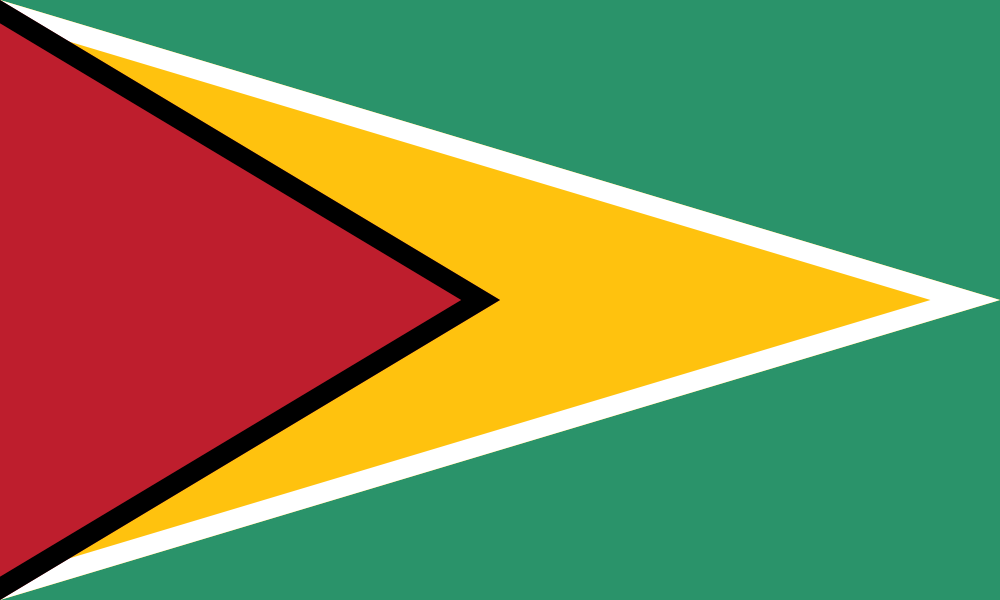
The Golden Arrowhead, adopted at independence on 26 May 1966. Designed by American vexillologist Whitney Smith. A green field with a long yellow triangle stretching from the hoist (the country’s mineral wealth), a red triangle bordered in black at the centre (the zeal and dynamism of nation-building), and a thin white edge to the yellow (the country’s many rivers). One of the most striking national flags in the Americas.
Coat of Arms

Granted at independence in 1966. A shield bearing three blue wavy bars (the rivers Essequibo, Demerara and Berbice), a Victoria Regia water-lily (the national flower) and a Canje pheasant. Supported by two jaguars holding a pickaxe, a sugar cane and a rice stalk (mining, sugar and rice, the three traditional pillars). Above, an Amerindian head-dress; below, the motto.
National Motto
"One People, One Nation, One Destiny." Adopted at independence. The deliberate emphasis on unity reflects the country’s ethnic and cultural diversity and the explicit national project to bind those communities into a single nation.
Seat of Government

National Anthem
"Dear Land of Guyana, of Rivers and Plains," lyrics by Archibald Leonard Luker, music by Robert Cyril Gladstone Potter. Adopted at independence in 1966.
National Dish
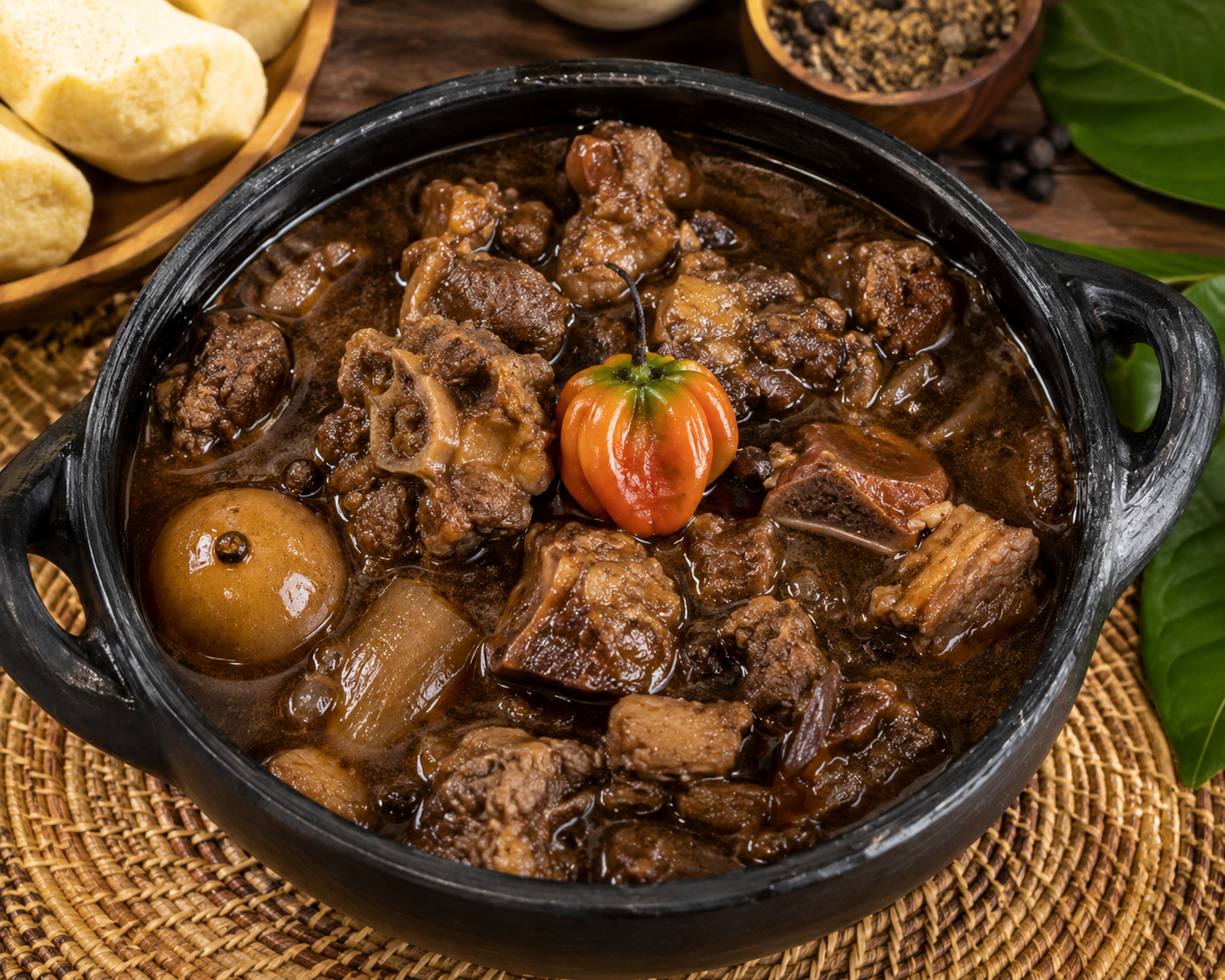
Pepperpot. A slow-stewed meat dish (traditionally beef, but also pork or game), seasoned with cassareep (a thick black sauce made from the boiled-down juice of bitter cassava), cinnamon, clove and Wiri Wiri pepper. Of Amerindian origin, adapted into the Guyanese Christmas tradition. Served with plait bread or homemade rolls. Beyond pepperpot, the everyday national dishes are cook-up rice (a one-pot of rice, peas, coconut milk and salted meat), roti and curry (Indo-Guyanese), and Metemgee (an Afro-Guyanese one-pot with ground provisions and coconut milk).
Did You Know
Guyana is divided into 10 administrative regions, not parishes (the country was reorganised from three counties in 1980). The coastal corridor where almost everyone lives is below sea level, protected by a Dutch-built dyke system and a 459-kilometre sea wall. From west to east along the coast: Region 1, Barima-Waini (NW, capital Mabaruma, against the Venezuelan border); Region 2, Pomeroon-Supenaam (capital Anna Regina, the Essequibo Coast); Region 3, Essequibo Islands-West Demerara (capital Vreed en Hoop, opposite Georgetown); Region 4, Demerara-Mahaica (capital Triumph, contains the national capital Georgetown, and is the most populous region); Region 5, Mahaica-Berbice (capital Fort Wellington); Region 6, East Berbice-Corentyne (capital New Amsterdam, the second-largest city, against the Suriname border on the Corentyne River). The interior regions are: Region 7, Cuyuni-Mazaruni (capital Bartica, gold and diamond country); Region 8, Potaro-Siparuni (capital Mahdia, home of Kaieteur Falls); Region 9, Upper Takutu-Upper Essequibo (capital Lethem, the Rupununi savannah against the Brazilian border); and Region 10, Upper Demerara-Berbice (capital Linden, the bauxite-mining city, Guyana’s second-largest urban centre). Beaches are rare and atypical of the Caribbean image; Shell Beach in Region 1 is the country’s best-known stretch, where four endangered sea-turtle species nest each year.
Country Code: the 592
+592. Guyana is unusual in CARICOM for having its own three-digit country code rather than sharing the +1 North American Numbering Plan (only Belize, Suriname, Haiti and Guyana sit outside the +1 club). Across the Caribbean and the Diaspora, many Guyanese identify themselves simply as "the 592," after the country’s telephone code. You will hear it at Mashramani in February, the Cricket World Cup, the Guyana UK Folk Festival, on Diaspora WhatsApp groups, and at any Guyanese gathering in Tooting, Tottenham, Queens or Toronto. Saying "I’m from the 592" is saying "I’m from home."
Leadership: Who Runs the Country
Guyana is a Cooperative Republic with an executive presidency: the President is both Head of State and Head of Government. King Charles III is not the Head of State. Guyana broke with the Crown on 23 February 1970 (Republic Day, also Mashramani) and the President has been Head of State ever since. The Prime Minister role exists but, unlike Westminster systems, is subordinate to the President and the holder also serves as a First Vice President. The National Assembly has 65 seats; the party (or coalition) winning the most seats forms the government, and its presidential candidate is sworn in as President.

Citizenship and Passport Eligibility 4-Region
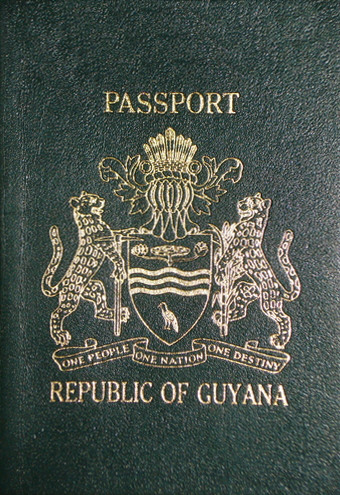
This is a strong picture for the Guyanese Diaspora. Guyana recognises dual citizenship under the Constitution, descent rules are among the deepest in the region, and the Guyanese passport is a full CSME-participant passport.
The routes, honestly
- By descent through a parent, the standard Diaspora route. A person born outside Guyana on or after 26 May 1966 (independence) is entitled to Guyanese citizenship by descent if at least one parent was a Guyanese citizen at the time of the birth. Documented through the Guyana High Commission, the New York Consulate-General or directly with the Citizenship and Immigration Services in Georgetown.
- By descent through a grandparent, available in practice for the second-generation Diaspora. The Constitution provides a route through a Guyanese grandparent, subject to documentation of the unbroken line. Confirm the current route directly with the High Commission as documentation requirements have tightened in recent years.
- By marriage, available to the foreign spouse of a Guyanese citizen, with a residence qualifying period.
- By registration / naturalisation, typically after a qualifying period of legal residence.
- By investment. Guyana does not currently run a Citizenship by Investment programme. It is one of only a few CARICOM countries without a CBI scheme (alongside the Bahamas, Trinidad and Tobago, and Suriname). A CBI route has been discussed in the National Assembly but is not in operation as of 2026; treat any third-party claim that Guyana has an active CBI with caution.
Guyana was a founding member of CARICOM in 1973 and is a full participant in the CARICOM Single Market and Economy (CSME). As a Guyanese national your passport carries the five freedoms of the CSME: free movement of goods, services, capital, the right of establishment, and the free movement of skilled persons.
To live and work in another CSME country, you apply for a CARICOM Skills Certificate, which covers 13 wage-earner categories including university graduates, teachers, nurses, artisans with vocational qualifications, household domestics with CVQ, sportspersons, musicians and others. Processing is typically five to eight weeks, the certificate is recognised across CSME participants, and the right to bring your spouse and dependants travels with it.
Honest note: Guyana is not in the October 2025 four-country Enhanced Full Free Movement pilot (Barbados, Belize, Dominica and SVG). For those four countries, no Skills Certificate is required. Outside that pilot, Guyana’s standard CSME rights apply across the other CSME participants. (The Bahamas does not participate in the CSME; Montserrat and Haiti are outside the free-movement framework.) The CARICOM Secretariat is headquartered in Georgetown, so Guyana sits at the institutional heart of the integration project.
Where to apply, by region
| From | Where to enquire |
|---|---|
| United Kingdom | Guyana High Commission, 3 Palace Court, Bayswater Road, London W2 4LP. Web: londonhc.mission.gov.gy. The London HC also covers Ireland and much of continental Europe. |
| USA | Embassy of Guyana, Washington D.C. Consulate-General of Guyana in New York (the country’s largest overseas mission, serving the very large New York Guyanese community). Honorary Consuls in additional US cities. |
| Canada | High Commission of Guyana, Ottawa. Consulate-General of Guyana in Toronto (serving the very large Toronto Guyanese community). |
| Europe | Embassy of Guyana in Brussels (mission to the European Union). Honorary Consuls in several European capitals. The London High Commission handles much of the European consular work. |
| In Guyana | Citizenship and Immigration Services, Ministry of Home Affairs, Georgetown; for descent and birth-registration matters, the General Register Office. |
For descent applications, the long-form birth certificate of your Guyanese parent (or grandparent for grandparent-route applications) is essential, properly Apostilled if issued abroad. Names and dates must match across generations: a difference in spelling can hold up the application and may require a sworn Affidavit. Reissue any short-form or photocopied certificates before you file.
Cost of Living 4-Region
An honest monthly comparison: your home city versus life in Guyana, in your own currency. Guyana sits at the cheaper end of the CARICOM range for everyday food, transport and rent in the parishes, but the oil-boom-driven housing market in Georgetown has pushed mid-range rents sharply upward since 2022; expat-standard accommodation in Georgetown now rivals Barbados pricing. Outside Georgetown (New Amsterdam, Linden, Bartica, the Berbice coast) prices remain modest.
| Monthly expense | London £ | New York $ | Toronto C$ | Guyana (USD equivalent) |
|---|---|---|---|---|
| Rent, 1-bed local-standard, Georgetown | £2,000 | $3,800 | C$2,400 | ~$500 to $900 USD |
| Rent, 1-bed expat-standard, Georgetown (Bel Air, Queenstown, Cummings Lodge) | £2,300 | $4,200 | C$2,800 | ~$1,500 to $3,500 USD |
| Rent, 1-bed local-standard, New Amsterdam / Linden | £2,000 | $3,800 | C$2,400 | ~$200 to $400 USD |
| Single person, modest lifestyle (all in) | £3,000 | $4,800 | C$3,800 | ~$1,400 to $2,200 USD |
| Couple, comfortable lifestyle, Georgetown (all in) | £3,800 | $6,500 | C$5,200 | ~$3,000 to $5,500 USD |
| VAT on most goods and services | 20% | Varies | 13% | 14% |
Since first oil in December 2019, Guyana has been the fastest-growing economy in the world, with real GDP growth running at 20 to 60 percent a year. This has driven sharp inflation in housing, services and skilled-labour rates in Georgetown and parts of Region 4, while pump prices, food and everyday-goods inflation have been more contained thanks to subsidy support. For returnees the practical implication is a two-speed cost picture: Georgetown is rapidly approaching Bridgetown or Port of Spain pricing for housing, while the coastal towns and interior remain affordable. Budget against today, not against 2018.
Housing and Property
As a Guyanese citizen you can buy and own land and property freely. Non-Guyanese can also buy, with no special permits required for residential property, though a foreign-investor process applies for large commercial purchases through the Guyana Office for Investment (GO-Invest). Title is held under Transport (a Roman-Dutch system inherited from the country’s Dutch colonial period) or, increasingly, under Certificate of Title. Title insurance and a properly conducted title search are essential.
Where returnees tend to settle
- Georgetown (Region 4 Demerara-Mahaica), the capital and the country’s commercial heart. Established residential areas include Bel Air, Bel Air Park, Queenstown, Kitty, Subryanville, Lamaha Gardens, Prashad Nagar and Eccles (the new expat / oil-sector belt north of the capital). The city sits below sea level and is protected by the historic Dutch-built dyke system and the modern sea wall; build flood-resilience into your housing choice.
- East Bank Demerara corridor, the spine of suburban Georgetown running north toward the airport. Eccles, Diamond, Grove and Providence have seen the heaviest new-build growth since 2020 and are the natural home for oil-sector workers and returnees.
- East Coast Demerara (Region 4), the strip east of Georgetown running along the coast through Plaisance, Buxton, Annandale, Enmore, La Bonne Intention and on to Mahaica. Established Indo- and Afro-Guyanese village communities, more affordable than central Georgetown.
- New Amsterdam (Region 6 East Berbice-Corentyne), the second-largest city, on the Berbice River. Strong Diaspora ties, a quieter pace, and the gateway to the Corentyne coast and the Suriname border.
- Linden (Region 10 Upper Demerara-Berbice), the historic bauxite-mining town, the second-largest urban centre, inland on the Demerara River.
- Berbice Coast villages (Region 6), the rural east-coast string of Indo-Guyanese rice-farming villages from Rosignol through to Skeldon, including Whim, Albion, Port Mourant, Rose Hall and Corriverton.
- Anna Regina and the Essequibo Coast (Region 2), the rice-and-coconut country, a quieter and significantly more affordable option, reached by ferry from Parika.
- Bartica (Region 7) and Lethem (Region 9), the main interior towns for returnees with mining, ranching or eco-tourism business connections. Practical realities of remote-area living apply: longer supply chains, fewer healthcare options and limited fibre internet.
- Amerindian Village Lands: significant areas of the interior are held communally by Amerindian villages under the Amerindian Act 2006 and cannot be bought by outsiders. Respect that boundary.
Guyana sits outside the Atlantic hurricane corridor (latitude ~6 degrees North, well south of the hurricane belt). Hurricanes are essentially not a concern. The genuine environmental risks are tidal flooding (Georgetown is below mean high tide and depends on a 459 km sea-wall and dyke network; the city has flooded badly in recent decades, most notoriously in January 2005), river flooding after heavy rain in the interior, and a long-term sea-level-rise pressure on the coastal sea defences. When buying or renting on the coast, ask honestly about the flood history of the specific street; older Georgetown wards are at higher risk than the East Bank Demerara new-build belt.
Healthcare
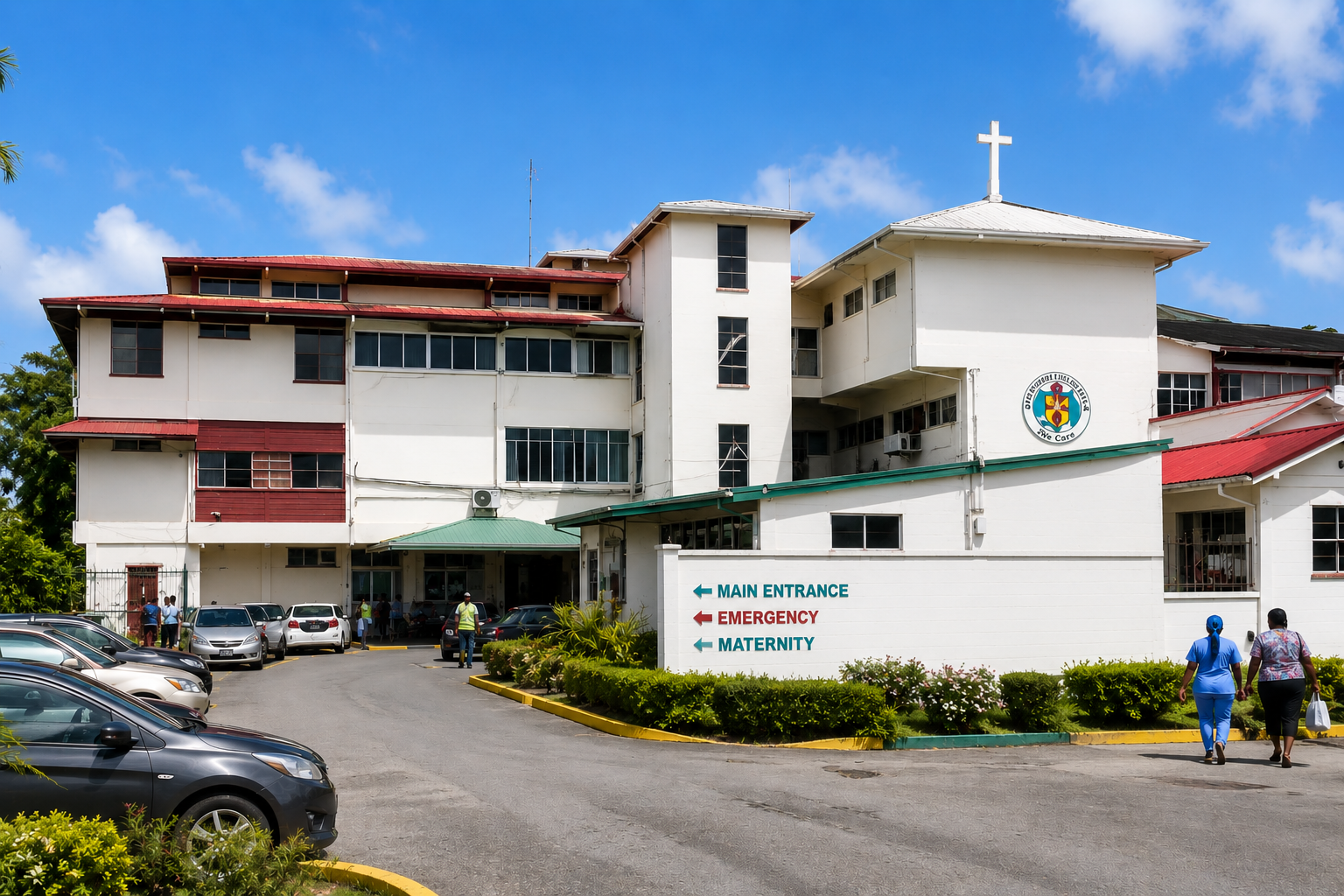
Healthcare in Guyana is run by the Ministry of Health, with public hospitals, regional health centres and a growing private sector. The public system is largely free at the point of use for citizens; most returnees layer a private policy on top because the public system is genuinely stretched and complex specialist care still often means a flight to Trinidad, Barbados, the US (Miami) or the UK.
Main hospitals and facilities
- Georgetown Public Hospital Corporation (GPHC): the national referral hospital, the country’s largest, in central Georgetown. Emergency, surgical, paediatric, maternity, diagnostic, oncology and growing specialist services. Has had significant infrastructure investment since the oil-era began.
- New Amsterdam Public Hospital (Region 6): the regional referral hospital for Berbice.
- Linden Hospital Complex (Region 10): the regional referral hospital for the bauxite country and the Upper Demerara.
- West Demerara Regional Hospital (Region 3): the regional referral hospital for the Essequibo Coast side of the capital.
- Suddie Public Hospital (Region 2) and Bartica Regional Hospital (Region 7): smaller regional facilities.
- Private hospitals in Georgetown: Woodlands Hospital, St Joseph Mercy Hospital, Balwant Singh Hospital, Davis Memorial and the newer Caribbean Heart Institute are the leading private options. Shorter waits and a wider specialist range; the natural first stop for returnees with private cover.
- The new oil-era public hospital build-out: the government has announced and begun construction on six new regional hospitals across the country (financed in part by oil revenues), planned to come online in stages from 2025 to 2027.
For older returnees
If you are returning at retirement age, plan three things before you travel. Arrange private health cover with strong medical-evacuation cover before arrival, since cover taken out later costs more and access to specialist care often means travel to Trinidad, Barbados, the US or the UK. Bring a full written record of your medical history and current prescriptions so a local doctor can continue your care without gaps. And check that any long-term medication you depend on is reliably available locally; build redundancy through a UK pharmacy if needed.
For complex specialist care (advanced cardiac surgery, complex oncology, neurosurgery, advanced neonatal), Guyanese have historically travelled to Trinidad (Port of Spain), Barbados (QEH), the US (Miami, Houston) or the UK. The Caribbean Heart Institute in Georgetown has reduced some of that, particularly for cardiac work. Build medical evacuation into your insurance from day one.
Education and Schools
Education in Guyana is free and compulsory between ages 5 and 16. The system is British-modelled in structure, with nursery (3 to 5), primary (5 to 11), secondary (11 to 16) and sixth form (16 to 18). At the end of secondary, students sit Caribbean Examinations Council (CXC) qualifications: the Caribbean Secondary Education Certificate (CSEC), broadly comparable to GCSE; sixth-form students sit the Caribbean Advanced Proficiency Examination (CAPE), comparable to A-levels. National Grade Six Assessment (NGSA) at age 11 streams pupils into secondary schools and is a significant national event each year.
Well-regarded schools
- Queen’s College, Georgetown, the country’s historic top secondary, founded 1844. Co-educational.
- The Bishops’ High School, Georgetown, the long-established Anglican secondary, originally a girls’ school, now co-educational.
- St Stanislaus College, Georgetown, the prestigious Catholic / Jesuit boys’ school (the alma mater of President Ali).
- St Joseph High School (Georgetown), the Catholic girls’ school.
- St Rose’s High School and President’s College (Golden Grove): leading Georgetown-area secondaries.
- Berbice High School (New Amsterdam) and Berbice Educational Institute: the leading secondaries in Region 6.
- The University of Guyana (UG), the national university (Turkeyen and Berbice campuses, founded 1963), plus the Cyril Potter College of Education for teachers. UWI has presence through partnerships, and several US-affiliated medical schools (American International School of Medicine, Texila American University) operate in the country.
Public schooling is free but families typically pay for uniforms, books, lessons and a small registration fee. The Catholic secondaries (St Stanislaus, St Joseph) and the historic Anglican secondaries (Bishops’, Queen’s) have competitive admission via NGSA results. Many Diaspora returnee families with sixth-form-aged children plan UWI (Cave Hill in Barbados, Mona in Jamaica, St Augustine in Trinidad), UG, or UK / US / Canadian universities; the strong Diaspora networks in those countries are a real advantage.
Banking, Tax and Money
A few registrations matter for every returning resident settling in Guyana.
The tax picture, honestly
Guyana’s tax system is moderate. Personal income tax is charged at 28 percent on chargeable income up to GYD 2,400,000 per annum (around US $11,500) and at 40 percent on income above that, on local-source income; a basic personal allowance applies. Value Added Tax (VAT) is charged at 14 percent on most goods and services (with zero-rated and exempt categories). Capital gains tax is 20 percent on net gains, except gains arising more than 25 years after the asset was acquired, or gains under GYD 500,000, which are exempt. Property tax: effective 1 January 2025, individuals are exempt from Property Tax, a major change. Corporate tax is 25 percent (commercial companies) or 40 percent (telecoms, banks). The Guyanese Dollar is floating, not pegged, against the USD.
Inheritance tax: an honest comparison with the UK
This is a real and rarely-discussed advantage for returning Diaspora, with one specific nuance to watch for.
- The UK position: UK Inheritance Tax is currently 40 percent on the value of an estate above the nil-rate band of £325,000 (with an additional £175,000 residence nil-rate band where a main home passes to direct descendants, and full spouse exemption). Most middle-class UK estates with a home and pension are affected.
- The Guyana position: per PwC, Guyana does not impose inheritance, estate or gift taxes on the transfer of assets upon death. Beneficiaries do not pay tax on inherited assets.
- The nuance worth knowing: an Estate Duty / Process Fee does exist. The Guyana Revenue Authority charges Estate Duty at 0.5 percent of the value of the estate exceeding GYD 100,000 (around US $480), payable on the deceased’s Guyana-situs assets before distribution. This is not an inheritance tax in the UK sense (paid by the beneficiary on what they receive); it is a small estate-level duty on the value of the estate, and at 0.5 percent it is dramatically lower than the UK 40 percent. But it is a real cost to plan for.
- The cross-border reality. UK domicile is sticky. A UK-domiciled person can still face UK Inheritance Tax on their worldwide estate even after relocating to Guyana. Domicile is a different test from residence and is hard to shed. There is no UK-Guyana double-tax treaty covering inheritance specifically. Treat this as one of the most important conversations to have with a qualified UK tax adviser before you go.
Wills and estate planning
This is genuinely important, often missed, and frequently sad in its consequences.
- Why it matters. Many UK Diaspora have a UK Will that does not properly cover Guyanese property, or no Will at all. On death this can throw the estate into intestacy across two jurisdictions, which is slow, costly and distressing for family at the worst possible moment.
- Widely-recommended practice (not legal advice). Cross-border practitioners commonly recommend two Wills, drafted to work together: a UK Will covering your UK estate, and a separate Guyana Will covering your Guyanese property, each containing language making clear it does not revoke the other. Use a local lawyer in Guyana for the local Will.
- The local rules. Inheritance is governed by the Wills Act, the Deceased Persons Estates Administration Act, and the Family and Dependants Provision Act (which allows close relatives and dependants to apply for reasonable provision from an estate, similar in shape to the UK 1975 Act). The Probate Registry of the High Court of the Supreme Court of Judicature in Georgetown handles grants. Uncontested probate is usually granted in six to twelve weeks.
- UK Wills and resealing. A particular advantage in Guyana: a grant of probate obtained from a UK court can be resealed by the Guyanese High Court. In practice this means a UK grant covering Guyanese assets can often be used directly, rather than needing a fresh Guyana probate from scratch. Confirm with a local lawyer for your situation.
- Intestacy formula, if no Will. If you die without a valid Will: a surviving spouse with children receives one-third of the estate, the children share the remaining two-thirds equally; a surviving spouse without children inherits the entire estate. The Family and Dependants Provision Act gives dependants an additional route to claim reasonable provision.
- Practical pointers. Name an executor in each jurisdiction. If the executor is not resident in Guyana, a local agent must be appointed via Power of Attorney to obtain the grant of probate. Review every five years or on a major life event. Tell your executor where the Wills are stored.
This is general information for orientation. Always speak to a qualified local lawyer before drafting or relying on a Will.
Guyana offers a Returning Resident concession allowing a citizen who has lived abroad for a qualifying continuous period to import household goods and, subject to conditions, a vehicle, with relief from some import duty. The exact current qualifying years, eligible items and any cap on vehicle value are set by the Guyana Revenue Authority Customs and Trade Administration and have changed over the years. Confirm the current rule directly before you ship anything.
Work and Business
As a Guyanese citizen you can live and work in the country freely, with no work permit required. Under the CSME framework, nationals of other CSME states can apply for a Skills Certificate (see Citizenship). Under the October 2025 free-movement pilot, nationals of Barbados, Belize, Dominica and St Vincent and the Grenadines have enhanced rights across those four pilot countries; Guyana is not yet a pilot member.
The main sectors
The Guyanese economy has been transformed since first oil in December 2019. The major sectors today are: oil and gas, dominated by the ExxonMobil-Hess-CNOOC consortium operating the Stabroek Block offshore (production around 650,000 barrels per day in 2026 and rising, with multiple new floating production vessels ramping up); gold and mining (small-scale operators, Aurora, Omai), one of the country’s long-standing pillars; agriculture and agro-processing (rice, the country’s historic staple export, plus sugar, fruit and fishing); bauxite (Linden, Berbice); timber and forestry (the interior); construction, in a building boom servicing the oil sector; BPO and ICT, a growing English-speaking shared-services sector; and tourism, distinctively eco-tourism focused (Kaieteur Falls, the Rupununi savannah, Iwokrama rainforest, Shell Beach turtle nesting).
Starting a business
New businesses register through the Deeds and Commercial Registries Authority in Georgetown and obtain a trade licence from the relevant municipal authority. Guyana Office for Investment (GO-Invest) is the national investment-promotion agency and the main contact point for inward investment, incentive schemes and oil-sector engagement.
The oil-era opportunity is real but uneven. Oil-sector contracting, construction services, hospitality serving the oil community, professional services and BPO are the strongest growth areas. The traditional rice, sugar and bauxite communities have seen less direct benefit. Diaspora returnee businesses often do best when they connect Guyanese supply chains to the UK / US / Canadian Diaspora market, serve the oil-era services economy, or develop the eco-tourism niche around the country’s extraordinary interior.
Driving and Transport 4-Region
Guyana drives on the right, the same as the US, Brazil, Suriname, Venezuela and most of mainland South America. This is one of only three CARICOM jurisdictions to drive on the right (alongside Belize and Suriname) and is the single biggest practical adjustment for UK returnees, who have to retrain after a lifetime of left-hand driving. Steering wheels are on the left as in the US. Main coastal roads (the East Coast Highway from Georgetown out to Berbice, the East Bank Demerara to the airport, the West Coast / Essequibo Coast roads) are paved and reasonable but heavily trafficked; secondary roads in the interior degrade quickly in the rainy season. Cheddi Jagan International Airport (CJIA) at Timehri, around 41 km south of Georgetown, is the main international gateway with direct flights from New York (JFK), Toronto, Miami, Trinidad, Barbados, Panama and several Caribbean hubs; there are no direct flights between Georgetown and the UK as of 2026, the standard UK route is via JFK, Trinidad or Barbados. Eugene F Correia International Airport at Ogle, just east of Georgetown, handles regional flights and interior charters.
| Licence held | How it works | Where | Cost |
|---|---|---|---|
| UK licence | Visitors may drive on a valid UK licence (often with an International Driving Permit) for up to three months. For residence, conversion to a Guyanese licence is needed. | Licence Revenue Office; Police Force | ~$30 to $60 USD conversion |
| US licence | Visitors may drive on a valid US licence for up to three months. | As above | ~$30 to $60 USD |
| Canadian licence | Visitors may drive on a valid Canadian licence for up to three months. | As above | ~$30 to $60 USD |
| EU licence | Visitors may drive on a valid EU licence (an International Driving Permit is often required alongside) for up to three months. | As above | ~$30 to $60 USD |
For residence beyond visitor periods, you will convert to a full Guyanese driver’s licence at the Licence Revenue Office. Public transport is mainly by privately-operated minibuses on numbered routes from Stabroek Market in Georgetown (cheap, frequent, and an experience in themselves); taxis are not metered but most journeys have agreed standard fares; agree the fare before you set off. Inter-regional transport runs by minibus (East Coast / East Bank / Berbice), and by ferry across the Demerara and Essequibo rivers. Interior travel (Lethem, Mahdia, Bartica) is by 4WD on rough roads or by small-plane charter.
Bringing your pet
Cats and dogs can be brought to Guyana with proper paperwork. Current requirements typically include an import permit from the Guyana Livestock Development Authority (GLDA), microchip identification, current rabies vaccination, and a veterinary health certificate issued shortly before travel. The exact current requirements, fees and any restrictions were not verified at build, so confirm directly with GLDA well before you plan to travel.
Internet and Connectivity
Connectivity in Guyana has improved sharply in recent years. The market is dominated by two operators: GTT (Guyana Telephone and Telegraph), the long-established incumbent, and Digicel Guyana, the challenger. The Public Utilities Commission (PUC) regulates the sector.
Both operators offer fibre-to-the-home plans in Georgetown, the East Bank Demerara corridor, New Amsterdam, Linden and the larger coastal settlements, with consumer speeds typically up to 200 to 500 Mbps. Mobile is 4G LTE across most of the populated coast; 5G has been rolling out on a limited footprint since 2024, mostly in Georgetown. A standalone broadband plan typically runs around GYD 12,000 to 25,000 per month (around US $60 to $120).
Interior regions (Region 7 Bartica, Region 8 Mahdia, Region 9 Lethem, Region 1 Mabaruma) and Amerindian village communities still have very limited fibre coverage, and Starlink has become a transformative resilience and remote-work option in the interior since 2024, with many Amerindian communities now connected for the first time.
Safety: The Honest Picture
This section needs honest reading.
Day-to-day safety in Guyana is broadly comparable to other CARICOM countries with significant urban populations. The US State Department currently rates Guyana at Level 2 ("exercise increased caution"), citing violent crime in parts of Georgetown and the Diamond / Sophia areas, particularly after dark. The UK FCDO advises ordinary precautions across most of the country, with specific advice about Georgetown wards (avoid Tiger Bay, Albouystown and parts of the inner Stabroek area after dark) and against unnecessary travel close to the Venezuela land border. Petty crime, opportunistic robbery and home invasions are the main risks; gun crime is significantly lower than in Trinidad, Jamaica or parts of the Eastern Caribbean. Outside Georgetown, the coastal towns (New Amsterdam, Anna Regina, Linden) and the interior are generally calm.
The Venezuela-Essequibo dispute, factually
This is a real, live and ongoing matter, and a guide that did not mention it would be dishonest. Venezuela claims most of the territory west of the Essequibo River, an area of around 159,500 square kilometres covering Regions 1, 2, 7, 8, 9 and parts of Region 3 (roughly two-thirds of Guyana’s territory). The dispute dates back to the 19th century and the 1899 Arbitral Award which set the current border in Guyana’s favour. Venezuela has rejected the validity of that award since the early 1960s.
The matter is currently before the International Court of Justice (ICJ) in The Hague at Guyana’s instance; the ICJ has confirmed it has jurisdiction and substantive proceedings continue, with a final judgment expected this decade. In December 2023 Venezuela held a controversial domestic referendum asserting the claim, and in early 2024 declared a "Guayana Esequiba" state on paper, which the international community (including the US, the UK and CARICOM) does not recognise. Tensions rose meaningfully in 2023 and 2024 around the offshore Stabroek Block oil-licence area; an Argyle Declaration signed by both presidents in December 2023 committed both sides to non-violence, but the underlying claim remains live.
For Diaspora returnees: most of Guyana’s population (over 90 percent) lives on the eastern coastal strip in Regions 4, 5 and 6, well east of the disputed zone. The FCDO and the US State Department both advise against travel close to the Venezuelan land border (especially Region 1 and parts of Region 7); the populated coast is unaffected. Honest information is the best protection for you and your family.
Environment and natural hazards
Guyana sits outside the Atlantic hurricane corridor; hurricanes are essentially not a risk (a real advantage over the rest of CARICOM). The genuine environmental concerns are coastal flooding (Georgetown is below mean high tide, defended by the historic Dutch dyke system and modern sea wall; the 2005 Great Flood is the defining recent event), seasonal river flooding in the interior after heavy rain, and the long-term climate-change pressure on the coastal sea defences. Earthquakes are essentially absent.
Diaspora Missions, UK Association and Community 4-Region
The country’s diplomatic missions serving the Diaspora, plus the community channels you can plug into. Guyana has one of the largest CARICOM Diasporas in absolute terms (estimates range from ~300,000 to ~500,000 first- and second-generation Guyanese living abroad, against a domestic population of ~820,000, making the Diaspora roughly the same size as the country itself).
UK Diaspora Association
- Guyana UK Social Development Association (GUSDA), gusda.uk. The main UK Diaspora umbrella, founded in February 1995 (originally as the Guyana UK Sports Development Association) and broadened in 2017 to its current Social Development remit. Registered as a Charitable Incorporated Organisation (CIO) in March 2024. Flagship events: the Annual Guyana Family Sports and Fun Day at Croydon Arena (which draws thousands each summer), and the Annual Guyana UK Folk Festival. GUSDA also fundraises for charitable causes in Guyana and supports Guyanese in the UK.
- The Guyana High Commission Diaspora Engagement programme, run from Palace Court, London. Acts as a structured liaison between the Government of Guyana and the UK Diaspora, runs the periodic Guyana UK Awards, and maintains a database of UK Diaspora groups. A useful first port of call for community connections.
- Guyana Diaspora Sustainability & Investment Conference (GDSIC), a UK / London-anchored annual conference connecting the Guyanese Diaspora to investment, philanthropy and trade opportunities in Guyana. Particularly relevant in the oil era.
- Cross-Caribbean umbrellas: the British Caribbean Association (BCA), Friends of the Caribbean, the Caribbean & African Health Network (CAHN), the British Caribbean Chamber of Commerce, and the UWI Alumni Association UK Chapter all serve UK Guyanese alongside other CARICOM nationals.
Facebook Groups and Pages
Where the UK Diaspora can plug into Guyanese community life online. A curated list, not exhaustive:
- Guyana High Commission UK, official Facebook page for consular announcements, Diaspora events and updates from the Government of Guyana.
- Department of Public Information Guyana (DPI) and Office of the President Guyana, the central Government information pages.
- Stabroek News, Guyana Chronicle and Kaieteur News, the most-read national daily newspaper pages.
- News Source Guyana and NCN News Guyana, broadcaster news pages.
- GUSDA, the umbrella UK group’s page (events, AGM, Family Sports Day, Folk Festival).
- Guyana Diaspora UK and Guyanese in the UK, community groups for events, news, and informal mutual support.
- The Caribbean Diaspora (~1.7k members) and British Caribbean Development (~5.6k members), broad cross-CARICOM Facebook groups where Guyanese Diaspora are well-represented.
- Region- and town-specific groups: look for groups for Berbice, New Amsterdam, Corriverton, Linden, Bartica, Lethem, and Essequibo Coast villages, plus alumni groups for Queen’s College, Bishops’ High, St Stanislaus and the leading secondaries.
Not sure where to start?
Map your move with the Relocation Intelligence Calculator: your citizenship eligibility, budget and timeline, costed clearly.
Your First Steps
- Gather and Apostille your documents. The long-form birth certificate of your Guyanese parent (or grandparent for grandparent-route applications) first.
- Apply for citizenship and your passport via the London High Commission, the New York Consulate-General, the Toronto Consulate-General or directly with Citizenship and Immigration Services in Georgetown.
- Treat any third-party claim of a Guyana CBI route with caution: there is no active Guyana CBI programme as of 2026.
- Decide which region suits your family. For Georgetown-area working life: Region 4 (the city itself, East Bank Demerara corridor for new-build, East Coast Demerara for established Diaspora villages). For Berbice family roots: Region 6 (New Amsterdam, the Corentyne coast). For interior or eco-tourism life: Regions 7 (Bartica), 9 (Lethem) or 10 (Linden), with eyes open about supply chains and healthcare distance.
- Register with the National Insurance Scheme and the Guyana Revenue Authority for a TIN on arrival.
- Arrange private health cover with strong medical-evacuation cover (Trinidad, Barbados, Miami, UK), and bring full medical records and prescriptions.
- Speak to a qualified local lawyer about a Guyana Will to sit alongside any UK Will. Confirm whether your UK grant of probate can be resealed by the Guyanese High Court for your Guyana-situs assets, or whether a local Will is the cleaner path.
- If you are buying property, do a full title search and consider title insurance; Guyana operates a hybrid Roman-Dutch Transport and Certificate of Title regime that benefits from professional handling.
- Confirm Returning Resident customs concessions directly with the Guyana Revenue Authority Customs and Trade Administration before you ship anything.
- Run your numbers through the Relocation Calculator and plan your shipping with the 2026 Shipping Bible.