🇲🇸 Moving to Montserrat from the UK
Montserrat is the "Emerald Isle of the Caribbean", a British Overseas Territory and not an independent country. The Diaspora is considerably larger than the home population, and Montserrat is the only place outside Ireland that observes St Patrick's Day as a national public holiday.
Of every country in this guide, Montserrat is the most structurally different and the most British-tied. King Charles III is Head of State and is represented locally by a UK-appointed Governor, not a Governor-General; the elected Premier leads the Government but works alongside the Governor in a way no independent CARICOM country does. The country was profoundly reshaped by the Soufrière Hills volcanic eruptions of 1995 onwards: the colonial capital Plymouth was buried under pyroclastic flows, the southern two-thirds of the island became a permanent Exclusion Zone, and nearly two-thirds of the population emigrated, mostly under a 1998 UK government scheme that gave Montserratians full British citizenship from 2002. For the UK Diaspora in London, Birmingham, Preston and Ipswich (and the smaller US and Canadian communities), this guide gives you what you need to think honestly about return: citizenship (which for most of you is already British), land, healthcare, the volcano realities that frame everything north of the Belham Valley, and the One Montserrat rebuild programme led by Premier Reuben Meade since October 2024. The country is small, safe, English-speaking, EC-Dollar-pegged, and uniquely positioned for Diaspora returnees with British citizenship in their pocket.
Identity and Culture
Before the practicalities, this is the place. Its symbols, its sound, its flavour. Montserrat is the "Emerald Isle of the Caribbean," named for its rolling green hills and for the historic Irish indentured-servant heritage that gave the island a unique cultural inheritance among CARICOM nations. Montserrat is the only place in the world outside Ireland that observes St Patrick’s Day as a national public holiday (17 March, also commemorating a 1768 slave uprising on the same date). English is the official language, with Montserratian Creole spoken locally. The population is overwhelmingly Afro-Montserratian with Irish, English and Scottish admixture, plus smaller numbers of British civil servants, expat retirees, and a growing Indian and Asian community in trade and professional services.
National Flag
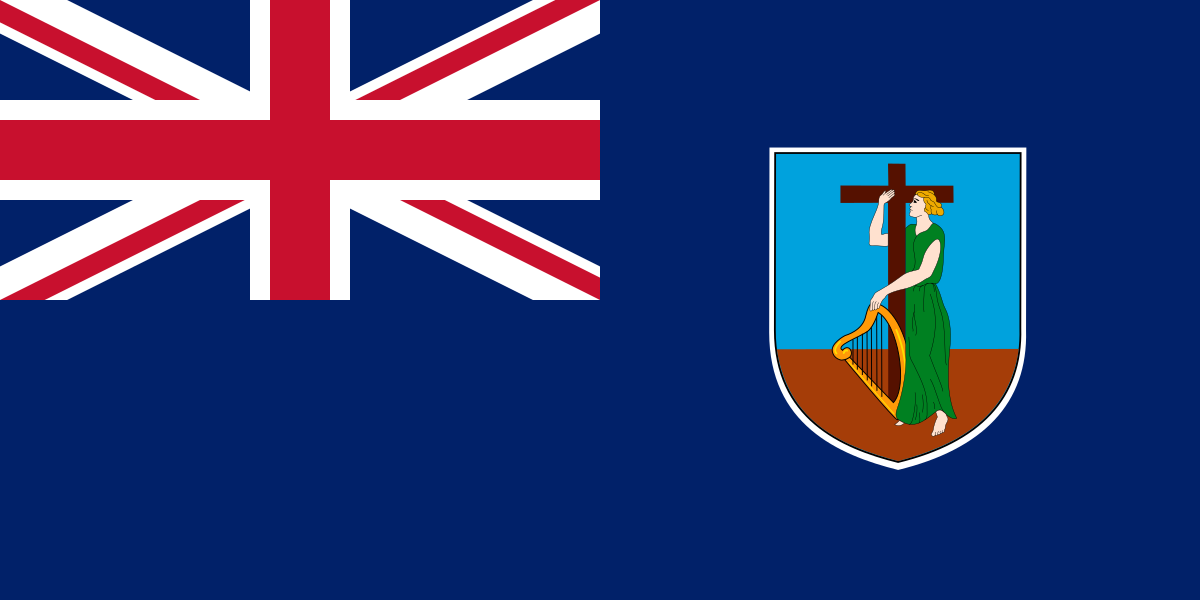
The defaced Blue Ensign, in the British Overseas Territory tradition. A blue field with the Union Flag in the canton (top-left quarter) and the Montserrat coat of arms in the fly. Adopted in 1909. As a BOT, Montserrat does not have an independence flag; the Blue Ensign is the official flag of the territory.
Coat of Arms

A green shield bearing a depiction of Erin (the female personification of Ireland) embracing a Christian cross with a golden harp at her side: a unique Caribbean depiction of the island’s Irish heritage. The Erin figure was drawn directly from the iconography of 17th-century Ireland and is found on no other national symbol in the Americas.
National Motto
"Each Endeavouring, All Achieving." A motto centred on collective effort and shared progress, particularly resonant in the post-eruption rebuilding period.
Seat of Government
National Anthem
As a British Overseas Territory, Montserrat’s official national anthem is "God Save the King". The country also has a separately-recognised Territorial Song, "Motherland," widely sung at official ceremonies and at the 2025 30th Anniversary Thanksgiving Service in London.
National Dish
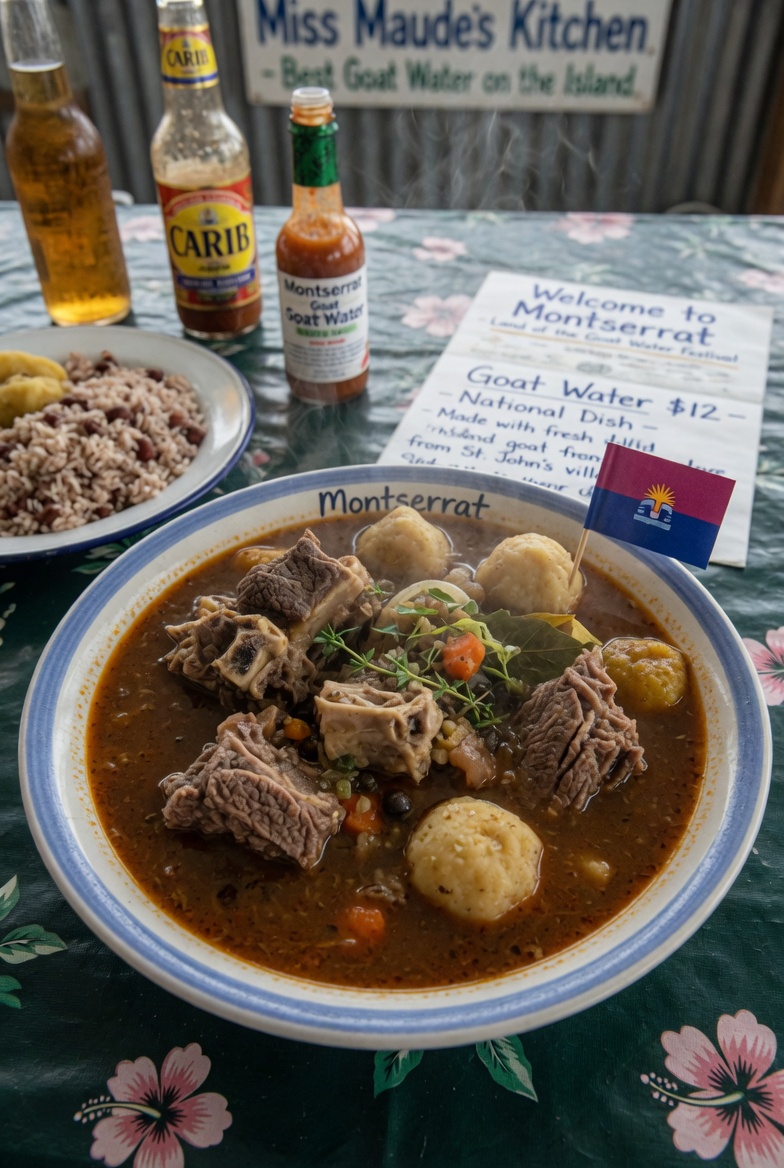
Goat Water. A slow-stewed mutton or goat broth flavoured with cloves, mace, scotch bonnet, thyme and rum, served with bread or dumplings. The unofficial national dish, served at every wedding, christening, funeral and St Patrick’s Day celebration in Montserrat and across the UK Diaspora. Other staples: mountain chicken (a large frog historically endemic to Montserrat and Dominica, now endangered and largely protected), fungi (cornmeal porridge), saltfish and bakes, oildown, and ginger beer.
Did You Know
Montserrat is divided into three parishes, of which only one is now fully habitable: St Peter (north and centre, the safe zone that contains Brades, Salem, St John’s, Cudjoehead, Lookout and Davy Hill, and the planned new permanent capital at Little Bay); St Anthony (the central former-capital parish, partially in the Exclusion Zone, including the buried capital Plymouth and the Belham Valley); and St Georges (the southern parish, entirely within the Exclusion Zone). The current de facto capital is Brades (St Peter parish); Little Bay on the north-west coast is being developed as the new permanent capital, with new port and town infrastructure under construction in stages from 2024 to 2027. Beaches are limited and most are dark volcanic sand; the island’s most-loved beach is Rendezvous Bay, the only white-sand beach in the country, reached by boat from Little Bay. Woodlands Beach, Bunkum Bay, Lime Kiln Beach and Old Road Bay are the other accessible north-coast options.
Country Code: the 664
+1 664. Across the Caribbean and the global Montserratian Diaspora, Montserratians identify themselves simply as "the 664," after the country’s telephone area code. The number is sufficiently iconic that one of the leading UK Diaspora cultural groups is called Village664. You will hear it at Montserrat St Patrick’s Day Festival each March, at the Montserrat Calabash Festival each July, at the Christmas Festival, on the Diaspora WhatsApp groups, and at any Montserratian gathering in Stockwell, Hackney, Birmingham, Preston, Ipswich, Brooklyn or Toronto. Saying "I’m from the 664" is saying "I’m from home."
Leadership: Who Runs the Country
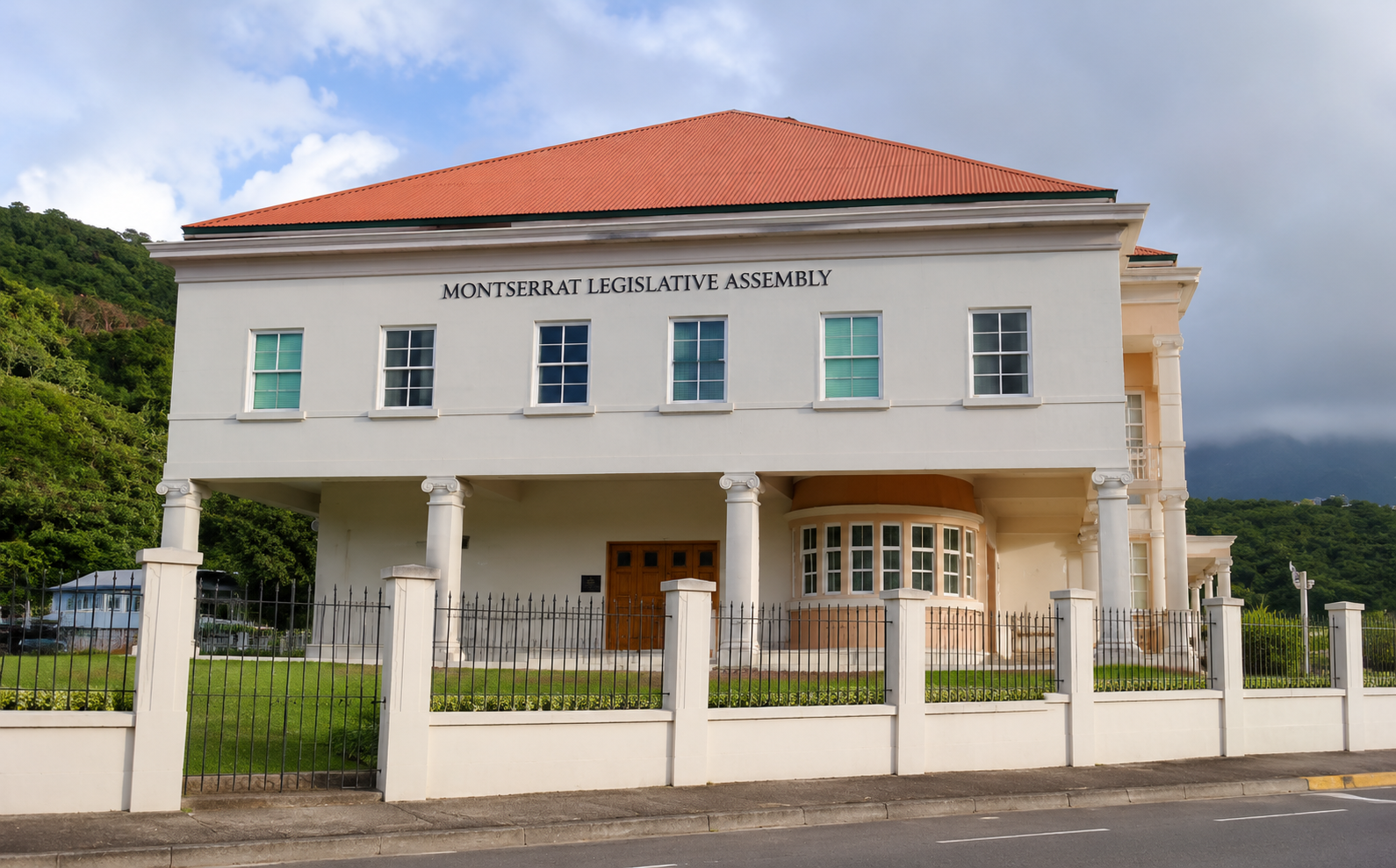
Montserrat is a British Overseas Territory, not an independent country. The constitutional structure is unique among CARICOM nations covered in this guide. King Charles III is Head of State and is represented locally by a UK-appointed Governor (not a Governor-General). The Premier is the elected head of government and chairs Cabinet for most domestic matters, but the Governor retains direct constitutional authority for defence, external affairs, internal security, the public service and the administration of the courts; the Governor chairs Cabinet for these reserved matters. The unicameral Legislative Assembly has nine elected members from a single island-wide constituency, with the Attorney-General and Financial Secretary as ex officio members. Elections are held every five years.

Citizenship and Passport 4-Region
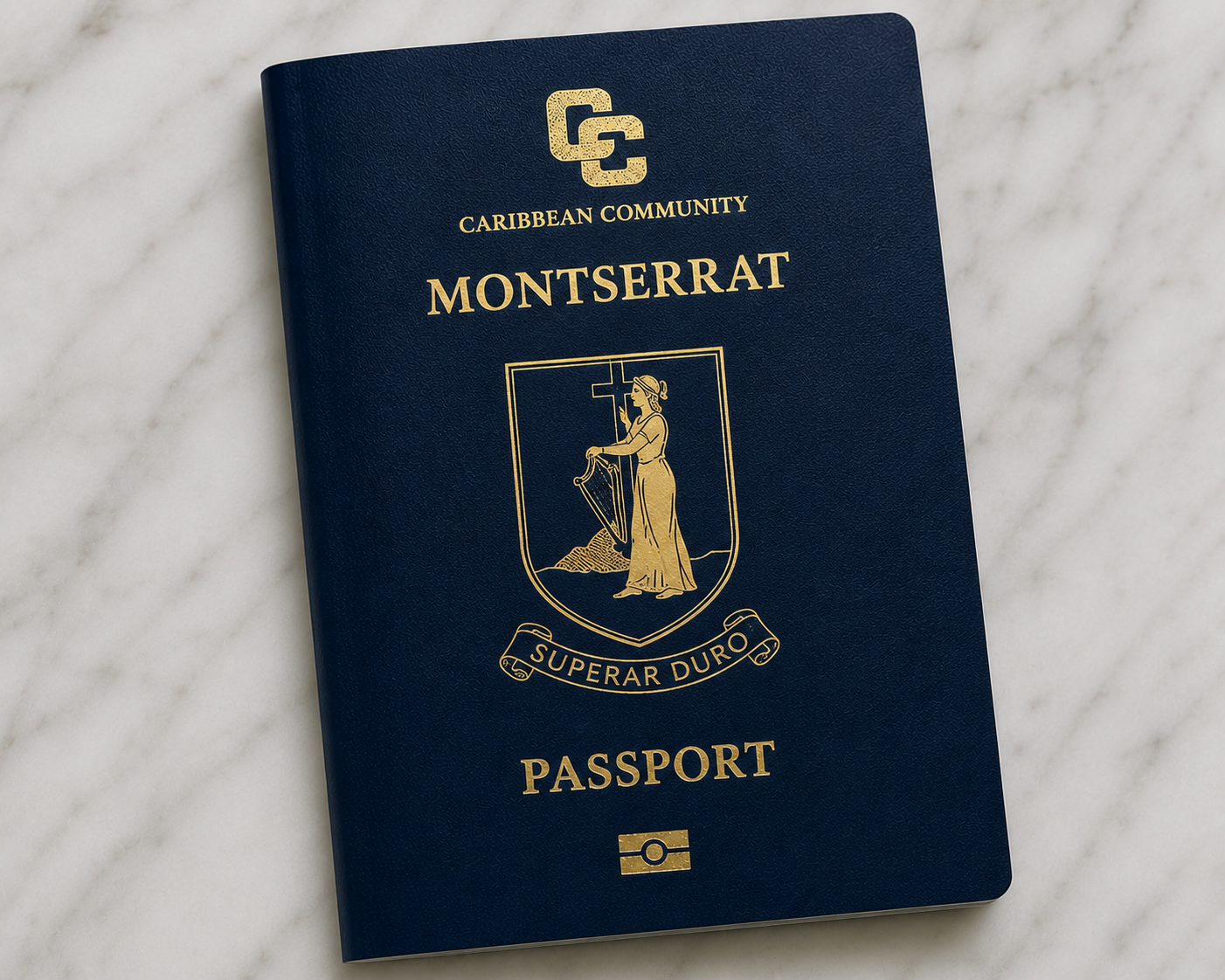
Montserrat’s citizenship picture is the simplest and most favourable of any country in this guide for UK-based Diaspora, because most Montserratians born or registered in the country are already British citizens.
The routes, honestly
- British Overseas Territories Citizenship (BOTC) by birth, descent or registration in Montserrat. This is the formal Montserrat citizenship. Granted under the British Nationality Act 1981 as amended.
- Full British Citizenship, since 21 May 2002. Under the British Overseas Territories Act 2002, virtually all existing British Overseas Territories Citizens (BOTCs) of Montserrat were granted full British citizenship automatically, and BOTC status acquired since then carries British citizenship as well. The practical effect: almost every Montserratian alive today is also a British citizen with the unrestricted right of abode in the UK. This is the single most distinctive advantage Montserrat offers in the entire CARICOM map.
- By descent through a parent or grandparent, for UK Diaspora children and grandchildren. Where a parent or grandparent was a Montserratian BOTC, registration as a BOTC and full British citizen is available through Her Majesty’s Passport Office and the Governor’s Office in Brades. The exact route depends on the dates of birth involved and the citizenship status of the qualifying ancestor at the relevant date; specialist advice is sensible.
- By naturalisation in Montserrat after a qualifying period of legal residence, granted by the Governor.
- By investment. Montserrat does not run a Citizenship by Investment programme. As a BOT, citizenship matters are reserved under UK constitutional control; there is no CBI route. Treat any third-party claim otherwise with caution.
Montserrat is an Associate Member of CARICOM, not a Full Member, on account of its BOT status. As a result, Montserrat does not participate fully in the CARICOM Single Market and Economy (CSME) and is not part of the October 2025 four-country Enhanced Full Free Movement pilot (Barbados, Belize, Dominica and SVG). Montserratians wishing to live and work in other CARICOM countries face the standard entry and residence requirements of each receiving country.
This is more than compensated for, for most Diaspora purposes, by automatic full British citizenship: a Montserratian carries full UK right of abode (live, work, study, vote in UK elections), full freedom of movement to every part of the United Kingdom and the British Overseas Territories, and visa-free or visa-on-arrival access to most of the world on a UK passport. Few CARICOM nationals have a stronger travel document than a Montserratian-born British citizen.
Where to apply, by region
| From | Where to enquire |
|---|---|
| United Kingdom | His Majesty’s Passport Office, UK (for British passports and most BOTC registration enquiries). The Montserrat Government UK Office (MGUKO), the official Government of Montserrat office in London, runs the Diaspora liaison and signposts consular processes. Web: montserrat-gov.uk. |
| USA | British Embassy and Consulates-General (since Montserratians travel on UK passports). The Montserrat Tourism Division has US representation in Atlanta. Honorary Consuls in some US cities. The British Embassy network handles consular and emergency matters. |
| Canada | British High Commission, Ottawa, and Consulates-General. The Montserrat Association of Toronto is the main Diaspora liaison. |
| Europe | British Embassy network, supplemented by Government of Montserrat external relations through MGUKO London. |
| In Montserrat | Office of the Governor, Brades (for citizenship and passport matters under BOT constitutional authority); Immigration Department of the Government of Montserrat (for residence and work permits). |
For descent applications by UK-born children and grandchildren of Montserratian-born parents and grandparents, the precise route through the British Nationality Act 1981 as amended depends on the dates of birth involved, whether the qualifying ancestor was a BOTC at the relevant date, and a series of technical statutory tests. Routinely, registration as a British Overseas Territories Citizen by descent is the cleaner path, with full British citizenship attaching from the 2002 commencement date. Use a UK immigration adviser or solicitor experienced in BOT nationality matters; do not rely on generic descent guidance written for independent CARICOM countries.
Cost of Living 4-Region
An honest monthly comparison: your home city versus life in Montserrat, in your own currency. Montserrat is meaningfully more expensive than its size and income would suggest because the island is very small, most goods are imported from the UK, the US, or onward through Antigua and Guadeloupe, the energy mix is still dominated by diesel generation (geothermal exploration is ongoing), and the small consumer market gives limited scale economies. Rents are modest by international standards but housing supply is genuinely constrained in the safe northern parishes, particularly in the Davy Hill / Lookout / Salem / Olveston belt.
| Monthly expense | London £ | New York $ | Toronto C$ | Montserrat (USD equivalent) |
|---|---|---|---|---|
| Rent, 1-bed local-standard, Brades / Davy Hill / Lookout | £2,000 | $3,800 | C$2,400 | ~$700 to $1,200 USD |
| Rent, 1-bed expat-standard, Salem / Olveston / Woodlands | £2,300 | $4,200 | C$2,800 | ~$1,200 to $2,200 USD |
| Utilities (MUL electricity + water + diesel-impacted), monthly | ~£200 | ~$200 | ~C$200 | ~$200 to $450 USD |
| Single person, modest lifestyle (all in) | £3,000 | $4,800 | C$3,800 | ~$1,800 to $2,700 USD |
| Couple, comfortable lifestyle Salem / Olveston (all in) | £3,800 | $6,500 | C$5,200 | ~$3,500 to $5,200 USD |
| Consumption tax on most goods and services | 20% | Varies | 13% | n/a (no general consumption tax) |
The Government of Montserrat’s One Montserrat initiative under Premier Meade is actively encouraging Diaspora skills return, with a Montserrat Diaspora Database (operated by MGUKO) matching Diaspora professionals to public-sector and private-sector skills gaps. Demand for housing in the safe zone has tightened as the new permanent capital at Little Bay develops, and rental supply for skilled returnees is genuinely competitive. Plan housing well before the move.
Housing and Property
As a Montserratian, a BOTC, or a British citizen with a parent or grandparent connection, you can buy and own land freely in Montserrat. Non-Montserratian non-citizens require an Alien Land Holding Licence from the Government, which is granted relatively routinely for residential property but adds a stamp duty premium. Property title is registered under the Registered Land Act in a Torrens-style system, administered by the Land Registry in the Department of Land Survey and Registry. A proper title search and survey are essential, particularly for inherited land in the safe northern parishes where formal succession may not have been registered across generations.
Where Diaspora returnees tend to settle
All settlement is concentrated in the safe zone in the north and north-west of the island (St Peter parish and the safe parts of St Anthony parish).
- Brades: the current de facto capital, the seat of Government Headquarters, and the most densely-developed of the post-eruption settlements. Practical and walkable; the largest concentration of government offices, banks and shops.
- Davy Hill, Lookout, Cudjoehead, St John’s, Geralds: the established northern settlements, with mixed local and Diaspora-returnee populations. Geralds is the location of John A. Osborne Airport.
- Salem and Old Towne: established pre-eruption settlements that fall within the maximum hazard zone’s outer boundary; access is permitted but new construction is regulated. Substantial Diaspora-returnee and expat-retiree presence.
- Olveston and Woodlands: the historic expat / Diaspora belt on the west coast, with views over the Belham Valley to the volcano. The former home of AIR Studios (George Martin’s recording studio, 1979-1989). Premier residential, with a small but well-established UK and US retiree community.
- Little Bay and Carr’s Bay: the new permanent capital under construction. New port, new town centre, new government quarter, civic and commercial infrastructure being developed in stages from 2024 to 2027. The most active land-development frontier on the island.
- Honest no-go reminder. The southern two-thirds of the island remains a permanent Exclusion Zone under the Disaster Management Act. The former capital Plymouth, the former main residential areas of Kinsale, Cork Hill, St Patrick’s, Gingoes, Trant’s, Spanish Point, and the former airport at Bramble are all permanently uninhabitable. Tourism into parts of the Exclusion Zone is occasionally permitted in escorted day tours; residence and property purchase in any Exclusion Zone area is not permitted.
The Soufrière Hills volcano remains active. The eruption that began on 18 July 1995 has had multiple phases; the most destructive pyroclastic flows occurred between 1995 and 2010, with the worst single event on 25 June 1997 when 19 people were killed in the central villages. Dome activity has continued at varying levels since 2010, and the Montserrat Volcano Observatory (MVO) at Flemmings (on the northern flank of the central hills) maintains continuous monitoring. The Government publishes a Hazard Level Assessment in a standard zoning system; for any property in the north of the island, ask the seller honestly which zone the property falls in, and verify against the current MVO published map before committing. Hurricanes remain a separate, real risk: Hurricane Hugo in September 1989 (which destroyed AIR Studios) and Hurricane Lenny in 1999 are the historic reference points, alongside the storms of recent years that affected the wider Leewards.
Healthcare
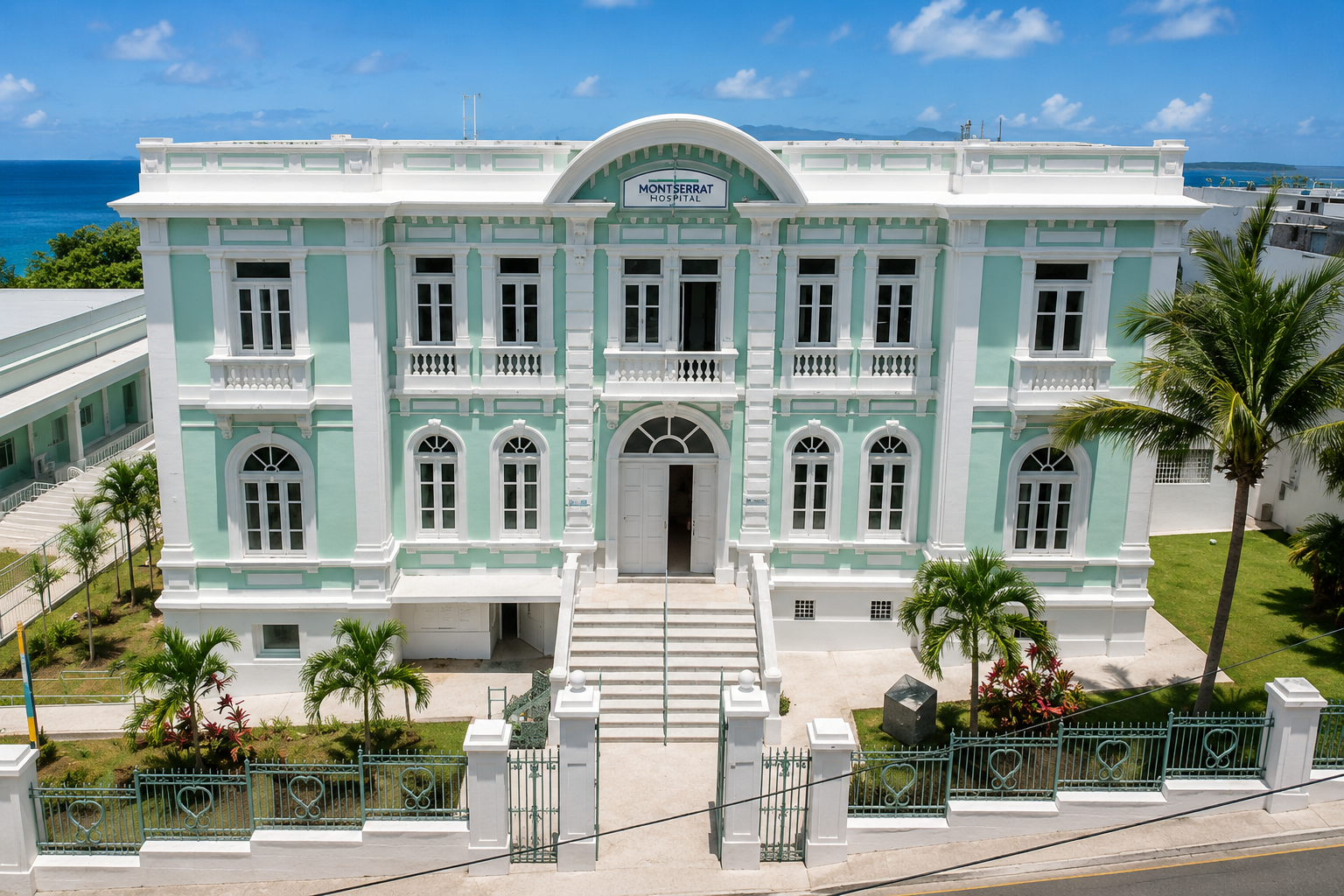
Healthcare in Montserrat is run by the Ministry of Health and Social Services, with a small public health network and an increasingly active private-sector relationship to neighbouring Antigua and Guadeloupe. A returnee should plan honestly: Montserrat does not have the specialist capacity of a Trinidad, Jamaica or Barbados, and complex care routinely means a medical-evacuation flight to Antigua (~30 minutes), Guadeloupe (the CHU Pointe-à-Pitre), Trinidad, Miami or the UK.
Main hospitals and facilities
- Glendon Hospital, St John’s: the country’s only hospital, opened in 1992 in the north of the island and now the de facto national hospital following the loss of the pre-eruption main hospital in Plymouth. Approximately 30 inpatient beds, with surgical, paediatric, maternity, dental and laboratory services, an A&E department, and an outpatient pharmacy.
- Primary Healthcare Centres at Cudjoehead, St Peter’s, and Salem, providing community-level outpatient and chronic-disease care.
- St Augustine Medical Services and a small number of private GP practices in Brades and Davy Hill provide private outpatient services and direct billing to UK private medical insurers.
- Mental Health Services coordinated by the Ministry of Health with regional partner support; specialist inpatient care is generally provided off-island.
- Medical Evacuation: routine referrals to Mount St John’s Medical Centre in Antigua (under government cost-share arrangements for citizens), CHU Pointe-à-Pitre in Guadeloupe, the Cardiac Centre at Mount Hope Trinidad, Miami private hospitals, or the UK NHS / private system for Diaspora returnees with UK access. Med-evac is a real cost line; build it into your insurance.
For older returnees
If you are returning at retirement age, plan three things before you travel. Arrange comprehensive private health cover with strong medical-evacuation cover before arrival; for Montserrat this is non-negotiable. Bring a full written record of your medical history and prescriptions; UK NHS summary care records can be requested through your UK GP before travel. And stock a 90-day supply of any critical long-term medication: small pharmacies on Montserrat may not reliably stock specialty preparations, and the practical resupply pipeline runs through Antigua.
For complex specialist care (advanced cardiac, oncology, neurosurgery, advanced neonatal), Montserrat’s standard referral pattern is to Antigua (Mount St John’s) or Trinidad (Eric Williams Medical Sciences Complex / Mount Hope) in the first instance, and to Miami or the UK NHS for tertiary needs. Diaspora returnees with active UK NHS entitlement often plan complex care in the UK on visits; verify your UK entitlement status with HMRC and your local Integrated Care Board before relocating, particularly if you have been outside the UK for several years.
Education and Schools
Education in Montserrat is free and compulsory from age 5 to 16. The system is British-modelled in structure: early childhood, primary, secondary, and the option of sixth-form study at the Montserrat Community College. End-of-secondary qualifications are Caribbean Examinations Council (CXC) CSEC (broadly equivalent to GCSE) and CAPE (broadly equivalent to A-level). The Common Entrance Examination at age 11 streams pupils into the country’s single secondary school.
Well-regarded schools
- Montserrat Secondary School (MSS), Salem: the country’s only secondary school, co-educational. Successor to the pre-eruption Montserrat Secondary School in Plymouth.
- Primary schools: Brades Primary, Lookout Primary, St Augustine Primary, St Peter’s Primary, Salem Primary. All small (often 50 to 200 pupils) and tightly-knit.
- Montserrat Community College (MCC), the country’s post-secondary institution, offering Associate degree-level qualifications, technical and vocational education, and the Sixth Form Centre. Affiliations with University of the West Indies (UWI) for some onward pathways.
- Outbound pathways: most Montserratian sixth-form leavers progress to UWI (Cave Hill, Barbados; Mona, Jamaica; St Augustine, Trinidad), UK universities (a particular feature given automatic British citizenship: Montserratians qualify for UK home-fee status in some circumstances, subject to the standard three-year UK residence test for fee purposes; check with the institution), or US / Canadian institutions.
Montserrat’s small school system is one of the country’s real strengths for returning families: small class sizes, safe walkable communities, and a curriculum that maps cleanly onto UK and Caribbean onward routes. The honest limitation is the absence of a wider sixth-form choice; ambitious sixth-form-aged children commonly study elsewhere. UK Diaspora families with secondary-aged children often plan a Sixth Form / A-level transition back to the UK (greatly simplified by the British-citizenship advantage), or onward UWI study.
Banking, Tax and Money
A few registrations matter for every returning resident settling in Montserrat.
The tax picture, honestly
Montserrat’s tax system is moderate and notably distinctive in CARICOM. Personal income tax is charged on a banded PAYE scale rising from 5 percent to a top rate of around 30 percent, with a generous personal allowance. Montserrat does not levy a general consumption tax or VAT; instead, a Customs Service Charge applies on imports and a small range of specific consumption taxes apply on tobacco, alcohol, fuel and motor vehicles. Property tax applies to land and buildings at modest rates administered by the IRD. Corporate income tax is around 30 percent. The XCD is pegged to the USD at 2.70.
Inheritance tax: an honest comparison with the UK
This is a real and rarely-discussed advantage for returning Diaspora.
- The UK position: UK Inheritance Tax is currently 40 percent on the value of an estate above the nil-rate band of £325,000 (with an additional £175,000 residence nil-rate band where a main home passes to direct descendants, and full spouse exemption). Most middle-class UK estates with a home and pension are affected.
- The Montserrat position: Montserrat does not impose an inheritance tax or estate tax. Beneficiaries do not pay tax on inherited assets. Stamp duty applies to the registration of the inherited title and is the practical cost line on Montserrat-situs property inheritance.
- The cross-border reality. This is the single most important honest caveat in the entire Montserrat picture. Because most UK Montserratian Diaspora are UK domiciled (often deemed-domiciled by long UK residence) under HMRC rules, UK Inheritance Tax can still bite on the worldwide estate, even after relocation to Montserrat and even where the assets are Montserrat-situs. Domicile is sticky and very hard to shed; the UK-Montserrat constitutional link, while it does not by itself fix domicile, makes the practical analysis particularly important. Treat this as one of the most important conversations to have with a qualified UK tax adviser before you go, alongside a Montserratian lawyer for the local Will.
Wills and estate planning
- Why it matters. Many UK Montserratian Diaspora have a UK Will that does not properly cover Montserratian property, or no Will at all. On death this can throw the estate into intestacy across two jurisdictions, which is slow, costly and distressing for family.
- Widely-recommended practice (not legal advice). Cross-border practitioners commonly recommend two Wills: a UK Will for your UK estate, and a separate Montserrat Will for your Montserrat-situs assets, each containing language making clear it does not revoke the other. Use a local lawyer in Montserrat for the local Will.
- The local rules. Inheritance is governed by Montserratian statute in the common-law tradition; the Probate Registry of the Eastern Caribbean Supreme Court (the regional Superior Court of Record serving the OECS, headquartered in Saint Lucia, with the Court of Appeal sitting on circuit) handles grants. Uncontested probate is usually granted in three to six months; complex estates take longer. Common-law spouse claims are recognised in modified form by statute.
- UK Wills and resealing. A grant of probate obtained from a UK court can be resealed by the Montserrat High Court under the Colonial Probates Act. In practice this means a UK grant covering Montserrat assets can often be used directly, rather than needing a fresh local probate from scratch. Confirm with a local lawyer.
- Practical pointers. Name an executor in each jurisdiction. If the executor is not resident in Montserrat, a local agent must be appointed via Power of Attorney to obtain the grant of probate. Review every five years or on a major life event. Tell your executor where the Wills are stored.
This is general information for orientation. Always speak to a qualified local lawyer and a UK tax adviser before drafting or relying on a Will.
The Government of Montserrat offers customs concessions for returning nationals through the Customs and Revenue Service. A Montserratian returning after a qualifying period abroad may import household goods and effects (and, subject to conditions, a vehicle) with relief from some Customs Service Charge. The exact current qualifying period, eligible items and any cap on vehicle age and value have been adjusted over the years; confirm the current rule directly before you ship anything.
Work and Business
As a Montserratian, BOTC or British citizen with a Montserratian parental link, you can live and work in Montserrat without a work permit. Non-Montserratian non-citizens require a work permit issued by the Labour Department on behalf of the Government. The Government’s One Montserrat programme under Premier Meade is actively matching Diaspora skills to identified domestic skills gaps via the Montserrat Diaspora Database operated by MGUKO.
The main sectors
Montserrat’s economy is highly concentrated. The major sectors today are: public administration, the country’s largest employer, anchored by UK Budget Aid support to the Government; construction, in a sustained boom as the new permanent capital at Little Bay is built; geothermal energy, an active national investment programme with two test wells drilled in 2013 and 2016 and a commercial deployment under planning; volcano-science tourism, the country’s distinctive niche, anchored by MVO and the Volcano Interpretation Centre, drawing scientific visitors and adventurous tourists; fisheries and small-scale agriculture; creative industries, drawing on the AIR Studios legacy and the St Patrick’s Festival; and BOT financial services, modest in scale and tightly regulated under FCDO oversight.
Starting a business
New businesses register through the Companies Registry at the Financial Services Commission of Montserrat. Montserrat Development Corporation (MDC) is the national investment-promotion agency and Diaspora investment liaison.
The Diaspora returnee opportunity in Montserrat is particularly strong in three areas: skilled-trades and construction (the Little Bay new capital build is a 5-to-10-year programme with sustained skills demand), public-sector secondment (medicine, education, finance and ICT into the Government of Montserrat, often through MGUKO-coordinated Diaspora deployment), and Diaspora tourism services (small hotels, villas, eco-tourism, volcano-science adventure tourism). The trade-off is honest: a very small market and a high cost of imports limit pure retail and consumer-goods business plans.
Driving and Transport 4-Region
Montserrat drives on the left, the same as the UK, in the standard Commonwealth fashion. Steering wheels are on the right. The road network is concentrated in the safe northern parishes and is well-maintained for the small island, with most of the country reachable in around 30 minutes from Brades. The John A. Osborne Airport at Geralds, opened on 11 July 2005 to replace the pre-eruption Bramble Airport (now in the Exclusion Zone), is the country’s only airport; the runway is short and limited to small turboprop aircraft. There are no direct flights between Montserrat and the UK. The standard UK Diaspora route is via Antigua (V.C. Bird International Airport, ANU), with onward connections to Montserrat on small turboprops (FlyMontserrat or SVG Air) or the daily ferry from Antigua (around 90 minutes). British Airways and Virgin Atlantic both fly daily to Antigua from London Heathrow and London Gatwick.
| Licence held | How it works | Where | Cost |
|---|---|---|---|
| UK licence | Visitors must obtain a Visitor’s Driver Permit on arrival, valid alongside the UK licence. For residence, conversion to a Montserratian licence is needed. | Royal Montserrat Police Service (Traffic Department) | ~$30 to $60 USD visitor; conversion fee separately |
| US licence | Visitor’s Driver Permit on arrival, valid alongside the US licence. | As above | ~$30 to $60 USD |
| Canadian licence | Visitor’s Driver Permit on arrival, valid alongside the Canadian licence. | As above | ~$30 to $60 USD |
| EU licence | Visitor’s Driver Permit on arrival; an International Driving Permit is recommended. | As above | ~$30 to $60 USD |
For residence, you will convert to a full Montserrat driver’s licence through the Royal Montserrat Police Service Traffic Department. Public transport is by minibus and private taxi; there is no formal scheduled bus service, but minibuses run regularly between Brades, Salem, Olveston, Davy Hill and the airport at Geralds. Inter-island ferry (the Jaden Sun, Antigua to Montserrat, around 90 minutes) operates on most days and is the working transport link to Antigua. Most Diaspora returnees keep a private vehicle.
Bringing your pet
Cats and dogs can be brought to Montserrat with proper paperwork. Current requirements typically include an import permit from the Veterinary Services Division of the Department of Agriculture, microchip identification, current rabies vaccination, and a veterinary health certificate issued shortly before travel. The UK is generally an approved-origin country. Confirm the exact current requirements directly with the Veterinary Services Division well before you plan to travel.
Internet and Connectivity
Connectivity in Montserrat is a small but functional market. The country is served by Flow Montserrat (the Liberty Latin America brand, formerly Cable & Wireless), the historic incumbent, and Digicel Montserrat, the challenger. The Telecommunications Department of the Government of Montserrat regulates the sector under Eastern Caribbean Telecommunications Authority (ECTEL) frameworks.
Both operators offer fibre and cable broadband across the safe northern parishes, with consumer speeds typically up to 100 to 300 Mbps. Mobile is 4G LTE across the populated north; 5G has not yet been deployed. Standalone broadband typically runs from XCD 150 to 400 per month (around US $55 to $150).
Starlink became available in Montserrat in 2024 and is increasingly used as a resilience layer for businesses and Diaspora returnees, particularly important given the island’s exposure to hurricane disruption and volcanic ashfall on terrestrial infrastructure. Power supply via Montserrat Utilities Limited (MUL) is generally reliable but diesel-dominated; an inverter or generator stack is a sensible resilience investment for a working home setup.
Safety: The Honest Picture
Montserrat is one of the safest countries in the Caribbean from a crime perspective and one of the more closely-monitored from a natural-hazard perspective. The two pictures matter separately.
Crime and public safety
The UK FCDO rates Montserrat at standard precautions, with no specific travel restriction. The US State Department rates Montserrat at Level 1 ("Exercise Normal Precautions"), the lowest of the four levels. Crime is low in absolute terms and largely confined to opportunistic petty theft; violent crime is rare. The Royal Montserrat Police Service is small and community-rooted; police-population ratios are high.
The volcano, honestly
The Soufrière Hills volcano began an eruption episode on 18 July 1995 after centuries of dormancy. Successive pyroclastic flows and dome collapses through the late 1990s and 2000s buried the capital Plymouth, destroyed the southern third of the island (now the permanent Exclusion Zone), and killed 19 people in the worst single event on 25 June 1997. Approximately two-thirds of the pre-eruption population (over 7,000 of around 10,500) emigrated, predominantly to the UK under a 1998 UK Government Assisted Voluntary Returns / Assisted Passage scheme. The volcano remains active but with low-level dome activity since the major eruptive phase ended around 2010. The Montserrat Volcano Observatory (MVO) at Flemmings maintains continuous monitoring and publishes a Hazard Level Assessment; the safe northern parishes have remained habitable throughout, and life in the north is fundamentally normal day-to-day. For any property or activity decision, the published Hazard Zone map is the practical reference.
The wider picture: ashfall affects the north periodically during dome-collapse events; respiratory advisory is published by MVO and the Ministry of Health when ash levels rise. Diaspora returnees with chronic respiratory conditions should plan accordingly and consult MVO’s public information directly.
Other environment and natural hazards
Montserrat sits in the Atlantic hurricane corridor. Hurricane Hugo (Cat 4, 17 September 1989) devastated the island in the most damaging hurricane of the 20th century for Montserrat, killing 11 people and destroying AIR Studios at Olveston. Hurricane Lenny (1999) caused significant coastal damage. Recent hurricanes have largely tracked north or south of the island. Earthquake risk is moderate as part of the Caribbean Plate boundary system. Tsunami risk along the coast is real and is one of the contingency scenarios in the Montserrat Disaster Management Coordination Agency (DMCA) planning framework.
Before you travel, check the official FCDO travel advice for Montserrat.
Diaspora Missions, UK Association and Community 4-Region
The country’s diplomatic and Diaspora representation, plus the community channels you can plug into. Montserrat has the highest Diaspora-to-domestic ratio of any country in this guide: against a domestic population of approximately 4,400, the UK Montserratian Diaspora alone is estimated at 7,000 to 10,000 first-generation Montserratians plus a second/third generation of Caribbean-British heritage of similar or greater size. Major UK centres are London (especially Stockwell, Brixton, Hackney and Tottenham), Birmingham, Preston and Ipswich. Smaller communities exist in the US (Brooklyn, New England) and Canada (Toronto).
Honest note on the structure: because Montserrat is a BOT, there is no UK High Commission of Montserrat (as a sovereign-state diplomatic mission). Consular and external-affairs work for Montserratians is done through the UK consular network (since Montserratians are British citizens); Diaspora liaison and economic / cultural representation is done through the official Government of Montserrat office in London below.
UK Diaspora Associations
The UK Montserratian Diaspora has the densest community-organisation network relative to home-country size of any country in this guide. A short and necessarily incomplete list:
- Montserrat Overseas People’s Progressive Association (MOPPA): one of the longest-established UK Montserratian umbrella bodies, active in advocacy, cultural events and Diaspora liaison.
- Montserrat Voices: a UK-based community voice on Montserratian issues, particularly active in post-eruption advocacy.
- Preston Montserrat and Friends Association: the North West English Montserratian umbrella, anchoring the Preston community that grew significantly under the 1997-1998 UK Government Assisted Passage scheme.
- Village664: a UK-based Diaspora cultural and community organisation named after the country code.
- One Montserrat Foundation: a Government-of-Montserrat-linked Diaspora vehicle aligned to the One Montserrat national programme.
- Local church congregations and St Patrick’s societies across London (particularly New Life Assembly Church Hackney, and Pentecostal congregations in Brixton and Stockwell), Birmingham, Preston and Ipswich.
- The Montserrat 30th Anniversary UK Community Choir (active 2025), and the Alliouagana Pearl community arts work.
- Cross-Caribbean umbrellas: the British Caribbean Association (BCA), the Caribbean & African Health Network (CAHN), and pan-Caribbean Diaspora networks serve UK Montserratians alongside other CARICOM nationals.
Major recent Diaspora events: the National Thanksgiving Service marking 30 years since the volcano eruption, held on 29 June 2025 at Westminster Central Hall, drew more than 500 attendees from across the UK (coach travel from Preston, Ipswich and Birmingham) and included a message of reflection from His Majesty The King. The inaugural Montserrat Diaspora Leadership Conference followed on 23 November 2025 in Victoria, London, hosted by MGUKO and Premier Meade.
Facebook Groups and Pages
Where the UK Diaspora can plug into Montserratian community life online. A curated list, not exhaustive:
- Montserrat Government UK Office (MGUKO), the official Diaspora liaison page.
- Government of Montserrat and Office of the Premier Montserrat, central Government pages.
- Discover Montserrat, the leading independent Montserratian news and current-affairs page.
- Montserrat Focus, an active local news outlet.
- MOPPA, Village664, Preston Montserrat and Friends, One Montserrat Foundation, and the church-anchored community pages.
- Alliouagana-themed cultural pages (Alliouagana is the indigenous Taino name for Montserrat).
- The Caribbean Diaspora, British Caribbean Development and the broader Pan-Caribbean UK community groups, where Montserratians are well-represented despite small absolute numbers.
Not sure where to start?
Map your move with the Relocation Intelligence Calculator: your citizenship eligibility, budget and timeline, costed clearly.
Your First Steps
- Confirm your British citizenship status. For most UK Montserratian Diaspora the British Overseas Territories Act 2002 already settles this; for the second and third UK-born generations, check the descent route carefully through Her Majesty’s Passport Office and the Governor’s Office Brades.
- Register with the Montserrat Diaspora Database operated by MGUKO. If you have a skill the Government of Montserrat is actively seeking through One Montserrat, the rest of your move becomes easier.
- Decide which safe-zone settlement suits you: Brades for civic and walkable convenience; Davy Hill / Lookout / Geralds for established northern community living; Salem / Old Towne for Diaspora-returnee community feel with Belham Valley views; Olveston / Woodlands for premium west-coast settlement; Little Bay for the new permanent-capital frontier.
- Treat any claim of a Montserrat CBI route with caution: there is no Montserrat CBI programme. Citizenship for Diaspora is by descent or registration, not by investment.
- Register with Montserrat Social Security Fund and the Inland Revenue Department for a TIN on arrival.
- Arrange private health cover with strong medical-evacuation cover (Antigua / Trinidad / Miami / UK). Bring full medical records and at least 90 days of any critical prescriptions.
- Speak to a qualified local lawyer about a Montserrat Will to sit alongside any UK Will. Confirm whether your UK grant of probate can be resealed by the Montserrat High Court for your Montserrat-situs assets.
- If you are buying property, do a full title search through the Land Registry. Verify the current MVO Hazard Zone for the specific property and check post-eruption Disaster Management Act zoning permissions for any construction or renovation plans.
- Confirm Returning Resident customs concessions directly with the Customs and Revenue Service before you ship anything.
- Plan air access via Antigua (ANU): direct UK flights to Antigua on BA and Virgin Atlantic, onward Antigua-Montserrat by air (FlyMontserrat / SVG Air) or by the Jaden Sun ferry.
- Run your numbers through the Relocation Calculator and plan your shipping with the 2026 Shipping Bible.