🇸🇷 Moving to Suriname from the UK
Suriname is the only Dutch-speaking country in the Americas and an independent republic since 25 November 1975. President Dr Jennifer Geerlings-Simons is the country's first female President, sworn in on 16 July 2025. The largest Surinamese Diaspora is in the Netherlands (~350,000), not the UK.
Of every country in this guide, Suriname is the most structurally distinct: a republic with a President as Head of State and Head of Government (no Governor-General, no King), a Dutch-language official register and a Sranan Tongo street language, a Dutch civil law jurisdiction (not common law), the Surinamese Dollar (SRD) rather than the EC Dollar, and on the verge of a major offshore oil transition with the TotalEnergies GranMorgu project expected to come online in 2028. For the UK Diaspora (small but distinct), the much-larger Netherlands Diaspora, and the growing US and Canadian families, this guide gives you what you need to think honestly about return: citizenship (descent or naturalisation, since there is no CBI), cost of living, healthcare, the CSME position (Suriname is a Full Member but not in the October 2025 four-country pilot), the practical no-direct-UK-flights reality via Amsterdam, and the civil law succession steps that make a returnee’s life easier. The country is the size of England plus Wales, multilingual, multi-religious, EC-Dollar-free, and home of one of the most photographed UNESCO World Heritage colonial-Dutch capitals in the world.
Identity and Culture
Before the practicalities, this is the place. Its symbols, its sound, its flavour. Suriname is the smallest sovereign country in South America by both land area and population, the only Dutch-speaking country in the entire Americas, and the most religiously and ethnically diverse country in CARICOM. The 2012 census recorded the country’s population as Hindustani (Indo-Surinamese, ~27 percent, descendants of British Indian indentured labourers brought 1873-1916), Maroon (~22 percent, descendants of escaped enslaved Africans who established autonomous communities in the interior from the 17th century onward), Creole (~16 percent, descendants of African enslaved peoples and mixed-heritage urban population), Javanese (~14 percent, descendants of Indonesian-Javanese contract labourers brought 1890-1939), mixed (~13 percent), Indigenous (~4 percent, principally Lokono/Arawak and Karińa/Caribs), and smaller Chinese, Lebanese, Sephardic Jewish, Portuguese-Jewish, Boeroe (Dutch-farmer descendant) and other communities. Languages: Dutch is the sole official language (Suriname is the third member of the Dutch Language Union after the Netherlands and Belgium), but Sranan Tongo (the English-based creole lingua franca) is the everyday spoken language across most ethnic and class boundaries. Sarnami Hindustani (the Bhojpuri-derived Indo-Surinamese language), Javanese, six Maroon languages (Saramaccan, Paramaccan, Ndyuka, Aluku, Kwinti, Matawai), and Indigenous Cariban and Arawakan languages are all in active use, alongside English and Portuguese as widely-spoken trade languages. The country celebrates Phagwah (Holi) in March, Eid al-Fitr and Eid al-Adha, Easter and Christmas, Keti Koti (the African-Surinamese day of emancipation, 1 July), Indian Arrival Day, Javanese Arrival Day, and Independence Day on 25 November.
National Flag
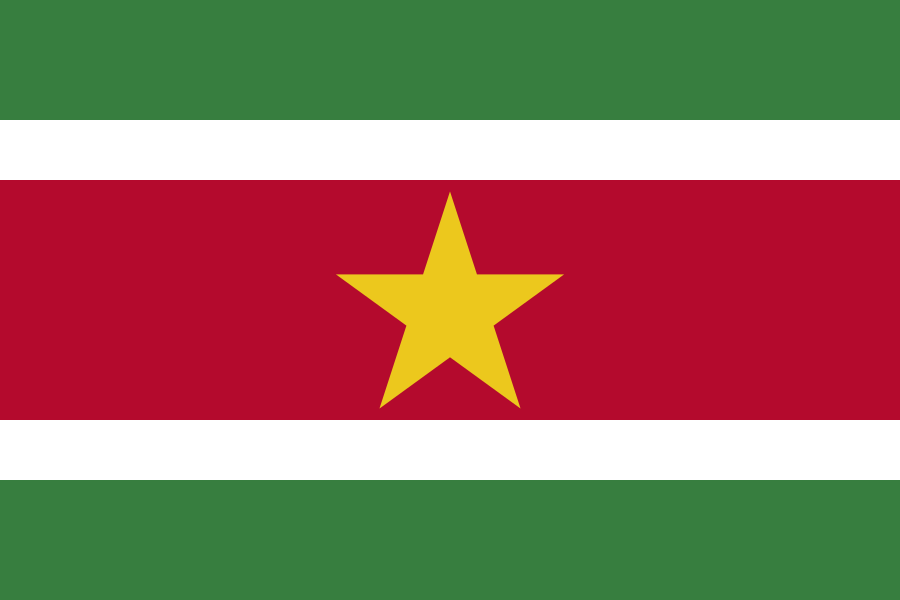
Adopted on 25 November 1975 (Independence Day). Five horizontal bands: green (top), white, red, white, and green (bottom), with a five-pointed yellow star in the centre. The green represents fertility and agricultural land, the white represents justice and freedom, the red represents progress and love, and the yellow star represents the unity of the country’s diverse population and the bright future.
Coat of Arms

Granted at independence in 1975. Two Indigenous Surinamese figures support a shield divided in two: the left half showing a sailing ship (referencing the African slave trade and the migration ships that brought the country’s diverse population), the right half showing a palm tree (representing the people and the land). A diamond in the centre of the shield contains a five-pointed star (the same star as the flag). Motto in Latin beneath: "Justitia, Pietas, Fides" ("Justice, Devotion, Loyalty").
National Motto
"Justitia, Pietas, Fides" ("Justice, Devotion, Loyalty", Latin). A motto centred on the civic foundations of the country, taken from the coat of arms granted on independence in 1975.
Seat of Government

National Anthem
"God zij met ons Suriname" ("God Be With Our Suriname"), with two stanzas: the first in Dutch (by Cornelis Atses Hoekstra, 1893), and the second in Sranan Tongo (by Henri Frans de Ziel, 1959). Music by Johannes Corstianus de Puy (1876). Adopted on independence in 1975. The bilingual anthem is one of very few in the world to officially mix two languages.
National Dish
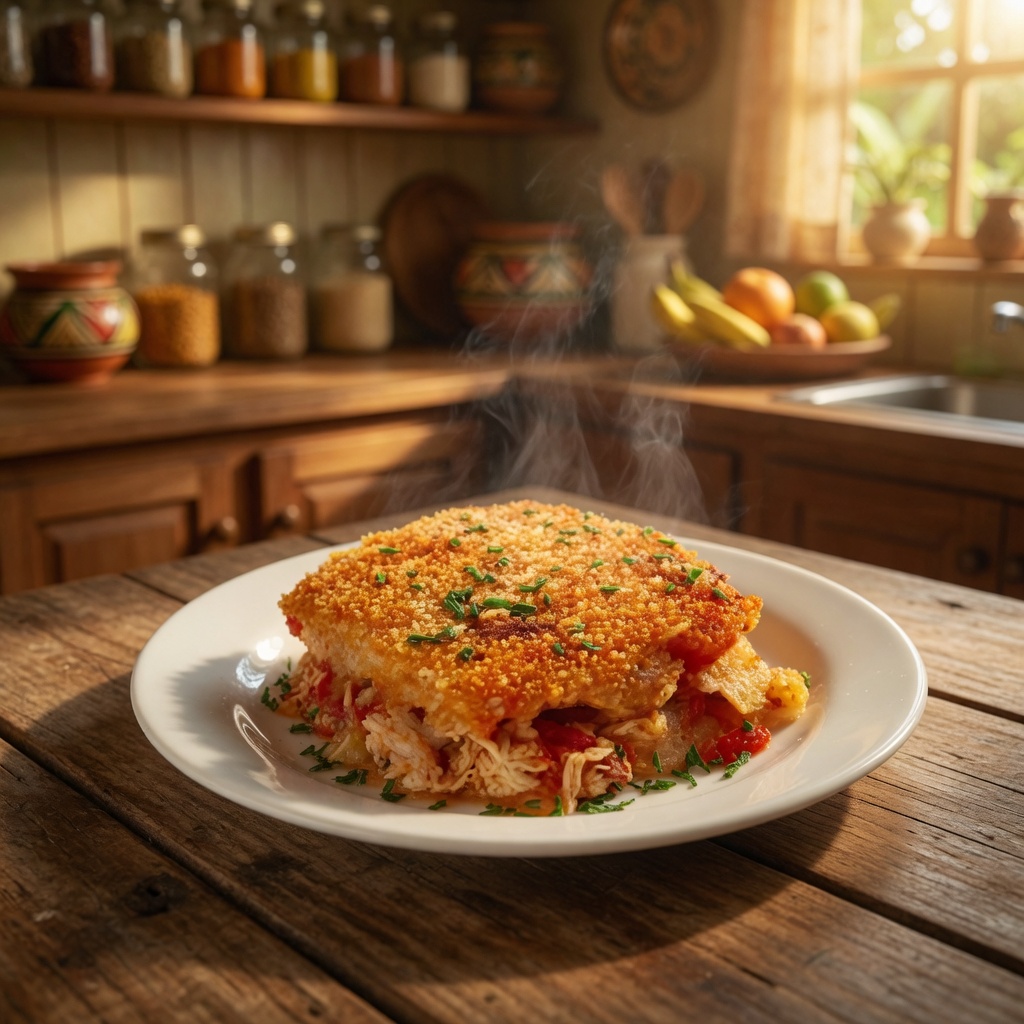
Suriname does not have a single officially declared national dish, but the most-celebrated national favourites are Pom (a Creole oven-baked dish of grated pomtajer root, citrus, and chicken, served especially at celebrations) and Bami Goreng and Nasi Goreng (the Javanese-Surinamese stir-fried noodles and rice). Other staples reflect the country’s mosaic: roti with curry chicken or duck (Hindustani heritage), moksi alesi (mixed-rice Creole dish), bara (Hindustani lentil fritter), saoto soup (Javanese-Surinamese chicken soup), cassava bread, and the local Parbo Bier brewed by the Surinaamse Brouwerij in Paramaribo.
Did You Know
Suriname is divided into ten districts: Paramaribo (the capital district, coextensive with the city, the country’s political, commercial and cultural heart, almost half the national population), Wanica (immediately south and west of Paramaribo, the largest suburban district), Nickerie (the far west, rice-growing country bordering Guyana across the Corantijn River, capital Nieuw Nickerie), Coronie (a narrow coastal district between Nickerie and Saramacca), Saramacca (west of Paramaribo, agricultural), Para (south of Paramaribo, contains the Johan Adolf Pengel International Airport), Commewijne (east across the Suriname River, the historic plantation district), Marowijne (the far east, bordering French Guiana across the Marowijne River, the principal Maroon homeland), Brokopondo (the central interior, contains the Brokopondo Reservoir and the historic Saramaccan and Aluku Maroon villages), and Sipaliwini (by far the largest district, covering the entire southern interior, the Indigenous and Maroon-dominated Amazonian rainforest belt, more than 80 percent of the country’s area). The capital is Paramaribo (Paramaribo district), with Nieuw Nickerie the country’s second city. Beaches are limited (the country’s coastline is heavily mud-flat and mangrove, not white-sand); the country’s natural draws are the rainforest interior, river systems and the UNESCO-listed colonial wooden architecture of Paramaribo.
Country Code: the 597
+597. Across the global Surinamese Diaspora, Surinamers identify themselves simply as "the 597," after the country’s telephone area code (one of only two CARICOM country codes that is not in the North American Numbering Plan +1 family; the other is Haiti at +509). You will hear it at Phagwah and Eid celebrations in Amsterdam Bijlmer, at Keti Koti commemorations in Rotterdam, at the Surinamese-Dutch community events in The Hague, at the smaller Surinamese-British gatherings in London, and across the New York, Miami and Toronto Diaspora. Saying "I’m from the 597" is saying "I’m from home."
Leadership: Who Runs the Country
Suriname is a presidential republic, not a constitutional monarchy. The President is both Head of State and Head of Government, exercising executive power directly through the Council of Ministers (Cabinet). The President is elected by the unicameral 51-seat National Assembly (De Nationale Assemblée, DNA) for a five-year term, with a two-thirds majority required; if no candidate achieves two-thirds in two rounds, the larger Federation of Districts and Resorts votes instead. There is no Governor-General. Independence from the Netherlands was attained on 25 November 1975; the current Constitution dates from 1987.
The country reached a major historical milestone in 2025. Following the inconclusive National Assembly election of 25 May 2025, in which no party reached a majority (NDP 18 seats, VHP 17 seats, others 16), a coalition led by the National Democratic Party (NDP) negotiated a two-thirds support bloc and on 6 July 2025 the National Assembly elected Dr Jennifer Geerlings-Simons as the country’s first woman President. She was inaugurated on 16 July 2025 for a five-year term ending 2030.

Citizenship and Passport 4-Region
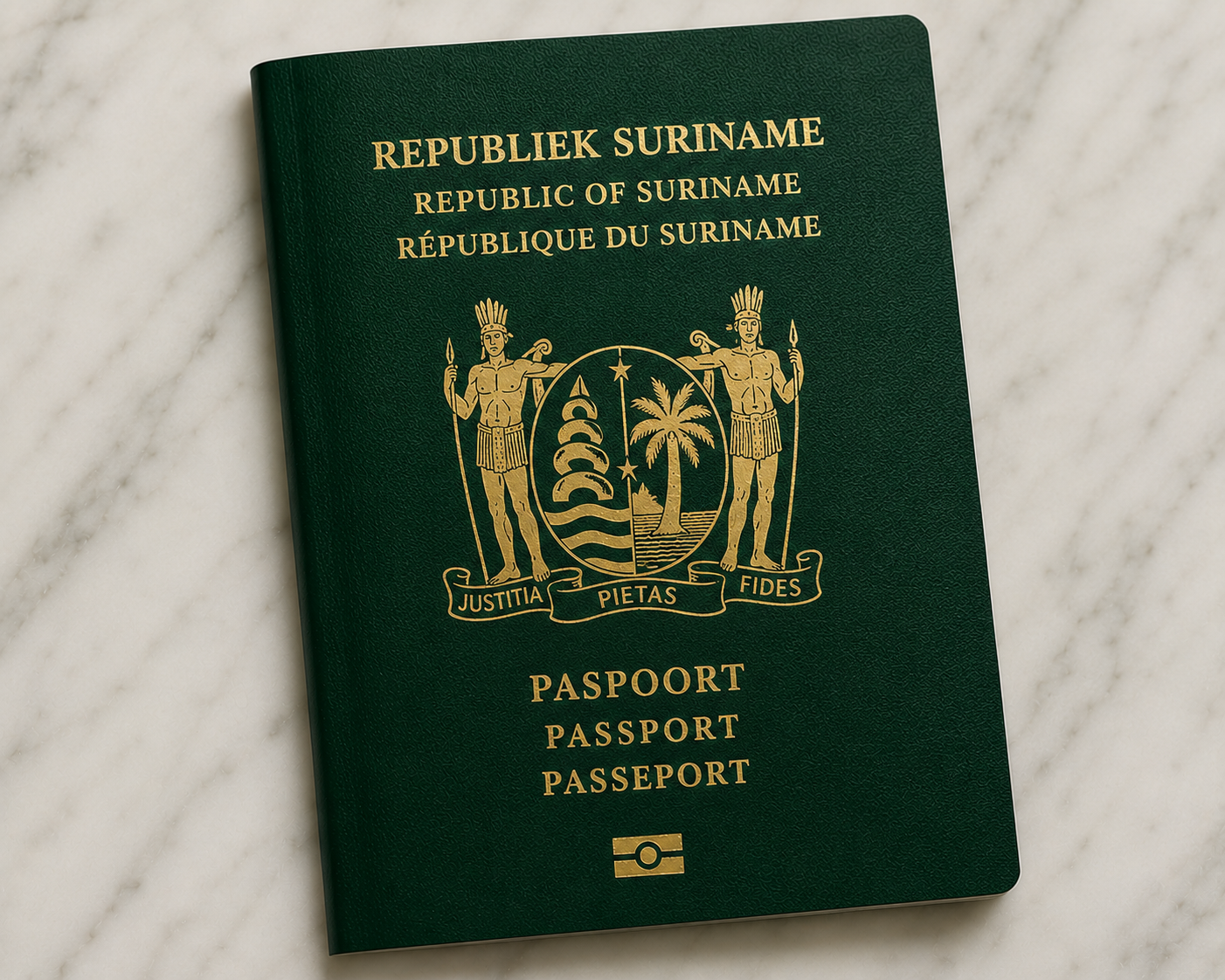
The honest summary: Suriname offers descent and naturalisation, and like SVG and Haiti, has no Citizenship by Investment programme. The Surinamese passport is widely regarded among UK and Dutch holders for the practical reasons of family return and inheritance rather than as a global-mobility instrument.
The routes, honestly
- By birth: anyone born in Suriname to a Surinamese parent is a citizen. Birth on Surinamese soil to non-Surinamese parents does not automatically confer citizenship (the rules are jus sanguinis-dominant, not pure jus soli).
- By descent: a child born outside Suriname whose mother or father is a Surinamese citizen is a citizen by descent. This is the principal route for second-generation Netherlands-born and UK-born Diaspora children of Surinamese parents.
- By naturalisation: standard naturalisation rules under the Nationality and Residency Act, requiring lawful residence and a Dutch-language competence component.
- By option / declaration: shorter routes are available for certain family members of Surinamese citizens (spouses, registered partners, adopted children) and for former Surinamese citizens who relinquished citizenship on Netherlands naturalisation under historic rules and now wish to re-acquire it.
- By investment (CBI): no CBI programme exists in Suriname. The Geerlings-Simons government has not announced any intention to introduce one; verify any third-party claim to the contrary directly with the Cabinet of the President at kabvp.sr.
- Dual citizenship: permitted with restrictions. Suriname recognises dual citizenship in specific circumstances (notably for children born to Surinamese parents abroad, and in certain bilateral cases with the Netherlands), but the rules are more restrictive than most other CARICOM countries. Surinamese who voluntarily acquire another nationality as adults may automatically lose Surinamese citizenship under the Nationality and Residency Act unless they specifically take steps to retain it. This is particularly relevant for the Netherlands-Diaspora generation that naturalised as Dutch from the 1980s onward, and for UK Diaspora returnees who naturalised as British. Check your individual position directly with the Embassy of Suriname in The Hague or London before relying on dual-citizen status.
Suriname is a Full Member of CARICOM (joined 4 July 1995, the only Dutch-speaking CARICOM Member State) and a Full Member of the CARICOM Single Market and Economy (CSME). CSME guarantees CARICOM nationals broad rights to live and work across the participating 14 CARICOM states under the Skills Certificate regime (13 eligible tiers, 5 to 8 week processing). On 1 October 2025, four CARICOM countries (Barbados, Belize, Dominica and St Vincent and the Grenadines) implemented Enhanced Full Free Movement. Suriname is not in the October 2025 pilot; Surinamers continue to require a CARICOM Skills Certificate to live and work in those four countries, and equally Suriname continues to require a Skills Certificate from incoming CARICOM nationals. The Government has not publicly committed to a pilot-expansion date.
Where to apply, by region
| From | Where to apply |
|---|---|
| The Netherlands (the primary Diaspora) | Embassy of the Republic of Suriname, Alexander Gogelweg 2, 2517 JH The Hague. Tel: +31 (0)70 365 0844. Consulate-General in Amsterdam at the De Boelelaan and at smaller consular outposts across the Netherlands. The Hague Embassy is the principal touchpoint for the 350,000-strong Netherlands Diaspora and handles passport renewal, descent registration, military-service exemption documentation and consular emergencies. |
| United Kingdom (smaller Diaspora) | Suriname does not currently maintain a resident Embassy or High Commission in London. Consular services for UK Diaspora are typically routed through the Embassy of Suriname in The Hague, the Surinamese Mission to the United Nations in New York, or the Honorary Consul (if currently appointed in London; verify before travel). UK Diaspora applicants commonly visit the Hague Embassy in person. |
| USA | Embassy of the Republic of Suriname, 4301 Connecticut Avenue NW, Suite 460, Washington DC 20008. Tel: +1 202 244 7488. Consulate-General in Miami serves the Florida Diaspora and the Caribbean Basin US-Surinamese community. |
| Canada | Suriname is accredited to Canada through the Embassy in Washington DC and via Honorary Consuls in Toronto and Montreal. There is no resident Embassy in Ottawa. |
| Europe | Embassies in The Hague (the principal Diaspora mission), Brussels (the EU institutions), Paris (covering also French Guiana, with which Suriname shares the Marowijne River border), Berlin, and Madrid. UN Permanent Mission in New York. |
| In Suriname | Centraal Bureau voor Burgerzaken (Central Civil Registry, CBB), Paramaribo, for civil status and passport matters. The Ministry of Home Affairs (Ministerie van Binnenlandse Zaken) for naturalisation and residence matters. |
Cost of Living 4-Region
An honest monthly comparison: your home city versus life in Suriname, in your own currency. Suriname has been one of the lower-cost CARICOM countries to live in by USD-equivalent measure in recent years, primarily because of the significant devaluation of the Surinamese Dollar (SRD) through 2020-2024 against the USD and EUR. The IMF Extended Fund Facility programme concluded successfully in March 2025 and the macroeconomy has stabilised; the SRD is now floating rather than pegged, and the Centrale Bank van Suriname (CBvS) publishes a daily reference rate. Many goods and most imports are dollar-priced or dollar-indexed.
| Monthly expense | London £ | Amsterdam € | New York $ | Suriname (USD equivalent) |
|---|---|---|---|---|
| Rent, 1-bed local-standard, Paramaribo central | £2,000 | €2,000 | $3,800 | ~$400 to $750 USD |
| Rent, 1-bed expat-standard, Zorg en Hoop / Tourtonne / Elisabeths Hof | £2,300 | €2,200 | $4,200 | ~$900 to $1,800 USD |
| Utilities (EBS electricity + SWM water), monthly | ~£200 | ~€200 | ~$200 | ~$120 to $300 USD |
| Single person, modest lifestyle (all in) | £3,000 | €2,800 | $4,800 | ~$1,200 to $2,000 USD |
| Couple, comfortable lifestyle (all in) | £3,800 | €3,500 | $6,500 | ~$2,500 to $4,000 USD |
| VAT (general turnover tax) | 20% | 21% | Varies | 10% standard (sales tax / VAT), levied on most goods and services |
The Surinamese Dollar has experienced significant devaluation in recent years, with the SRD-USD rate moving from around 7 in 2019 to around 35 in 2026. Most rent, school fees, vehicle imports, electronics and many private-school and private-hospital fees are quoted in USD or EUR rather than SRD. Many Diaspora returnees maintain a USD or EUR bank account in addition to their SRD account and convert SRD as needed. The Centrale Bank van Suriname stabilised the exchange rate through 2024-2025 under the IMF Extended Fund Facility programme that concluded in March 2025, and the post-IMF macroeconomic picture under the Geerlings-Simons government is one of cautious stabilisation ahead of the expected 2028 first-oil revenue inflow.
Housing and Property
As a Surinamese citizen, by birth, descent or naturalisation, you can buy and own land freely across the country. Non-citizens face restrictions in the interior districts (Sipaliwini, Brokopondo) where significant areas are held under customary Indigenous and Maroon tenure rather than registered freehold. Property title in the developed coastal districts is registered through the Glis (Grondregistratie en Land Informatie Systeem, the Land Registry and Cadastre), administered by the Ministry of Spatial Planning and Environment. A proper Dutch-civil-law title search and survey are essential, particularly for inherited family land in Commewijne, Saramacca and Para districts where formal succession may not have been registered across the post-independence generations.
Where Diaspora returnees tend to settle
- Paramaribo central (Paramaribo district): the walkable old city. The UNESCO Historic Inner City, Onafhankelijkheidsplein, Fort Zeelandia, the Suriname River waterfront, the Palmentuin (Garden of Palms). Practical and central for working-age returnees with strong street-life and cultural access.
- Zorg en Hoop, Tourtonne, Elisabeths Hof, Geyersvlijt (Paramaribo district): the south and south-west residential belts of Paramaribo. Mixed local and expat populations, the highest density of Diaspora-returnee homes on the suburban side, good road access to the airport corridor.
- Lelydorp and the airport corridor (Wanica and Para districts): suburban-to-rural belt running south along the Indira Gandhiweg and the Desiré Delano Bouterse Highway toward the Johan Adolf Pengel International Airport at Zanderij. The most-affordable working-age option.
- Commewijne (across the Suriname River, east of Paramaribo): the historic plantation district, ferry and bridge access from the capital. Lush, agricultural, the highest concentration of restored colonial plantation buildings. Increasingly popular with returnees wanting space and quiet.
- Nieuw Nickerie (Nickerie district, far west): the country’s second city and the rice-growing capital. Border with Guyana across the Corantijn River. Smaller Diaspora-returnee community.
- Albina (Marowijne district, far east): the small town across the Marowijne River from Saint-Laurent-du-Maroni in French Guiana. Lively cross-border trade. Generally less developed for returnees.
Suriname is at low risk for hurricanes (the country lies just south of the standard Atlantic hurricane corridor, like Trinidad and Tobago and Guyana). The country is also not on a major earthquake fault line. The principal natural-risk factors are seasonal flooding (the major wet season is May to August, the minor wet season November to January, with significant low-lying coastal flood risk during heavy rain) and interior accessibility (vast tracts of Sipaliwini and Brokopondo districts are accessible only by river or small aircraft, with limited emergency services). For coastal property, check the local flood-zone classification with the District Commissioner’s office before committing. The UNESCO Historic Inner City of Paramaribo has specific heritage-protection requirements for any renovation or rebuilding work, administered by the Stichting Gebouwd Erfgoed Suriname.
Healthcare
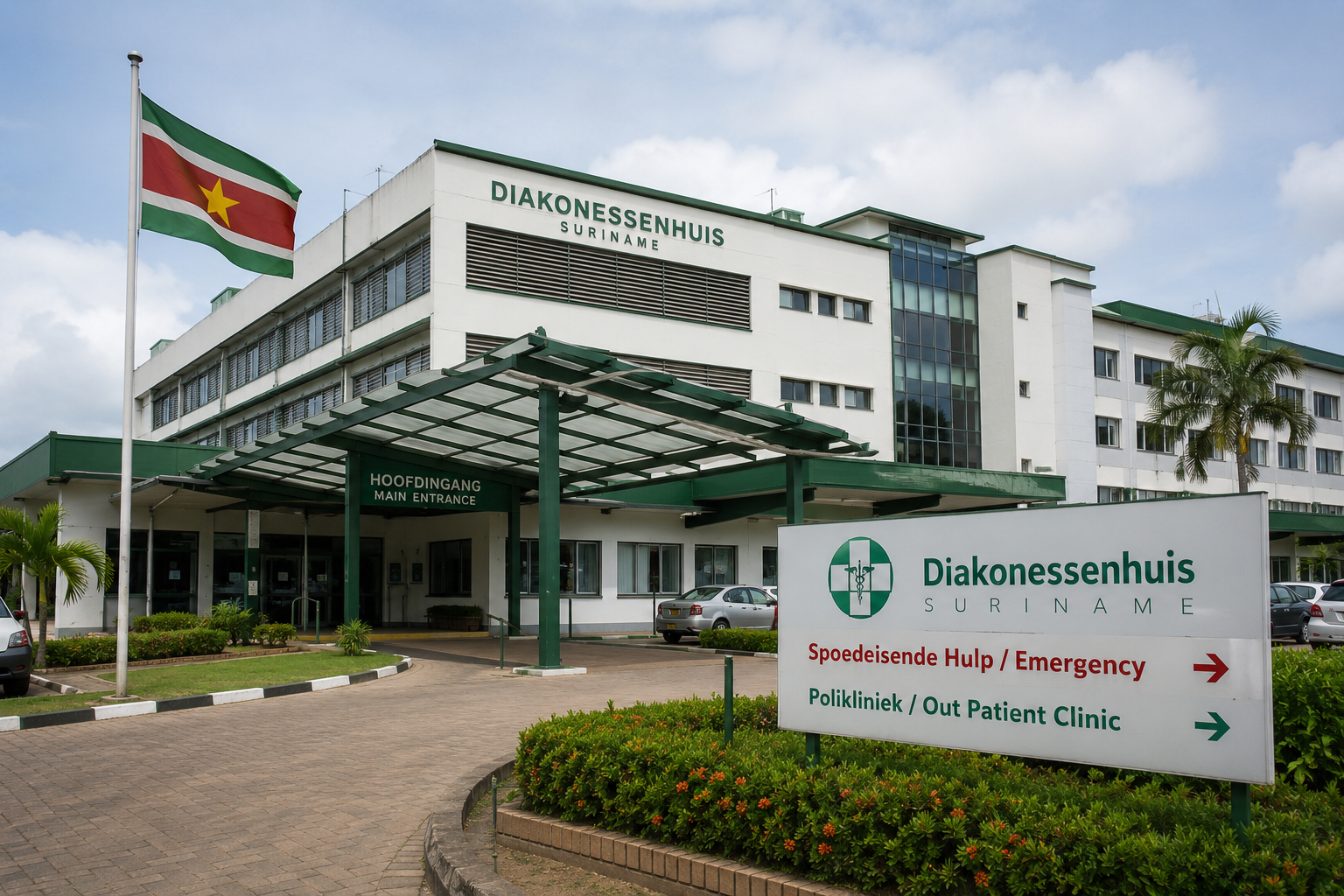
Healthcare is run by the Ministry of Health (Ministerie van Volksgezondheid). The system is reasonable for a small mainland country, with the major Paramaribo public and university hospitals handling most acute and specialist care, a network of regional hospitals and clinics in the coastal districts, and a Medical Mission (Medische Zending) network serving the Maroon and Indigenous communities of the interior. Complex care typically still means a medical-evacuation flight to the Netherlands, Trinidad, the US, Brazil or Colombia.
Main hospitals and facilities
- Academisch Ziekenhuis Paramaribo (AZP): the country’s principal academic teaching hospital, affiliated with the Anton de Kom University Medical Faculty. The principal location for surgery, maternity, paediatrics, A&E, and specialist outpatient clinics. The flagship Dutch-language teaching institution.
- Sint Vincentius Ziekenhuis (Paramaribo): the historic Roman Catholic-founded hospital, a major part of the public network.
- ’s Lands Hospitaal (Paramaribo): the older Government-managed public hospital.
- Diakonessenhuis (Paramaribo): the Moravian-Church-founded hospital.
- Regional hospitals: Lachmipersad Mungra Streekziekenhuis Nieuw Nickerie (the largest regional facility outside Paramaribo); Marwina Ziekenhuis Albina (Marowijne district).
- Medische Zending (Medical Mission): the country’s outstanding interior-health network, operating around 60 primary-care clinics across Sipaliwini, Brokopondo and the deeper Marowijne interior, providing free primary care to the Indigenous and Maroon communities.
- Private practices: a number of private GP, specialist and dental practices in Paramaribo, Zorg en Hoop, Tourtonne and Nieuw Nickerie.
- Medical Evacuation: standard referrals are to Dutch academic hospitals (Erasmus MC Rotterdam, AMC Amsterdam, LUMC Leiden), the Eric Williams Medical Sciences Complex / Mount Hope in Trinidad, Miami private hospitals, or Colombian and Brazilian tertiary centres. Med-evac flights are a real cost line; build them into your insurance.
For older returnees
If you are returning at retirement age, plan three things before you travel. Arrange comprehensive private health cover with strong medical-evacuation cover; for Suriname this is non-negotiable, particularly if you plan to live outside Paramaribo. Bring a full written record of your medical history and prescriptions; UK NHS summary care records can be requested through your UK GP before travel, and Dutch huisarts (GP) records through your existing huisarts in the Netherlands. And stock a 90-day supply of any critical long-term medication.
For complex specialist care (advanced cardiac, oncology, neurosurgery, advanced neonatal), Suriname’s standard referral pattern is the Netherlands in the first instance for the Dutch-language clinical environment and the historic Dutch-Surinamese medical relationship, and Trinidad, Miami, Bogotá or São Paulo for specific specialist needs. Diaspora returnees with active UK NHS entitlement often plan complex care in the UK on visits; verify your UK entitlement status with HMRC and your local Integrated Care Board before relocating. The Netherlands-Diaspora generation can typically retain Dutch zorgverzekering (basic health insurance) in specific circumstances for the first year of residency abroad; verify with the Sociale Verzekeringsbank (SVB) and Zilveren Kruis / CZ / Menzis or your current Dutch insurer before relocating.
Education and Schools
Education in Suriname is free and compulsory from age 6 to 12. The system is Dutch-modelled in structure: basisonderwijs (primary, 6 years), voortgezet onderwijs op juniorenniveau (junior secondary, VOJ), and voortgezet onderwijs op seniorenniveau (senior secondary, VOS) including academic-track VWO (pre-university) and HAVO. End-of-secondary qualifications are Dutch-equivalent: VWO diploma is broadly equivalent to UK A-level and the Dutch eindexamen-VWO; HAVO diploma is the intermediate track. Dutch is the language of instruction at all levels of mainstream schooling, which is a critical reality for UK-Diaspora returnee children whose first language is English. Sranan Tongo, Sarnami, Javanese and other heritage languages are used informally and in some bilingual community schools.
Well-regarded schools
- Primary and secondary public schools: a Dutch-modelled state school network across the ten districts. The Paramaribo and Wanica districts have the densest provision.
- Particularly well-regarded secondary schools: the Anton de Kom Lyceum and the Algemene Middelbare School (AMS) in Paramaribo, both VWO-level academic schools; the Mr Dr Jagernath Lachmonschool; the Henry Frans de Ziel Lyceum; the Don Boscoschool and the Stichting Onderwijs der Evangelische Broedergemeente (EBG, Moravian) schools; and the historic Hindostaanse vakopleiding network.
- International / private schools: the American Cooperative School of Paramaribo (English-language K-12 international school, US curriculum) is the principal English-language option and the most-common landing point for UK and US Diaspora returnee children, though placement and capacity are limited and waiting lists are real. A small Catholic English-Dutch bilingual track exists at certain private schools.
- Anton de Kom University of Suriname (AdeKUS): the country’s sole national university, located in Paramaribo. Faculties include Medical Sciences, Social Sciences, Technological Sciences, and Humanities. Affiliations with Dutch and Caribbean universities. The principal pathway for Surinamese tertiary study.
- Polytechnic College Suriname: applied-science HBO-equivalent tertiary education.
- Outbound pathways: the great majority of Surinamese sixth-form leavers historically progress to Dutch universities (the EUR Rotterdam, UvA and VU Amsterdam, Utrecht, Leiden, RUG Groningen and Maastricht being the most-common destinations), with smaller numbers going to UWI Cave Hill / Mona / St Augustine, UK universities, US institutions, and Canadian universities.
For UK Diaspora returning families with school-age children, the Dutch-language-only mainstream schooling is the single biggest practical hurdle on the Suriname page. UK-born children whose first language is English will typically need either intensive Dutch-language tuition (a "schakelklas" transition class is sometimes available in larger Paramaribo schools, but capacity is limited) or placement at the American Cooperative School of Paramaribo, which has the obvious English-curriculum advantage but at international-school fee levels (USD-priced, typically $12,000 to $20,000 per year per child). Netherlands-Diaspora returning families face a much smaller transition since their children are typically already in the Dutch system. Plan early.
Banking, Tax and Money
A few registrations matter for every returning resident settling in Suriname.
The tax picture, honestly
Suriname’s tax system follows the Dutch-civil-law model. Personal income tax is banded progressively from 8 percent (entry rate) to a top rate of 38 percent on higher incomes; non-residents are taxed on Surinamese-source income only. The country operates a turnover tax (BTW-equivalent) at a 10 percent standard rate. Corporate income tax is 36 percent. Property tax is administered by the Belastingdienst at modest rates. Stamp duty (Zegelrecht) applies on property transfers. The SRD floats against the USD; the CBvS publishes the daily reference rate.
Inheritance tax: an honest comparison with the UK and the Netherlands
This is one of the most important conversations for Diaspora returnees.
- The UK position: UK Inheritance Tax is currently 40 percent on the value of an estate above the nil-rate band of £325,000 (with an additional £175,000 residence nil-rate band where a main home passes to direct descendants, and full spouse exemption). Most middle-class UK estates with a home and pension are affected.
- The Netherlands position: Dutch erfbelasting (inheritance tax) applies at progressive rates depending on the relationship of the beneficiary to the deceased: spouses and children pay 10 percent (up to €152,368 in 2026) and 20 percent above, grandchildren 18 percent / 36 percent, and unrelated beneficiaries 30 percent / 40 percent. Substantial exemptions apply for spouses (€808,597 in 2026) and children.
- The Surinamese position: Suriname does not currently impose a separate inheritance tax on most estates in the Dutch civil law manner, though the inheritance regime is integrated with property transfer registration (Zegelrecht) and certain consumption-tax interactions on inherited assets. Confirm directly with the Belastingdienst before relying on this.
- The cross-border reality. The same caveat as for every other CARICOM country applies. UK Diaspora are typically UK domiciled (often deemed-domiciled by long UK residence) under HMRC rules, and Netherlands Diaspora are typically taxed on a worldwide-estate basis for the first ten years after departure from the Netherlands under the Dutch woonplaatsfictie (the so-called "ten-year rule" in successierecht). UK Inheritance Tax can bite on the worldwide estate, and Dutch erfbelasting can bite for ten years after departure, even after relocation to Suriname. Treat this as one of the most important conversations to have with a qualified UK tax adviser and / or a Dutch belastingadviseur before you go, alongside a Surinamese notaris (notary) and lawyer for the local Will.
Wills and estate planning
- Why it matters. Many UK and Dutch Surinamese Diaspora have a UK or Dutch Will that does not properly cover Suriname property, or no Will at all. On death this can throw the estate into intestacy across two or three jurisdictions, which is slow, costly and distressing for family.
- Suriname is a Dutch civil law jurisdiction. The Suriname Civil Code (the Burgerlijk Wetboek), descended from the 1838 Dutch Civil Code with significant 20th-century amendments, retains forced heirship (legitieme portie) rules for descendants. Children of the deceased are entitled to a fixed minimum portion of the estate, regardless of the terms of any Will. The detailed mechanics differ from the Netherlands (which substantially reformed its Civil Code in 2003) and from St Lucia (the only mixed common-law-plus-civil-law CARICOM jurisdiction). This is the single most important honest legal point on the Suriname page: do not assume a UK or Dutch Will alone will cleanly govern Suriname-situs land.
- Widely-recommended practice (not legal advice). Cross-border practitioners commonly recommend two or three Wills: a UK Will for your UK estate, a Dutch Will for your Dutch estate (the Diaspora majority), and a separate Suriname Will for your Suriname-situs assets, each containing language making clear it does not revoke the others, and the Suriname Will properly drafted in compliance with the Civil Code’s forced-heirship provisions. Use a notaris (notary) in Paramaribo; this is the Dutch civil law equivalent of an English solicitor and the standard professional for Will-drafting.
- The local rules. Inheritance is governed by the Suriname Burgerlijk Wetboek and supporting statute. Probate (de boedelafhandeling) is administered by the notaris together with the Belastingdienst. The Hof van Justitie (the High Court of Justice of Suriname) is the highest court; Suriname is not a member of the Caribbean Court of Justice in its appellate jurisdiction, and there is no further appeal beyond the Hof van Justitie.
- UK and Dutch Wills. A UK grant of probate or a Dutch verklaring van erfrecht obtained from the Netherlands does not automatically have effect on Suriname-situs land; the local notaris will need to open a separate Surinamese estate process. Confirm with a local notaris.
- Practical pointers. Name an executor in each jurisdiction. If the executor is not resident in Suriname, a local agent must be appointed via volmacht (Power of Attorney) to handle the estate. Review every five years or on a major life event. Tell your executor where the Wills are stored.
This is general information for orientation. Always speak to a qualified local notaris and a UK and / or Dutch tax adviser before drafting or relying on a Will.
The Government of Suriname offers customs concessions for returning nationals through the Customs and Excise Department. A Surinamese citizen returning after a qualifying period abroad may import household goods and effects (and, subject to conditions, a vehicle) with relief from some duty. The exact current qualifying period, eligible items and any cap on vehicle age and value are adjusted from time to time; confirm directly with the Customs and Excise Department (Douane) or via the Embassy of Suriname in The Hague before you ship anything.
Work and Business
As a Surinamese citizen, by birth, descent or naturalisation, you can live and work in Suriname without a work permit. Non-citizen non-CARICOM nationals require a work permit issued by the Ministry of Labour. Non-Surinamese CARICOM nationals can move under the CSME Skills Certificate regime in the 13 eligible tiers.
The main sectors
Suriname’s economy is dominated by the extractive sector: gold (the country’s largest current export, with the Newmont Merian mine and the Zijin Mining Rosebel mine as the principal regulated operators, plus a substantial small-scale gold-mining sector that the Geerlings-Simons government has signalled an intention to bring more fully into the tax base), and the soon-to-arrive offshore oil sector (the TotalEnergies GranMorgu project, a $10.5 billion deepwater development jointly with APA Corporation and Staatsolie Maatschappij Suriname, with first oil expected in 2028 at approximately 220,000 barrels per day from an estimated 700 million barrels of recoverable reserves; Petronas, Shell, Chevron and PetroChina are also active in Surinamese offshore concessions). Suriname is at the front of one of the world’s most-watched oil frontiers, sharing the Suriname-Guyana basin with Guyana’s already-producing Stabroek block. Other major sectors: agriculture (rice in Nickerie, bananas, vegetables, the historic plantation crops; the Mesopotamia-equivalent Surinamese rice belt is one of the largest in the wider Caribbean), bauxite and aluminium (historically dominant, now meaningfully diminished after the Suralco/Alcoa closure in 2017), fisheries (notably shrimp), tourism (the UNESCO Paramaribo Historic Inner City, the Brokopondo Reservoir, the Brownsberg Nature Park, the Marowijne River, the Sipaliwini rainforest interior, eco-lodge tourism), and international financial services. Hosts the inaugural Caribbean Energy Week 2026 under President Geerlings-Simons’ auspices.
Starting a business
New businesses register through the Kamer van Koophandel en Fabrieken (KKF, Chamber of Commerce). The Suriname Business Forum (SBF) is the principal business-coordination platform.
The Diaspora returnee opportunity in Suriname is particularly strong in three areas: oil-and-gas-adjacent services (the GranMorgu project alone will generate billions of dollars of services demand over 2026-2030, in logistics, accommodation, legal, accounting, engineering, drilling-services support, environmental and the entire upstream-services ecosystem; Dutch-language and English-language skill is a meaningful advantage), professional services (legal, notarial, accountancy, real-estate advisory, particularly around the post-IMF macroeconomic and oil-revenue transition), and creative industries and Dutch-Surinamese cultural exchange (Paramaribo has an active arts scene, the Bijlmer connection in Amsterdam is one of the strongest Caribbean-European cultural arteries in the world, and the music, food and design sectors all have considerable Diaspora opportunity). The trade-off is the same honest one: a small consumer market and a high cost of imports limit pure retail and consumer-goods business plans.
Driving and Transport 4-Region
Suriname drives on the left, the same as the UK, Guyana, and very few other countries in the Americas. Indeed, Suriname and Guyana are the only two sovereign countries in continental South America that drive on the left, a Dutch-colonial-era inheritance (the Dutch themselves switched to right-hand driving after the Napoleonic occupation, but their colonies including Suriname and Indonesia retained left-hand driving). Steering wheels are on the right. The road network on coastal Suriname is the standard mainland coastal pattern, with the East-West Link / Oost-West Verbinding running the full length of the coast from Albina (Marowijne, on the French Guiana border) through Paramaribo to Nieuw Nickerie (on the Guyana border), and the Desiré Delano Bouterse Highway (opened 15 May 2020) being the country’s first motorway, running 9.6 km from the eastern outskirts of Paramaribo to the John F. Kennedyweg near the airport. The country’s main international airport is Johan Adolf Pengel International Airport (PBM) at Zanderij in Para district, around 45 km south of Paramaribo (about 45 minutes on the Bouterse Highway).
The most honest point about Suriname for the UK Diaspora: there are no direct UK flights to Suriname. Connections are typically via Amsterdam Schiphol on KLM (the principal long-haul carrier serving the country, with daily AMS-PBM service taking around 9-10 hours each way), or via Trinidad (Port of Spain) on Caribbean Airlines, or via Belem and São Paulo on LATAM, or via Aruba and Curaçao on Surinam Airways. Surinam Airways (SLM) is the national flag carrier and operates the AMS-PBM service jointly with KLM and a regional Caribbean network. From the UK, the standard routing is London (Heathrow) to Amsterdam on KLM or BA, then Amsterdam to Paramaribo on KLM or SLM, total transit 14 to 18 hours including layover.
| Licence held | How it works | Where | Cost |
|---|---|---|---|
| UK licence | Visitors can drive on a UK licence for the duration of their visa-on-arrival or short-stay permission. For residence, conversion to a Surinamese licence is needed. | Centraal Bureau voor Rijvaardigheidsbewijzen (CBR-equivalent) / Korps Politie Suriname | Conversion fee ~SRD 700 to 1,500 (~$20 to $45 USD) |
| Netherlands licence | Conversion to Surinamese licence following residency registration. The Dutch-Surinamese reciprocity makes this the easiest conversion path. | As above | As above |
| US licence | Visitors can drive short-term; conversion required for residence. | As above | As above |
| Canadian licence | Visitors can drive short-term; conversion required for residence. | As above | As above |
For residence, you will convert to a full Surinamese driver’s licence through the Korps Politie Suriname (KPS). Public transport is by privately-run minibus (the well-known Suriname "lijnbussen" running fixed routes through Paramaribo and the coastal districts) and private taxi. Inter-district transport into Sipaliwini and Brokopondo is by 4x4, river boat, or small aircraft, and is meaningfully more arduous than coastal travel.
Bringing your pet
Cats and dogs can be brought to Suriname with proper paperwork. Current requirements typically include an import permit from the Veterinary Services Division of the Ministry of Agriculture, Animal Husbandry and Fisheries (LVV), microchip identification, current rabies vaccination with serology test post-vaccination, and a veterinary health certificate issued shortly before travel. The UK and the Netherlands are generally approved-origin countries. Confirm the exact current requirements directly with the LVV Veterinary Services Division well before travel.
Internet and Connectivity
Connectivity in Suriname is among the better mainland Caribbean markets. The country is served principally by Telesur (Telecommunicatiebedrijf Suriname), the publicly-owned national telecoms operator that is the historic incumbent, and Digicel Suriname, the challenger. Both operators offer fibre and cable broadband across Paramaribo, Wanica, Commewijne, Para and the rest of the coastal belt, with consumer speeds typically 100 to 500 Mbps in Paramaribo and the suburban districts.
Mobile is 4G LTE across all populated coastal areas; 5G has begun rollout in Paramaribo through 2024-2025 and is expanding through 2026. Standalone broadband typically runs from SRD 700 to 1,800 per month (around US $20 to $50). Interior coverage (Sipaliwini, deep Brokopondo) is much more limited and is the principal use-case for Starlink.
Starlink became available in Suriname in 2024 and is widely used by Maroon and Indigenous communities in the interior, by gold-mining operations in Sipaliwini, by eco-lodges in Brownsberg and the Marowijne, and as a resilience layer in coastal hurricane-disruption rare events. Power supply via EBS (Energiebedrijven Suriname, the national power utility) is generally reliable in the coastal districts; the country has one of the highest hydroelectric shares in the wider region thanks to the Brokopondo Reservoir / Stuwmeer (one of the world’s largest artificial lakes by surface area).
Safety: The Honest Picture
The UK FCDO publishes standard precautions for Suriname, with no specific travel restriction. The US State Department rates Suriname at Level 1 ("Exercise Normal Precautions") in its travel advisory, the lowest of the four levels. Tourist areas (UNESCO central Paramaribo, the Tourtonne and Zorg en Hoop residential belts, the Brokopondo Reservoir lodges, the Brownsberg Nature Park, the Commewijne plantations, the Marowijne riverside) are generally safe. The Korps Politie Suriname (KPS) has community police on tourist routes and the major Paramaribo neighbourhoods.
The honest picture: Suriname’s national homicide rate is meaningfully lower than the OECS small-state average, but petty crime (pickpocketing, opportunistic theft, vehicle break-ins) is real, particularly in central Paramaribo at night and around busy markets. The interior districts (Sipaliwini, parts of Brokopondo and Marowijne) include areas of informal gold-mining (porknokker) activity, particularly along certain rivers and in remote locations, with associated mercury-pollution and informal-settlement concerns; treat the interior with the same situational awareness you would treat the Guyana interior. The land borders with French Guiana (Albina, on the Marowijne River) and Guyana (Nieuw Nickerie, on the Corantijn River) have some informal cross-border smuggling, but normal travellers are not affected.
Environmental risks: Suriname is at low hurricane risk (south of the standard Atlantic corridor) and is not on a major earthquake fault. The principal natural-risk factors are seasonal flooding (major wet season May-August, minor wet season November-January) and the vast interior accessibility limitations. Suriname’s position outside the hurricane corridor is one of its most-distinctive practical advantages for return: a real reduction in insurance cost and infrastructure-disruption risk compared to the OECS island states.
Suriname is one of the safest mainland Caribbean countries on the UK FCDO and US State Department metrics, with a homicide rate that compares favourably to most CARICOM peers. The honest local point: petty crime in central Paramaribo at night is real, and the deep interior is genuinely remote. Coastal Paramaribo and the inner suburbs (Zorg en Hoop, Tourtonne, Elisabeths Hof, Geyersvlijt) report very high day-to-day safety. The Sipaliwini interior, the gold-mining belt and the French Guiana / Guyana land borders deserve the standard mainland Caribbean situational awareness.
Before you travel, check the official FCDO travel advice for Suriname.
Diaspora Missions, Netherlands and UK Association and Community 4-Region
The country’s diplomatic and Diaspora representation, plus the community channels you can plug into. Suriname is unusual in this guide in that the primary Diaspora is in the Netherlands, not the UK: around 350,000 Surinamese-Dutch people (more than half the home population of Suriname) form one of the largest Caribbean Diasporas in Europe, concentrated in Amsterdam (particularly the famous Bijlmer / Bijlmermeer district in Amsterdam Zuidoost), Rotterdam (the Afrikaanderwijk and Feijenoord districts), The Hague (Schilderswijk and Transvaal), Utrecht (Kanaleneiland and Overvecht), and Almere. The UK Diaspora is smaller and more dispersed.
Netherlands Diaspora Associations
The Netherlands Surinamese Diaspora is the country’s primary international community and has multiple deep-rooted organisations:
- Stichting Eer en Herstel Betalingen Slachtoffers van Slavernij in Suriname, the principal historic-reparations and slavery-legacy organisation.
- Surinaamse Vereniging in Nederland, the umbrella body for Surinamese-Dutch community organisations.
- Vereniging Ons Suriname (Amsterdam), the historic and continuing Surinamese-Dutch community centre.
- Bijlmer-anchored community networks: the Amsterdam Zuidoost Diaspora is the densest single Surinamese community outside Paramaribo and has dozens of cultural, religious and welfare associations.
- Hindostaanse, Javaanse, Kreoolse, Marron and Inheemse community associations in each major Dutch city reflect the diverse ethnic composition of the home country and operate parallel community structures.
- Sranan Tongo language and culture promotion organisations across the Netherlands, with significant Dutch academic engagement (the University of Leiden, the University of Amsterdam, Erasmus University Rotterdam).
UK Diaspora Associations
The UK Surinamese Diaspora is small but distinct, concentrated in London (particularly the wider South East with cross-pollination through the Dutch Diaspora), with smaller communities in the West Midlands and the South East. Major UK contacts include:
- Surinamese community in London: smaller informal community networks, often overlapping with the Dutch-speaking community at the Netherlands Embassy in London (38 Hyde Park Gate, SW7 5DP).
- The wider British-Caribbean networks (the British Caribbean Association, Voice Newspaper, the Caribbean & African Health Network) include some Surinamese members but the country is not their primary focus.
- Pan-Caribbean Diaspora groups, including the Amsterdam-anchored Bijlmer community networks, often serve as the practical hub for UK Surinamese travellers and emigrants given the proximity and the Dutch-language ease.
Facebook Groups and Pages
Where the Netherlands and UK Diaspora can plug into Surinamese community life online. A curated list, not exhaustive:
- Government of Suriname and Cabinet of the President, central Government pages.
- Suriname Tourism Foundation, the official tourism page.
- De Ware Tijd, Times of Suriname, Starnieuws, Suriname Herald, and Waterkant, the leading Dutch-language Surinamese news outlets (Waterkant in particular has a large Netherlands-Diaspora readership).
- Vereniging Ons Suriname, the principal Amsterdam Diaspora page.
- Surinaamse Vereniging in Nederland, the principal Dutch umbrella.
- Bijlmer Suriname community pages, the Amsterdam Zuidoost neighbourhood network.
- Sranan Tongo language and culture groups, the principal preservation networks for the lingua franca.
Not sure where to start?
Map your move with the Relocation Intelligence Calculator: your citizenship eligibility, budget and timeline, costed clearly.
Your First Steps
- Confirm your citizenship route. For UK-born or Netherlands-born children of Surinamese parents, the descent route through the Central Civil Registry (Centraal Bureau voor Burgerzaken) is the standard path; Suriname does not run a CBI programme.
- If you previously naturalised as British, Dutch, US or Canadian as an adult, verify directly with the Embassy of Suriname in The Hague whether you have retained your Surinamese citizenship or whether you have automatically lost it under the Nationality and Residency Act. This is critical and is one of the most-misunderstood points in the Surinamese-Dutch Diaspora.
- Choose your settlement: Paramaribo central or Tourtonne / Zorg en Hoop / Elisabeths Hof for working-age convenience; the Lelydorp / airport corridor for affordability; Commewijne for space; Nieuw Nickerie for the western rice-belt working-age option; the interior districts only if you have specific livelihood or community ties.
- Register with the Sociale Verzekeringsbank and the Belastingdienst for a Fiscaal Nummer (FIN) on arrival.
- Arrange comprehensive private health cover with strong medical-evacuation cover (Netherlands / Trinidad / Miami / Bogotá). Bring full medical records (UK NHS or Dutch huisarts) and at least 90 days of any critical prescriptions.
- Speak to a qualified Surinamese notaris (notary) about a Suriname Will to sit alongside any UK or Dutch Will. The Dutch civil law forced-heirship (legitieme portie) regime is the most important honest legal point on the page: do not assume your UK or Dutch Will alone will cleanly govern Suriname-situs land.
- If you are buying property, do a full Glis title search through the Land Registry. Verify any heritage-protection requirements with the District Commissioner’s office or the Stichting Gebouwd Erfgoed Suriname if the property is in the UNESCO Historic Inner City of Paramaribo.
- Confirm Returning Resident customs concessions directly with the Customs and Excise Department (Douane) before you ship anything.
- For school-age children, confirm an educational pathway early: Dutch-language mainstream school with optional schakelklas Dutch-language transition support, or the American Cooperative School of Paramaribo (English curriculum, USD-priced fees, limited capacity).
- Plan your air route: KLM Amsterdam to Paramaribo (PBM) is the principal long-haul gateway. From the UK, expect to transit Amsterdam. From the US, Surinam Airways and Caribbean Airlines via Miami and Trinidad.
- Run your numbers through the Relocation Calculator and plan your shipping with the 2026 Shipping Bible.