🇭🇹 Moving to Haiti from the UK
Haiti occupies the western third of Hispaniola, sharing the island with the Dominican Republic. The world’s first Black republic and the second-oldest in the Americas, independent on 1 January 1804.
This is the most difficult country to write a relocation guide about anywhere in the project. Haiti is in the middle of a profound and well-documented political and security crisis: there has been no elected President since the assassination of Jovenel Moïse on 7 July 2021, the Transitional Presidential Council that ran the country from April 2024 was dissolved on 7 February 2026, and Prime Minister Alix Didier Fils-Aimé now heads an interim government tasked with delivering the country’s first elections since 2016. Gang violence is severe in Port-au-Prince. The UK Foreign Office currently advises against all travel to Haiti, and the US State Department rates the country at Level 4 ("Do Not Travel"). Drop Da Pin will not pretend otherwise. For the Haitian Diaspora in the UK, US, Canada and France, this guide gives you what you need to think honestly about return: citizenship, land, healthcare, the civil-law inheritance system that is fundamentally different from the UK, and the practical first steps for the time when conditions allow. Haiti is more than its current crisis. It is the country that defeated Napoleon’s armies and ended chattel slavery for itself in 1804, the home of Vodou, Konpa, and one of the world’s deepest oral and visual cultures. The Diaspora carries that. So does this guide.
Identity and Culture
Before the practicalities, this is the place. Its symbols, its sound, its flavour. Haiti is a profoundly distinctive country: French and Haitian Creole (Kreyòl) are the official languages (Kreyòl alone is universally spoken; French is the language of administration, education and law and is spoken by an estimated 10 to 40 percent of the population). The country’s religious landscape is layered: Roman Catholicism, a strong Protestant evangelical presence (around 30 percent), and Vodou (formally recognised as a state religion in 2003), with most Haitians comfortable holding more than one tradition at a time. The population is overwhelmingly Afro-Haitian, with smaller mulatto, Levantine, French and Dominican communities.
National Flag
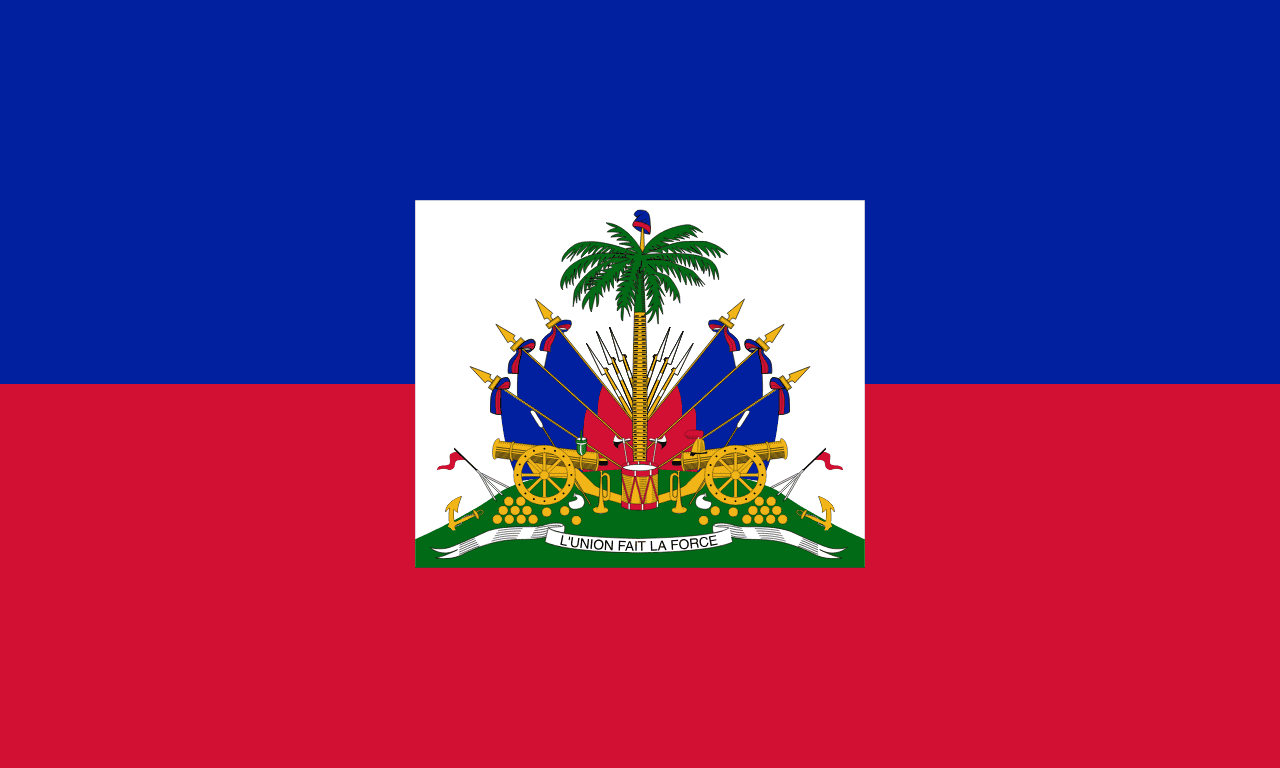
Two horizontal bands, blue over red, designed in 1803 when Jean-Jacques Dessalines tore the white stripe from the French tricolour at the Congress of Arcahaie and Catherine Flon stitched the remaining blue and red bands back together. At the centre, a white panel with the coat of arms: a royal palm topped with the Cap of Liberty, six furled flags, two cannons and the motto. The flag in this form was adopted in its current shape in 1986 after the fall of the Duvalier dictatorship.
Coat of Arms
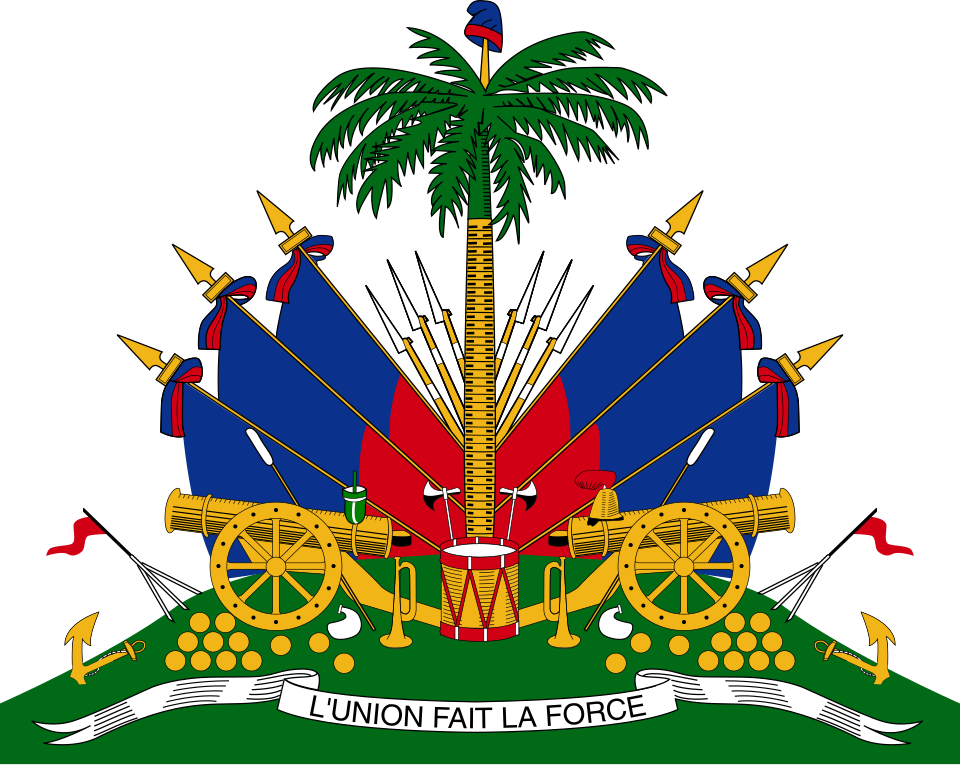
A royal palm topped by a Phrygian cap of liberty, surrounded by drums, cannons, bugles, anchors, bayonets, fasces and six furled national flags, with the motto on a scroll below. Symbols of the 1791-1804 revolution and of preparedness to defend independence.
National Motto
"L’Union Fait La Force." Kreyòl: "Inite Se Fòs." English: "Unity Makes Strength." The motto adopted at independence in 1804 and at the heart of the Haitian national project.
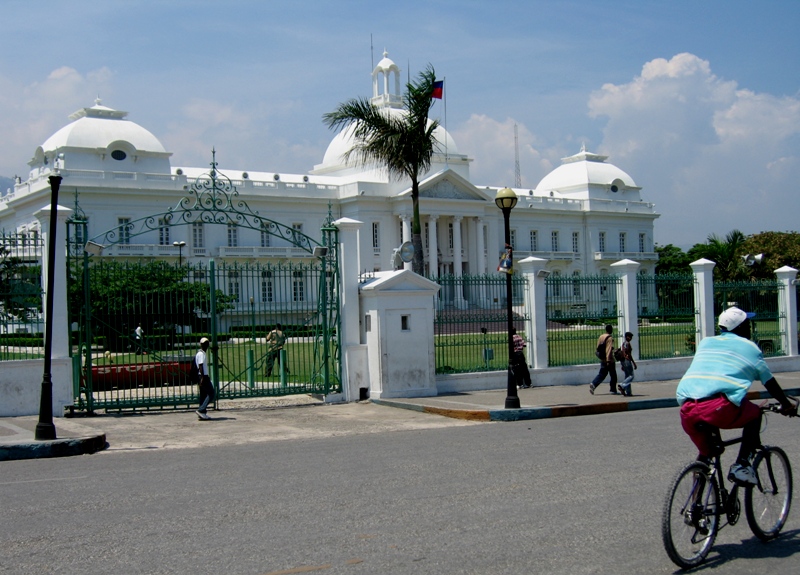
Seat of Government
National Anthem
"La Dessalinienne," lyrics by Justin Lérisson, music by Nicolas Geffrard. Adopted 1 January 1904, the centenary of independence. Honours the founder of the nation, Jean-Jacques Dessalines.
National Dish
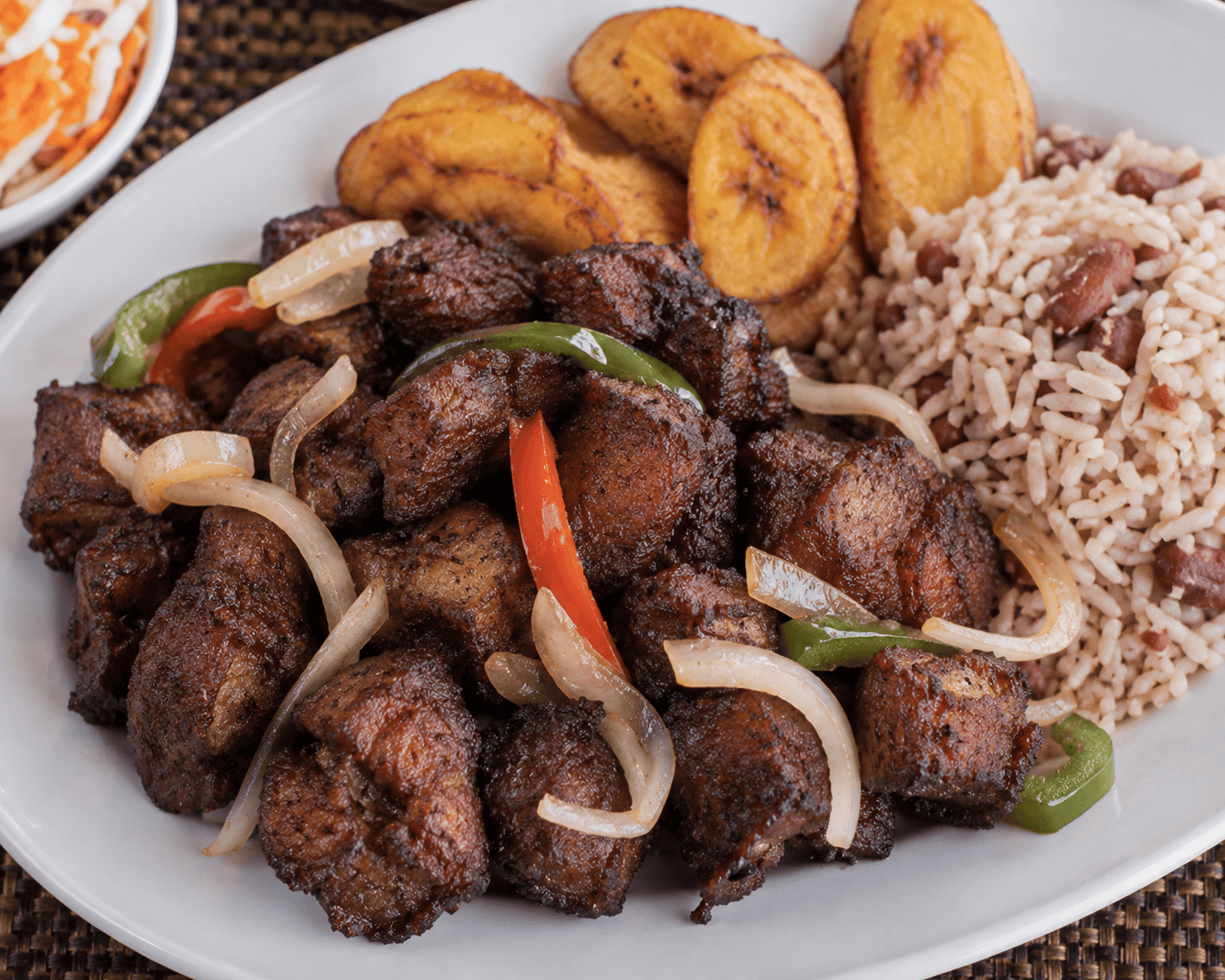
Diri ak Djon-Djon (black-mushroom rice), often considered the country’s signature dish, made with the unique dried djon-djon mushroom that grows only in northern Haiti. Soup Joumou (pumpkin soup) is the national independence dish, traditionally eaten every 1 January to mark the day Haitians could finally eat the soup that had been forbidden to enslaved people under French rule. Other staples: griot (marinated fried pork), bannann peze (smashed plantain), pikliz (the country’s spicy pickled-vegetable condiment), akra (malanga fritters) and tassot (fried beef).
Did You Know
Haiti is divided into 10 departments (not parishes or regions): Ouest (West, capital Port-au-Prince, the most populous); Sud-Est (South-East, Jacmel); Nord (North, Cap-Haïtien, the country’s second-largest city and the historic capital under King Henri Christophe); Nord-Est (North-East, Fort-Liberté); Artibonite (centre-west, Gonaïves, where independence was proclaimed in 1804); Centre (Hinche); Sud (South, Les Cayes); Grand’Anse (south-western tip, Jérémie); Nord-Ouest (North-West, Port-de-Paix); and Nippes (south-west coast, Miragoane, created in 2003, the youngest department). Each department is administered by a Deputy and divided into communes (municipalities) and sections communales. Haiti has roughly 1,535 kilometres of coastline; the country’s best-known beaches are at Labadee (a private resort lease on the Nord coast), Jacmel (Sud-Est), Île-à-Vache (off Les Cayes) and Côte des Arcadins (Ouest department, north of the capital). Honest note: many of these have been off-limits to international tourism since 2021.
Country Code: the 509
+509. Haiti is one of only four CARICOM countries outside the +1 North American Numbering Plan (with Belize +501, Suriname +597, Guyana +592). Across the Caribbean and the Diaspora, many Haitians identify themselves simply as "the 509," after the country’s telephone code. You will hear it at Karnaval in Jérémie and Jacmel each February, on Konpa-night WhatsApp groups, on independence-day flag celebrations every 18 May, and at any Haitian gathering in Brooklyn, Little Haiti in Miami, Montréal, Paris, or the smaller UK Haitian community in north London. Saying "I’m from the 509" is saying "I’m from home."
Leadership: Who Runs the Country
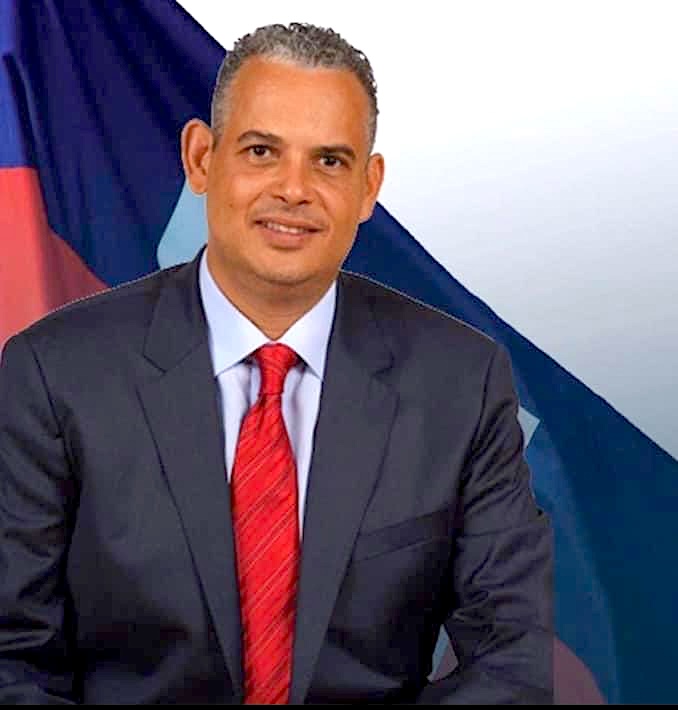
Haiti is constitutionally a semi-presidential republic under the 1987 Constitution (as amended in 2012), in which the President is Head of State and a Prime Minister is Head of Government. In practice, the country has been in an extended constitutional crisis since the assassination of President Jovenel Moïse on 7 July 2021. There has been no elected President since that day. The transitional governance arrangements set out below are what is in place as of May 2026.
Citizenship and Passport Eligibility 4-Region
For the Haitian Diaspora the citizenship picture is more favourable than recent media coverage suggests. Haiti formally recognised dual citizenship in the 2012 constitutional amendments (Article 11 amended in 2011, in force 2012), the descent rules are generous, and a Haitian passport carries CARICOM membership without CSME free-movement complications.
The routes, honestly
- By descent through a parent, the standard Diaspora route. Any person born to a Haitian father or mother (who themselves were Haitians of origin and not naturalised) is Haitian by origin (Article 11 of the Constitution as amended in 2012). This applies regardless of place of birth.
- Dual citizenship explicitly permitted since the 2012 constitutional amendments. Haitians by origin do not lose their nationality by holding another. Naturalised Haitians cannot generally hold dual nationality.
- By marriage, available to the foreign spouse of a Haitian citizen after a qualifying period of residence.
- By naturalisation, possible after a qualifying period of legal residence and good standing.
- By investment. Haiti does not currently run a Citizenship by Investment programme. Treat any third-party claim that Haiti has an active CBI route with caution.
Haiti joined CARICOM as a full Member State in 2002, but its participation in the CARICOM Single Market and Economy (CSME) is partial. Haiti does not participate in the CSME’s free movement of persons regime, and is also outside the October 2025 four-country Enhanced Full Free Movement pilot (Barbados, Belize, Dominica, SVG). In practice, Haitian nationals travelling to the rest of CARICOM still face the standard visa or entry-permit requirements of each receiving country; the CARICOM Skills Certificate process is not the same path for Haitians as it is for, say, Barbadian or Jamaican nationals.
This is set against a wider story of intra-CARICOM displacement: Haitian migration to the Bahamas, Turks and Caicos, the Dominican Republic and the wider region has been one of the defining humanitarian issues for CARICOM in recent years, and CARICOM has played a central role in convening political dialogue and coordinating the response to the security crisis.
Where to apply, by region
| From | Where to enquire |
|---|---|
| United Kingdom | Embassy of Haiti, Upper Brook Street, London W1. Ambassador H.E. Anaïse Manuel (the first Haitian woman appointed Ambassador to the UK). Web: haitianembassy.uk. Covers the UK, Ireland and several European postings. |
| USA | Embassy of Haiti, Washington D.C. Consulates-General in Miami (the country’s largest overseas mission, serving the very large Little Haiti and South Florida community), New York, Boston, Chicago, Atlanta and Orlando. Honorary Consuls in additional US cities. |
| Canada | Embassy of Haiti, Ottawa. Consulate-General in Montréal (serving the very large Québec Haitian community, the second-largest Haitian Diaspora in the world). Consulate-General in Toronto. |
| France and Europe | Embassy of Haiti, Paris (serving the largest European Haitian Diaspora). Embassy of Haiti to the Holy See (Rome). Embassy of Haiti to the European Union (Brussels). Honorary Consuls in Madrid, Berlin and other capitals. |
| In Haiti | Direction de l’Immigration et de l’Émigration, Ministry of the Interior, Port-au-Prince; for births and registrations, the Office National d’Identification (ONI). |
For descent applications, the long-form Haitian birth certificate (acte de naissance) of your Haitian parent is essential, properly Apostilled if issued abroad. Be prepared for documents in French rather than English; certified translations are commonly required. Names and dates must match across generations; differences in spelling between French and Kreyòl versions of a name are common and may require an Affidavit (acte de notoriété) before a notary. The Office National d’Identification (ONI) and the Archives Nationales in Port-au-Prince hold civil-status records; processing times and access can be slower than in many other CARICOM jurisdictions.
Cost of Living 4-Region
An honest monthly comparison: your home city versus life in Haiti, in your own currency. Headline numbers do not capture the full picture. Haiti is among the least expensive countries in the Americas for local goods, services and rent, but private security, generator-powered electricity, imported food, private healthcare and the cost of mobility (private driver, hardened vehicle, charter flights in and out) all add substantially to what a returnee will actually spend, particularly in Port-au-Prince.
| Monthly expense | London £ | New York $ | Toronto C$ | Haiti (USD equivalent) |
|---|---|---|---|---|
| Rent, 1-bed local-standard, secondary cities (Cap-Haïtien, Les Cayes, Jacmel) | £2,000 | $3,800 | C$2,400 | ~$200 to $500 USD |
| Rent, 1-bed expat-standard, Port-au-Prince (Pétion-Ville, Kènscoff) | £2,300 | $4,200 | C$2,800 | ~$900 to $2,500 USD |
| Generator fuel and private water (Port-au-Prince), monthly | n/a | n/a | n/a | ~$200 to $600 USD |
| Private security (driver, gatekeeper, guards), monthly | n/a | n/a | n/a | ~$500 to $2,000 USD |
| Single person, modest lifestyle outside Port-au-Prince (all in) | £3,000 | $4,800 | C$3,800 | ~$1,000 to $1,800 USD |
| Couple, comfortable lifestyle Port-au-Prince with security (all in) | £3,800 | $6,500 | C$5,200 | ~$3,500 to $7,000 USD |
| TCA (Turnover Tax) on most goods and services | 20% | Varies | 13% | 10% |
Haiti is genuinely cheap on local goods (markets, transport, school fees) and the Gourde’s depreciation has lowered the USD cost of local rent. But the practical cost of operating safely in Port-au-Prince in 2026 (private security, generator power and fuel, water delivery, premium private healthcare, charter air mobility for travel outside the metropolitan area) makes the total monthly outgoing for a Diaspora returnee meaningfully higher than the headline rent numbers suggest. Outside Port-au-Prince (Cap-Haïtien, Jacmel, parts of Sud) the picture is closer to the local-cost figure.
Housing and Property
As a Haitian citizen you can buy and own land and property freely. Non-Haitians can also buy with some restrictions on agricultural land. Property is held under the French civil-law system, registered through the Direction Générale des Impôts (DGI) and notarised by a notaire. A proper title search is essential, particularly for inherited land where succession may not have been formally registered across generations (a common issue across Diaspora families). Title insurance is recommended.
Where Diaspora returnees tend to settle
- Port-au-Prince and Pétion-Ville (Ouest department): Pétion-Ville, Kènscoff, Thomassin, Vivy-Mitchell, Delmas 75/95 and Frères are the established middle-class and Diaspora-returnee neighbourhoods, generally on higher elevations south and east of central Port-au-Prince. Central Port-au-Prince, Cité Soleil, Carrefour and much of the lower city have been seriously affected by gang control since 2023 and are not realistic relocation options for most Diaspora at this time.
- Cap-Haïtien (Nord department), the country’s second city, ~280 km north of Port-au-Prince. Historic colonial port, gateway to the Citadelle Laferrière, traditionally calmer than the capital. A meaningful number of returnees have chosen Cap-Haïtien as the practical base for return since 2023; Hugo Chávez International Airport (CAP) has direct flights from Miami and the Turks and Caicos.
- Jacmel (Sud-Est department), the cultural and arts capital, on the south coast, ~80 km from Port-au-Prince. Carnival, paper-maché, the Jacmel Film Festival, a long-established artistic Diaspora and a small expat community.
- Les Cayes and Île-à-Vache (Sud department), the southern provincial centre, badly affected by Hurricane Matthew in 2016 and the 14 August 2021 earthquake but recovering. Île-à-Vache is a small Caribbean island off the south coast.
- Gonaïves (Artibonite department), the city where Haitian independence was proclaimed on 1 January 1804. Important to the national memory; historically vulnerable to flooding.
- The Diaspora-rural pattern. A real share of Diaspora returnees plan a "two-base" return: a modest home in the family’s ancestral commune (often in the Nord, Sud or Nippes), and a working base in either Port-au-Prince, Cap-Haïtien or Miami. This is a realistic pattern given the current security picture.
Haiti is in the Atlantic hurricane corridor and on the boundary of the Caribbean and North American tectonic plates. Hurricane Matthew (Cat 4, 4 October 2016) devastated the south-west. The 12 January 2010 earthquake killed an estimated 220,000 to 300,000 people and remains the most lethal natural disaster in the modern history of the Americas; the 14 August 2021 earthquake (Magnitude 7.2) killed around 2,200 in the south, just one month after the assassination of President Moïse. Building back to seismic and hurricane standards is a real consideration in any property purchase or renovation. Verify any property’s construction date and post-2010/2021 retrofit status before you commit.
Healthcare
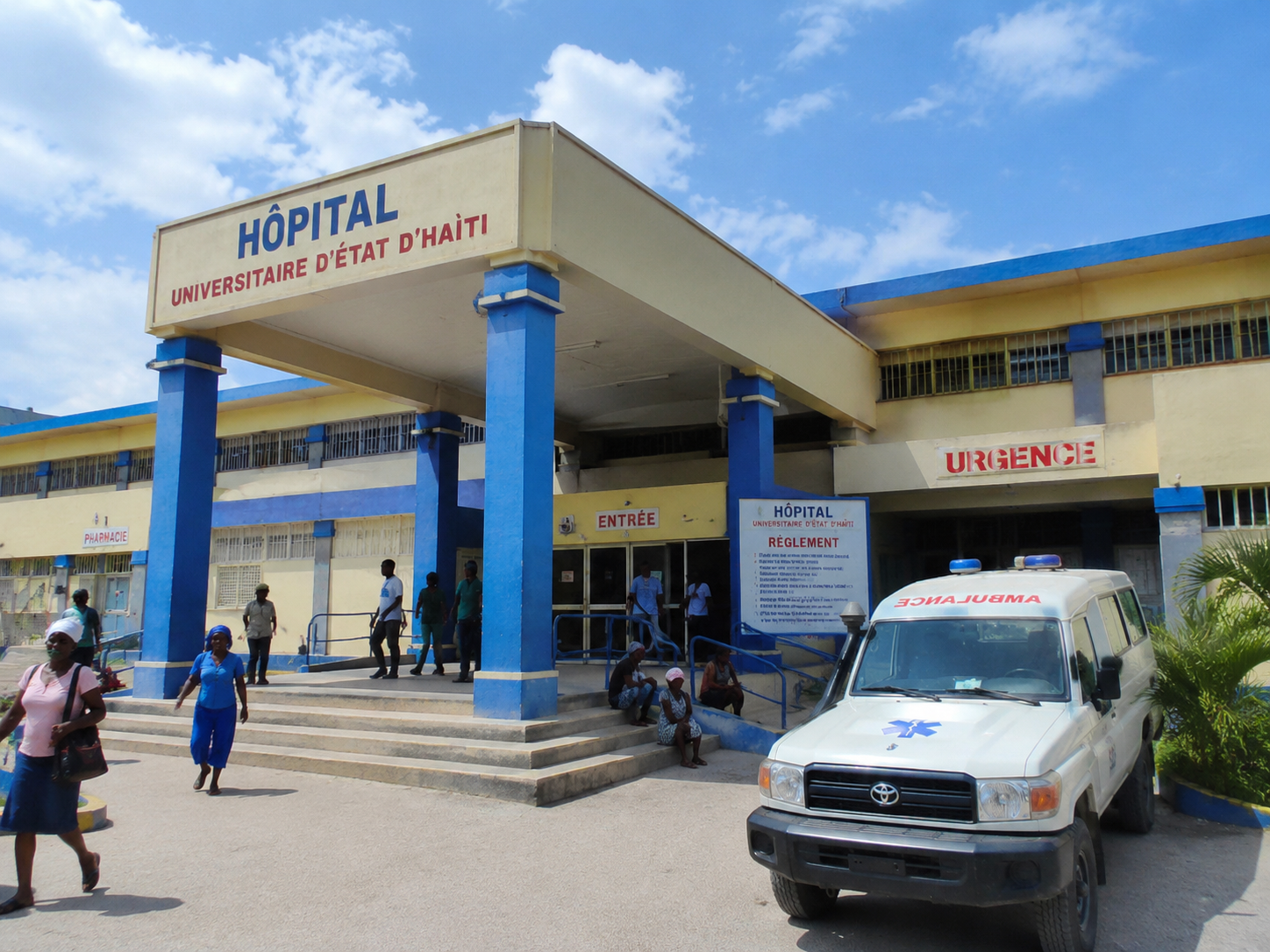
Healthcare in Haiti is genuinely stretched, and frank planning is essential. The public hospital network is underfunded, understaffed and has been further weakened by gang activity in Port-au-Prince since 2023. Many Haitian Diaspora returnees rely on a mix of private clinics, charity-run hospitals and medical evacuation. Most complex care requires travel out of the country, typically to Miami (the largest medical option), Santo Domingo (a 2-hour flight or 8-hour drive), or Havana.
Main hospitals and facilities
- Hôpital de l’Université d’État d’Haïti (HUEH), Port-au-Prince: the country’s largest public hospital and main teaching hospital, in central Port-au-Prince. Operations have been disrupted by the security situation and HUEH suspended services in early 2024 after gang attacks before partially reopening; verify current status before relying on it.
- Hôpital Bernard Mevs (Port-au-Prince), Hôpital du Sacré-Cœur de Milot (Nord, the leading hospital in the north of the country, established by the CRUDEM Foundation), Hôpital Saint-Damien (paediatric, Tabarre), Hôpital Bienfaisance de Pignon (Centre), Hôpital Sainte-Thérèse (Hinche): leading hospitals in the broader private and charity-supported network. Partners In Health (Zanmi Lasante) operates a substantial regional hospital network in the Plateau Central with international support.
- Private clinics in Pétion-Ville (Clinique du Cap, Clinique CDTI, Hospital Bernard Mevs and others): the natural first stop for many returnees with private cover, particularly for primary and routine specialist care.
- Université Notre-Dame d’Haïti and Université d’État d’Haïti medical schools train the country’s doctors; many medical professionals have emigrated to the US and Canada in recent years.
For older returnees
If you are returning at retirement age, plan four things before you travel. Arrange comprehensive private health cover with strong medical-evacuation cover before arrival; this is non-negotiable for Haiti. Bring a full written record of your medical history in French (not just English) so a local doctor can continue your care without delay. Stock a 90-day supply of any critical medication and arrange ongoing supply through a UK or US pharmacy; some specialty medications are not reliably available locally. And settle, where you can, in Cap-Haïtien, Jacmel, Mirebalais (Partners In Health serves the area), or other secondary centres rather than central Port-au-Prince; healthcare access in the metropolitan area has been severely affected by gang activity.
For complex specialist care (advanced cardiac surgery, oncology, neurosurgery, advanced neonatal, major orthopaedic), Haitians very commonly travel to Miami (the South Florida medical system), Santo Domingo (a 2-hour flight or 8-hour cross-border drive via the Malpasse / Jimaní border post when open), or Havana. Build medical evacuation into your insurance from day one. The Dominican Republic option in particular is the practical reality for Haitians in the south of the country and is significantly cheaper than Miami.
Education and Schools
Education in Haiti is French-modelled in structure: pre-school, primary (cycle fondamental, nine years), secondary (lycée, four years), with the baccalauréat as the school-leaving exam. The Government maintains the formal education system; in practice the majority of Haitian children attend private, religious or community schools (Catholic, Protestant, Vodou-sympathetic and increasingly Diaspora-funded). Bilingual instruction in French and Kreyòl is the official policy.
Well-regarded schools
- Collège Saint-Pierre (Anglican, Port-au-Prince), Collège Saint-Louis de Gonzague (Catholic, Pétion-Ville), Sacré-Cœur de Turyé, Institution du Sacré-Cœur (Catholic girls’ school, Turgeau), Sainte-Rose-de-Lima: long-established Catholic and Anglican secondaries.
- Union School (Pétion-Ville, American-system international school) and Quisqueya Christian School: the main international schools serving the expat and Diaspora-returnee community.
- Lycée Alexandre Pétion and the historic state lycées: the country’s historic public secondaries.
- Université d’État d’Haïti (UEH), the national university (founded 1944, on the Champ-de-Mars and other campuses). Université Quisqueya and Université Notre-Dame d’Haïti: the leading private universities. Many Haitian families with Diaspora links send children to UWI partners, the Dominican Republic, France, the US, Canada, or the UK for tertiary education.
The education system has been severely disrupted in the metropolitan area since 2023: schools have been closed, displaced or repurposed as shelters. UN OCHA reports continued displacement of children and disrupted school attendance through 2025-2026. Diaspora returnee families with school-age children should plan for international schools (Union, Quisqueya Christian), continued schooling in the secondary cities (Cap-Haïtien, Jacmel, Les Cayes), or remote learning bridges through UK / US / Canadian systems while conditions stabilise.
Banking, Tax and Money
A few registrations matter for every returning resident settling in Haiti.
The tax picture, honestly
Haiti’s tax system is moderate by international standards but enforcement and administration are constrained. Personal income tax is charged on a banded scale rising from 10 percent to 30 percent on chargeable income, with a basic personal allowance. Turnover Tax (TCA, Taxe sur le Chiffre d’Affaires) is the consumption tax, charged at 10 percent on most goods and services. Property tax (CFPB, Contribution Foncière des Propriétés Bâties) applies to owners of built properties at modest rates by the DGI. Corporate income tax is 30 percent. The Gourde is floating against the USD.
Inheritance under French civil law: a fundamentally different system
This is the most important honest point in this section, and it differs sharply from every other country covered by Drop Da Pin so far.
- The UK position you are coming from: the UK is a common-law jurisdiction with broad testamentary freedom. You can leave your estate to anyone you choose, subject only to the 1975 Inheritance (Provision for Family and Dependants) Act. UK Inheritance Tax at 40 percent applies above the £325,000 nil-rate band, with the £175,000 residence nil-rate band where a main home passes to direct descendants.
- The Haiti position: Haiti follows the French civil-law tradition through the Haitian Civil Code (Code civil haïtien), which inherits the Napoleonic Code system. The key consequence: réserve héréditaire, or forced heirship. A parent cannot disinherit their children. A fixed share of the estate must pass to the children regardless of what any Will says. The remaining "free portion" (quotité disponible) can be freely disposed of by Will. The exact shares scale with the number of children (one child takes half the estate, two children take two-thirds between them, three or more take three-quarters between them, leaving the disposable share at one-quarter).
- Inheritance tax in Haiti: the headline rates have historically been modest by French standards (Haiti does levy a succession tax, with rates and thresholds reviewed in successive Finance Laws), but the dominant cost for many Diaspora estates is the cost of completing the formal succession with a Haitian notaire, particularly where the family land has been undivided for generations.
- The cross-border reality. UK domicile is sticky. A UK-domiciled person can still face UK Inheritance Tax on their worldwide estate even after relocating to Haiti. Conversely, Haiti’s réserve héréditaire will apply to your Haiti-situs assets regardless of what your UK Will says. There is no UK-Haiti double-tax treaty covering inheritance. Treat this as one of the most important conversations to have with both a UK tax adviser and a Haitian notaire before you go.
Wills and estate planning
This is even more important in a civil-law country than in a common-law one.
- Why it matters. Many UK Diaspora have a UK Will that does not properly cover Haitian property, or no Will at all. Under Haitian law, the family land is already earmarked for the children under réserve héréditaire; what a Will can do is direct the disposable share, name an exécuteur testamentaire, and reduce the cost and time of formalising the succession.
- Two-Will practice. Cross-border practitioners commonly recommend two Wills, drafted to work together: a UK Will covering your UK estate, and a separate Haitian Will (testament authentique, executed before a Haitian notaire) covering your Haitian property. Each should reference the other clearly to avoid accidental revocation.
- The role of the notaire. Unlike a common-law solicitor, the Haitian notaire is a public official empowered to draft and authenticate succession documents, issue the acte de notoriété establishing the heirs, and oversee the registration of the inherited property. Choosing a reputable notaire in the relevant department is the single most important practical decision for an estate.
- Undivided family land (terre indivise). This is the most common Diaspora succession issue. Many Haitian families have land held undivided across multiple generations: grandparents, parents, aunts, uncles and cousins all hold theoretical shares but no formal partition has ever been done. Diaspora returnees often discover on arrival that the family land cannot be sold, mortgaged or even built on until a formal partage (partition) is completed. Budget time and legal cost for this; it is a normal Haitian succession reality.
- Practical pointers. Name an executor in each jurisdiction. Keep an authenticated copy of your Haitian birth certificate and your parents’ birth and marriage certificates. Review every five years or on a major life event. Tell your executor where the Wills are stored.
This is general information for orientation. Always speak to a qualified Haitian notaire and a UK tax adviser before drafting or relying on a Will. Civil-law succession in Haiti is materially different from any other CARICOM country covered by Drop Da Pin.
Haiti operates customs concessions for returning nationals and Diaspora investors through the Office Haitien des Douanes (Customs) and the Office Haitien de Promotion des Investissements (CFI). Eligibility, thresholds and the list of eligible items have been adjusted multiple times in the last decade and are administered subject to current security and revenue conditions. Confirm the current rule directly before you ship anything.
Work and Business
As a Haitian citizen you can live and work in the country freely, with no work permit required. The Diaspora is in practice one of the country’s largest economic engines: remittances accounted for around 23 percent of Haiti’s GDP in 2024 per the World Bank, and Diaspora investment in property and small business is meaningful.
The main sectors
Haiti’s formal economy has contracted significantly since 2018 in the face of political and security crises. The sectors still active in 2026 are: textiles and apparel, the country’s historic export industry, anchored by the CODEVI free zone at Ouanaminthe (Nord-Est) and benefiting from preferential US market access under HOPE/HELP legislation (a real Diaspora and investor opportunity, particularly given proximity to the Dominican Republic side of the border); agriculture and agro-processing (coffee, mangoes, cocoa, vetiver oil for the global perfume industry, the historic export of which Haiti is still the world’s largest producer); fisheries; tourism in safer areas (Labadee, parts of the Nord, Jacmel, Île-à-Vache), substantially reduced since 2018; construction in the secondary cities; and a large informal economy that sustains much daily life.
Starting a business
New businesses register through the Direction Générale des Impôts (DGI), the Ministère du Commerce et de l’Industrie, and the Office Haitien de Propriété Intellectuelle. Centre de Facilitation des Investissements (CFI) is the national investment-promotion agency and runs the Diaspora investment desk.
Diaspora-led businesses in Haiti often do best when they: build in secondary cities (Cap-Haïtien, Jacmel, Les Cayes, Hinche) rather than Port-au-Prince; serve the Diaspora market (remittance services, money-transfer, Diaspora housing, Diaspora-funded education); export to the US market via the HOPE/HELP arrangements (apparel, coffee, agricultural niche products, vetiver); or operate cross-border with the Dominican Republic (CODEVI textiles, agribusiness). The traditional play of importing consumer goods into the Port-au-Prince market is currently constrained by the security and logistics situation.
Driving and Transport 4-Region
Haiti drives on the right, the same as the US, the Dominican Republic, France and most of mainland Latin America. Steering wheels are on the left. This is one of only three CARICOM jurisdictions to drive on the right (with Belize and Guyana, plus Suriname) and is the single biggest practical adjustment for UK returnees, who have to retrain after a lifetime of left-hand driving. Main roads are paved but heavily potholed; road safety, road conditions and security checkpoints make a private driver the norm for Diaspora returnees, particularly in and around the metropolitan area.
Three main airports: Toussaint Louverture International Airport (PAP) in Port-au-Prince has been intermittently closed since 2024 due to security incidents; major international airlines suspended scheduled service to PAP for extended periods in 2024 and 2025. Hugo Chávez International Airport (CAP) in Cap-Haïtien remains operational and has become the primary international gateway, with direct flights from Miami and the Turks and Caicos. Antoine Simon Airport (LSC) at Les Cayes is a smaller regional airport. Border crossings to the Dominican Republic (Malpasse, Belladere, Ouanaminthe) are the practical alternative when air access is constrained. Always confirm current PAP status before booking.
| Licence held | How it works | Where | Cost |
|---|---|---|---|
| UK licence | Visitors may drive on a valid UK licence (plus a recommended International Driving Permit) for short stays. For residence, conversion to a Haitian licence is needed. | Office de l’Assurance Véhicules Contre Tiers (OAVCT) | Varies (confirm) |
| US licence | Visitors may drive on a valid US licence for short stays; IDP recommended. | As above | Varies |
| Canadian licence | Visitors may drive on a valid Canadian licence for short stays; IDP recommended. | As above | Varies |
| French / EU licence | French and EU licences are widely accepted for short stays; IDP recommended. | As above | Varies |
For residence beyond visitor periods, you will convert to a full Haitian driver’s licence at the OAVCT or the Direction de la Circulation et de la Police Routière. Public transport in Haiti is mainly by tap-tap (privately-operated colourful pick-up trucks on fixed routes, cheap and an icon of Haitian street culture) and minibuses. Inter-city transport runs by minibus on the main highways. Most Diaspora returnees rely on a private vehicle with driver.
Bringing your pet
Cats and dogs can be brought to Haiti with proper paperwork. Current requirements typically include an import permit, microchip identification, current rabies vaccination, and a veterinary health certificate issued shortly before travel. Confirm directly with the Ministère de l’Agriculture (Direction de la Quarantaine Vétérinaire) well before you plan to travel.
Internet and Connectivity
Connectivity in Haiti is concentrated in the major urban areas and has been affected by the security situation. The market is dominated by two operators: Digicel Haiti, the largest mobile and broadband provider, and Natcom (the National Telecommunications Company), joint-venture with Viettel. The Conseil National des Télécommunications (CONATEL) regulates the sector.
Both operators offer fibre and 4G LTE plans in Port-au-Prince, Pétion-Ville, Cap-Haïtien, Les Cayes, Jacmel and the larger towns, with consumer speeds typically up to 100 to 200 Mbps. Mobile is 4G across most of the populated coast and central plateau. 5G has not yet been deployed nationally. Standalone broadband typically runs from US $40 to $100 per month.
Starlink became authorised in Haiti in 2024 and has since become an important resilience layer for Diaspora returnees, businesses and aid organisations, particularly in rural areas and during periods of disrupted infrastructure. Power supply is intermittent in most of the country, so an inverter / battery / generator stack is essentially mandatory for a working home setup.
Safety: The Honest Picture
This section is the most important on the page, and Drop Da Pin will be direct.
The UK Foreign, Commonwealth & Development Office (FCDO) advises against all travel to Haiti. The US State Department rates Haiti at Level 4 ("Do Not Travel"), the most severe of the four levels, citing kidnapping, gang violence, civil unrest and limited healthcare. Most major commercial airlines do not currently operate scheduled flights to Port-au-Prince. UK travel insurance is generally invalidated by the FCDO advisory.
This is the honest baseline. Drop Da Pin will not pretend otherwise.
Behind the advisory: organised armed groups, often referred to as gangs (gangs), control an estimated 90 percent of the territory of central Port-au-Prince and exert strong influence in parts of Artibonite. The UN has reported approximately 6,000 killings in Haiti in 2025, and around 1.4 million people displaced internally (roughly 10 percent of the population). Around half the population faces acute food insecurity, the worst in the Caribbean. Kidnapping for ransom has been a documented risk to Diaspora returnees in particular.
The Multinational Security Support (MSS) mission, authorised by the UN Security Council in October 2023 and led by Kenya, deployed in 2024 to support the Haitian National Police; its mandate has been periodically renewed and reconfigured through 2025-2026. A separate UN Office in Haiti (BINUH) mandate continues. International support has not yet produced a sustained reversal of the security situation, but local police offensives in central Port-au-Prince intensified in late 2025 and early 2026.
For Diaspora returnees, the honest framing has three parts. First, most Diaspora "return" in 2026 is not permanent relocation but cyclical engagement: short, focused visits for family, funerals, business, or election observation. Second, the safer regions of the country (parts of the Nord including Cap-Haïtien, parts of the Sud-Est including Jacmel under most conditions, parts of Nippes, and the Plateau Central around Hinche) remain accessible to careful, well-supported visits, particularly when entering via Cap-Haïtien airport. Third, the country has come through worse before, and Diaspora returnees have a long history of being part of the rebuild. This guide is built for that horizon, alongside the honest current picture.
Environment and natural hazards
Haiti sits in the Atlantic hurricane corridor and on the boundary of the Caribbean and North American tectonic plates. Hurricane Matthew (Cat 4, 4 October 2016) devastated the south-west. The 12 January 2010 earthquake (Magnitude 7.0) killed an estimated 220,000 to 300,000 people in the worst natural disaster in the modern history of the Americas. The 14 August 2021 earthquake (Magnitude 7.2) killed around 2,200 people in the Sud, Grand’Anse and Nippes departments. Cholera resurged in 2022. Tsunami risk is real along the coast. Building back to seismic and hurricane standards is a permanent national priority.
Diaspora Missions, UK Association and Community 4-Region
The country’s diplomatic missions serving the Diaspora, plus the community channels you can plug into. The global Haitian Diaspora is estimated at over 4 million, against a domestic population of ~11.5 million. The largest Diaspora communities are in the United States (Miami / South Florida, New York, Boston, Atlanta, ~1.7 million), Canada (Montréal especially, ~165,000), the Dominican Republic (the largest single Diaspora population, ~500,000+ first-generation), France (Paris, ~80,000) and other Francophone countries. The UK Haitian community is smaller (estimated ~5,000 to 10,000 first- and second-generation, concentrated in north London).
UK Diaspora Association
- United Haitians in the UK (UHUK), uhuk.org. Charity Commission registered (England and Wales, charity number 1133997). PO Box 64124, London N15 9BD. Charitable objects: to advance UK public education in Haitian culture (arts, language, history); to fund the education of children in Haiti (school fees, uniforms, supplies); and to provide relief for victims of natural disasters in Haiti. The longest-established UK Haitian umbrella group.
- Haiti Support Group (HSG), haitisupportgroup.org. UK-based solidarity organisation operating for over 25 years, supporting trade unions, women’s organisations, peasant groups and grassroots Haitian civil-society organisations. Strong policy and analysis voice in the UK on Haiti.
- Embassy of Haiti UK Diaspora outreach, run from Upper Brook Street, London. Periodic town-hall meetings, cultural events with UK universities, independence-day commemorations (1 January and 18 May Flag Day).
- Cross-Caribbean umbrellas: the British Caribbean Association (BCA), the Caribbean & African Health Network (CAHN), and Pan-African cultural organisations serve UK Haitians alongside other CARICOM and African-Caribbean nationals. The UK Haitian community is small and these cross-community structures matter.
Facebook Groups and Pages
Where the UK Diaspora can plug into Haitian community life online. A curated list, not exhaustive:
- Embassy of Haiti UK, official Facebook page for consular announcements, Diaspora events and updates.
- Haitian Community in the United Kingdom, Worldwide & Friends (uhuk.org-linked), the main UK community Facebook page.
- UHUK Group, the United Haitians in the UK Facebook group.
- Le Nouvelliste, Loop Haiti and Haitian Times, the most-read Haitian news pages (French / English / Kreyòl).
- The Caribbean Diaspora, British Caribbean Development and Pan-African UK community groups, broad cross-Caribbean and Pan-African Facebook groups where UK Haitian Diaspora are represented.
- Department- and town-specific groups: look for groups for Cap-Haïtien, Jacmel, Les Cayes, Jérémie, Port-de-Paix and Gonaïves; many of these are bilingual French / Kreyòl.
Not sure where to start?
Map your move with the Relocation Intelligence Calculator: your citizenship eligibility, budget and timeline, costed clearly.
Your First Steps
- Read the current UK FCDO and US State Department travel advisories for Haiti before any travel planning. Treat the safety picture as the first input, not the last.
- Gather your French-language documents and Apostille them. The long-form acte de naissance of your Haitian parent (or grandparent, where relevant) first. Certified translations are commonly needed both ways.
- Confirm or claim your Haitian citizenship and passport via the London Embassy or the Embassy / Consulate-General in your region.
- Speak to a Haitian notaire early about family land: who is on the title, has the partage ever been done, are there shares held by Diaspora relatives in the US or Canada. This is the single most common Haitian Diaspora succession issue and it cannot be solved remotely once an emergency hits.
- Decide which part of the country suits your family. For most Diaspora returnees in 2026, this means Cap-Haïtien, Jacmel, Mirebalais, Les Cayes, Plateau Central, or a Diaspora-rural family commune outside the Port-au-Prince metropolitan area. For Port-au-Prince itself, plan carefully and with current security advice.
- Register with ONA / OFATMA (social security) and the DGI (Numéro d’Identification Fiscale) on arrival.
- Arrange comprehensive private health cover with strong medical-evacuation cover (Miami, Santo Domingo). Bring a 90-day supply of any critical medication and a written medical history in French.
- Speak to a qualified Haitian notaire about a Haitian Will to sit alongside any UK Will. Understand the réserve héréditaire (forced-heirship) rules before drafting.
- Plan air access: Cap-Haïtien (CAP) is the most reliable international gateway as of May 2026; PAP has been intermittently closed. Confirm current status before booking.
- Confirm Diaspora and Returning Resident customs concessions directly with the Office Haitien des Douanes before you ship anything.
- Run your numbers through the Relocation Calculator and plan your shipping with the 2026 Shipping Bible.
Tools and Quick Links
CARICOM Heroes & Notable Figures
The people who shaped Haiti — honoured at home and across the diaspora. See them on our Caribbean Events Calendar.