🇰🇳 Moving to St Kitts and Nevis from the UK
St Kitts and Nevis is the smallest sovereign country in the Western Hemisphere, a twin-island federation under King Charles III. PM Dr Terrance Drew currently serves as Chairman of CARICOM, and the country runs the world's oldest CBI programme (since 1984).
Of every country in this guide, St Kitts and Nevis is the most cleanly federal: Nevis has its own Premier, its own Island Administration, its own Island Assembly, and a constitutional right to secede that has been formally exercised in a 1998 referendum (which fell short of the two-thirds threshold). For the UK Diaspora in London, Birmingham, Luton, Slough and Manchester, plus the smaller US and Canadian communities, this guide gives you what you need to think honestly about return: citizenship (descent, naturalisation, or the world’s longest-running CBI programme), where on the federation to live (St Kitts and Nevis are 12 miles apart and feel very different), healthcare, the CARICOM CSME position after the October 2025 four-country pilot, and the practical UK property and inheritance steps that make a returnee’s life easier. The country is small, English-speaking, EC-Dollar-pegged, Commonwealth-aligned, and has the strongest direct UK air link of any single-airport Caribbean country (daily British Airways London Gatwick to Basseterre).
Identity and Culture
Before the practicalities, this is the place. Its symbols, its sound, its flavour. St Kitts and Nevis is known across the Caribbean as the "Mother Colony of the West Indies": St Kitts (Saint Christopher) was the very first English colony in the entire region in 1623, and from St Kitts the English and French both went on to settle Antigua, Barbuda, Montserrat, Anguilla, Tortola, Martinique and Guadeloupe. English is the official language, with St Kitts Creole spoken locally. The population is overwhelmingly Afro-Kittitian and Afro-Nevisian, with smaller numbers of mixed-heritage families, British and US retirees, and an active citizenry acquired through the Citizenship by Investment programme. The federation has a famously laid-back rhythm, the St Kitts Music Festival each June, the Culturama Festival on Nevis each July to August, and a Christmas-time National Carnival ("Sugar Mas") that runs from mid-December to early January.
National Flag
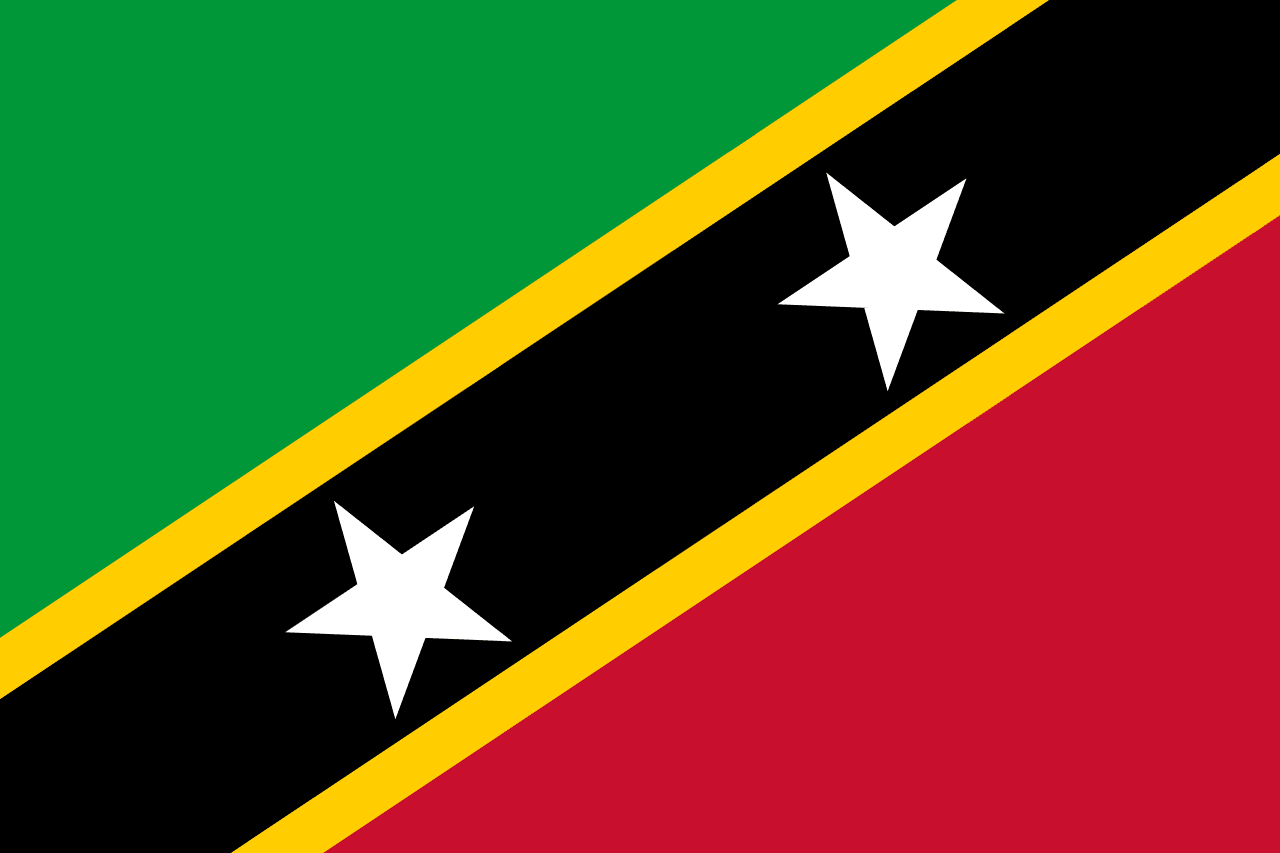
Adopted on Independence Day, 19 September 1983. A diagonal yellow-edged black band runs from lower hoist to upper fly, dividing a green triangle (fertility and the land) from a red triangle (the struggle from slavery and colonialism). Two white five-pointed stars on the black band represent hope and liberty. Designed by Edrice Lewis.
Coat of Arms
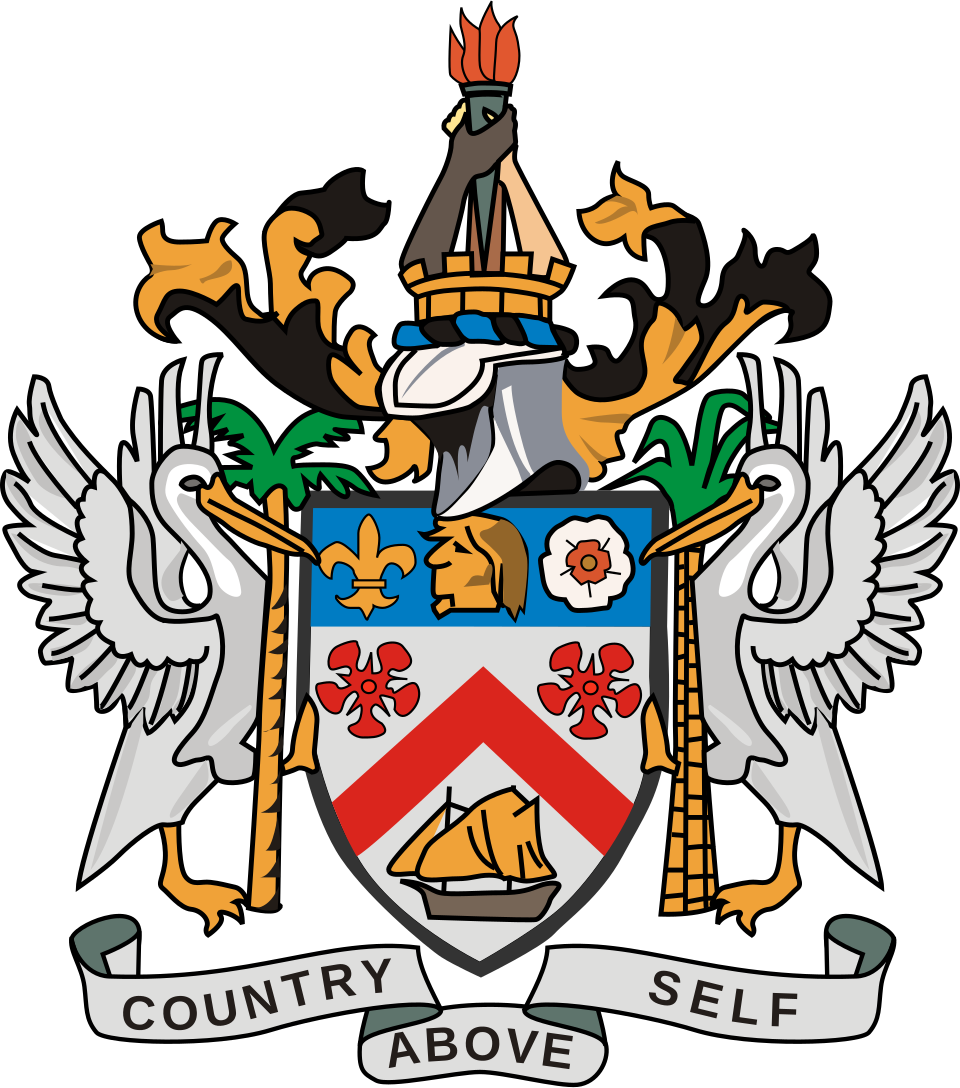
A central shield bearing the bust of a Carib chief, the fleur-de-lys of France and the rose of England (the federation's tri-national colonial inheritance), supported by a sugar cane and a coconut palm. The crest features the hand of a man and a woman together holding a torch, symbolising shared progress.
National Motto
"Country Above Self."
A motto centred on civic responsibility and the federal compact between the islands, taken from the national anthem.
Seat of Government
The federal Government is seated at Basseterre on St Kitts, where the National Assembly and Government Headquarters are located. Government House at Springfield is the Governor-General's residence.
National Anthem
"O Land of Beauty!"
Words and music by Kenrick Anderson Georges. Composed for independence in 1983. Sung at every federal occasion across both islands, at international sporting events, and at every diplomatic event at the High Commission in London.
National Dish
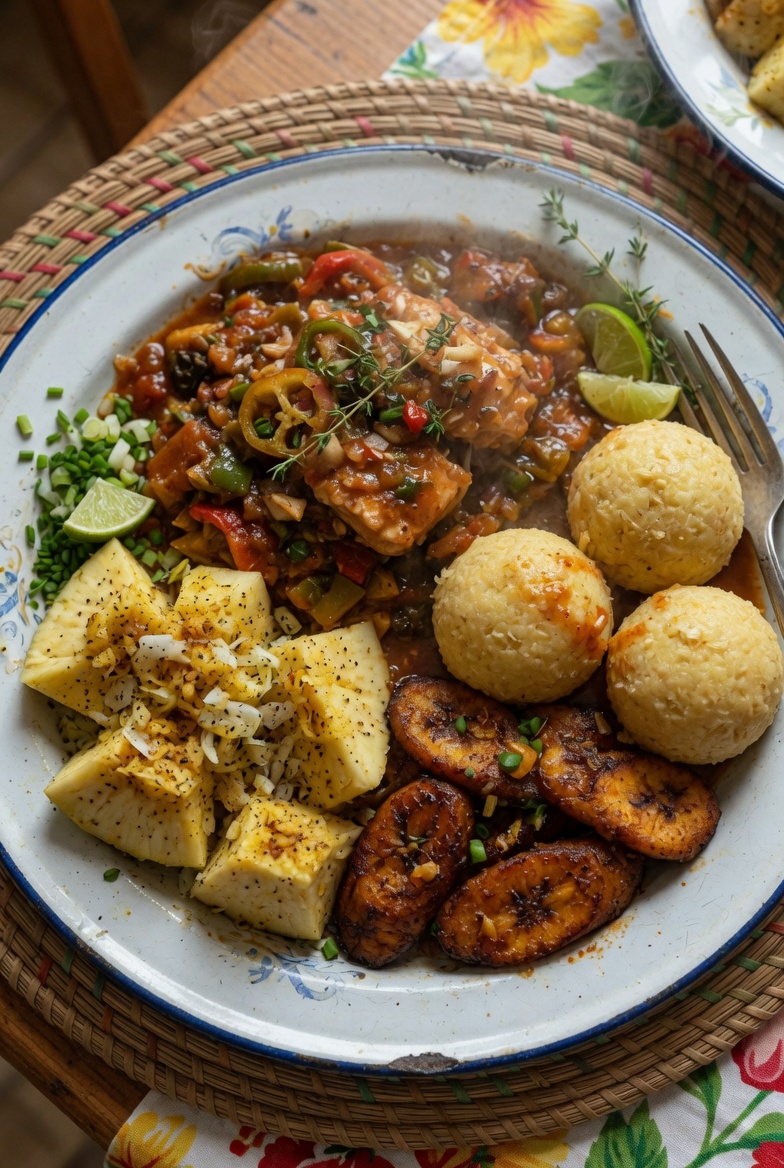
Stewed saltfish with spicy plantains, coconut dumplings and seasoned breadfruit. The traditional Kittitian and Nevisian "Saturday morning breakfast" of saltfish (cod), dumplings made from flour and grated coconut, and breadfruit. Other staples include goat water, conch chowder, black pudding, souse, johnny cakes, fresh-catch mahi-mahi and snapper, and the local Brimstone, Carib and Stag beers brewed in St Kitts.
Did You Know
The Federation of Saint Christopher and Nevis is divided into fourteen parishes: nine on St Kitts and five on Nevis. The federal capital is Basseterre on St Kitts; Nevis has its own administrative capital at Charlestown. The country has approximately 60 beaches across the two islands, from the dramatic black-volcanic-sand beaches of the windward Atlantic coasts to the postcard white-sand beaches of the leeward Caribbean coasts and the South-East Peninsula of St Kitts (Cockleshell Bay, Frigate Bay, South Friars Bay, Sand Bank Bay, Banana Bay).
Country Code: the 869
+1 869. Across the Caribbean and the global Kittitian-Nevisian Diaspora, Kittitians and Nevisians identify themselves simply as "the 869," after the country's telephone area code. You will hear it during Sugar Mas Carnival in December, at Music Festival in June, at Culturama on Nevis in August, and at any SKN gathering in Brixton, Manchester, Birmingham, Slough, Luton, Toronto, Brooklyn or Atlanta. Saying "I’m from the 869" is saying "I’m from home."
The most played songs in St Kitts and Nevis, updated daily. Chart data via Apple Music.
Tap any track for a preview, or open in Apple Music for full playback.
Leadership: Who Runs the Country
St Kitts and Nevis is a parliamentary constitutional monarchy within the Commonwealth, and the smallest sovereign country in the Western Hemisphere. King Charles III is Head of State, represented locally by a Governor-General. The constitutional structure is unusually federal for a country of this size: Nevis has its own Premier, its own Nevis Island Administration (NIA), its own Nevis Island Assembly, and a constitutional right of secession. The Federal Parliament (the National Assembly) has 15 seats; elections are held every five years.
The federal compact: how the country works in practice
The two islands are constitutionally tied together but operationally distinct. St Kitts pays federal taxes that fund federal government; Nevis has its own Island Treasury and substantial control of its internal revenue. The Premier of Nevis sits in the Federal National Assembly as an elected MP and historically has been Leader of the Opposition (as Mark Brantley is now), since the Nevis-based CCM almost always wins all three Nevis constituencies. Cabinet decisions made in Basseterre apply federally, but the Nevis Island Administration has its own Cabinet for Nevis-only matters. In a Nevis-only referendum in August 1998, secession from the Federation received 61.7 percent of the vote, just short of the two-thirds threshold required; the secession question is dormant rather than settled.
Citizenship and Passport 4-Region
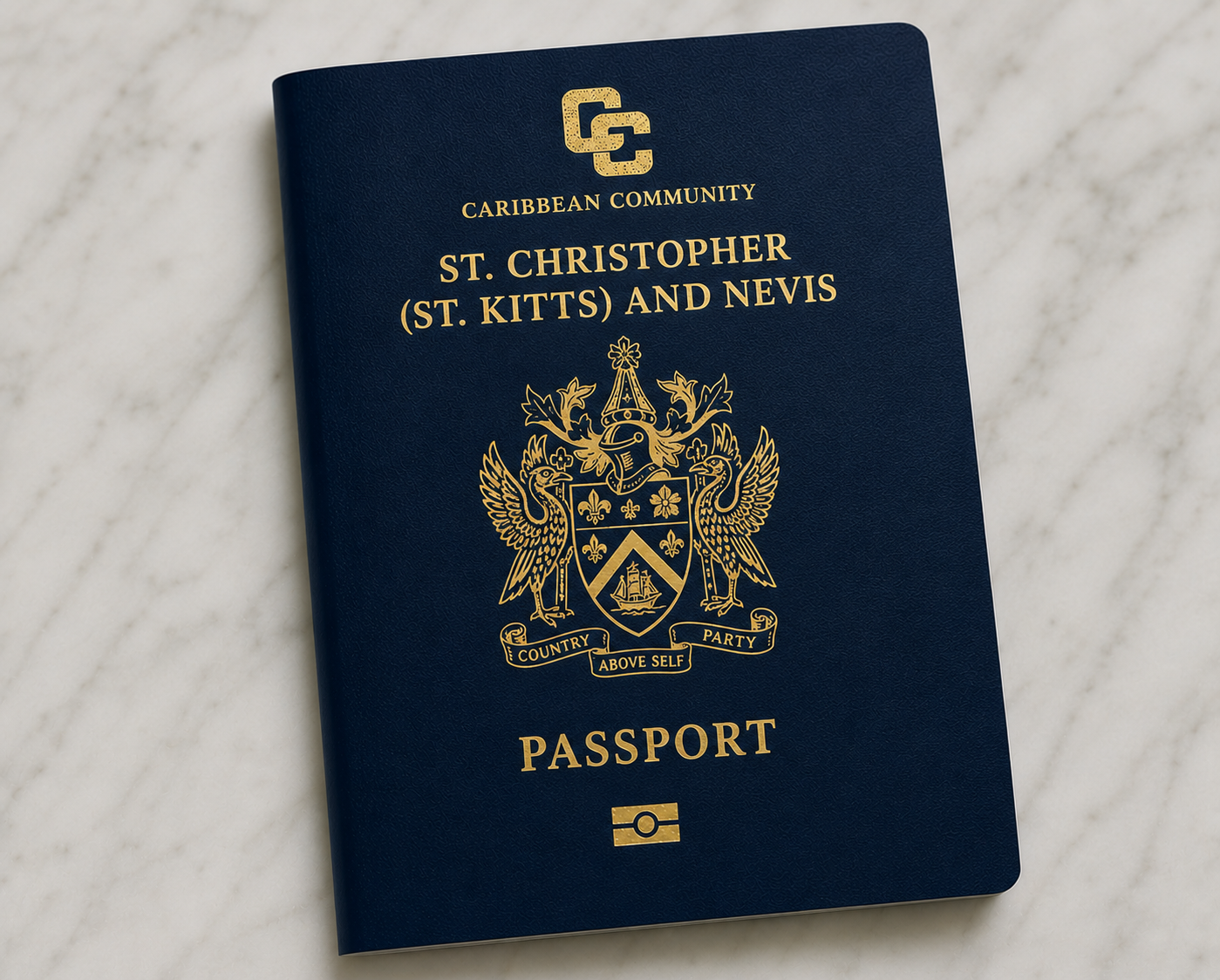
The honest summary: St Kitts and Nevis offers two well-defined doors, the descent and naturalisation route for those with a family or residency connection, and the world’s oldest Citizenship by Investment programme, which was launched in 1984 and underwent its most significant reform package on 8 January 2026.
The routes, honestly
- By birth: anyone born in St Kitts or Nevis is automatically a citizen. The Constitution of 19 September 1983 codifies the rules.
- By descent: a child born outside the Federation whose mother or father is a Kittitian-Nevisian citizen is also a citizen by descent. This is the easiest route for second-generation Diaspora children born in the UK to Kittitian or Nevisian parents.
- By naturalisation: residence in St Kitts and Nevis for 14 years is the standard naturalisation threshold under the Constitution. Naturalisation is granted by the Governor-General on the advice of the Minister of National Security, Citizenship and Immigration (currently Deputy PM Hanley).
- By registration: shorter routes exist for spouses, Commonwealth citizens with seven years of residence, and certain descent variants where the standard descent rule did not apply at birth.
- By investment (the CBI programme): see the dedicated subsection below. Available since 1984, the world’s oldest CBI programme. Significantly reformed January 2026.
- Dual citizenship: fully recognised. Holding a Kittitian-Nevisian passport does not require giving up your British, US or Canadian citizenship.
St Kitts and Nevis is a Full Member of CARICOM and a Full Member of the CARICOM Single Market and Economy (CSME). CSME guarantees CARICOM nationals broad rights to live and work across the 14 participating CARICOM states under the Skills Certificate regime (13 eligible tiers, 5 to 8 week processing). On 1 October 2025, four CARICOM countries (Barbados, Belize, Dominica and St Vincent and the Grenadines) implemented Enhanced Full Free Movement, a deeper pilot allowing CARICOM nationals to live and work in those four countries with no Skills Certificate at all and no maximum stay. St Kitts and Nevis is not in the October 2025 pilot. The Government has indicated openness to joining a later expansion but has not committed to a date.
Citizenship by Investment (CBI), honestly
This deserves its own subsection because it matters for prospective returnees and because the programme is in active transition.
- The programme. Established in 1984, the world’s first CBI programme. Ranked first in the CBI Index five consecutive years (2021-2025). The Citizenship by Investment Unit (CIU) was converted to an independent statutory body in October 2024 under the Citizenship by Investment Unit Act 2024.
- Investment routes (minimums).
- SISC (Sustainable Island State Contribution): US $250,000 non-refundable contribution for a single applicant or family of up to four. Additional dependents: US $50,000 per qualifying adult, US $25,000 per qualifying child.
- Public Benefit Project (PBO): from US $250,000, contribution to government-approved public-benefit project.
- Approved condominium / share-of-development real estate: from US $325,000, with a mandatory holding period of at least seven years.
- Approved single-family private home: from US $600,000.
- The 2026 reforms (announced 8 January 2026). The most significant restructuring since 1984. Headline changes: a new genuine-link framework introducing a mandatory physical-presence obligation; enhanced biometric e-passport requirements; expanded due-diligence on source of funds and financial integrity; mandatory in-person applicant interviews; new accountability rules for approved real-estate developers. Specific minimum-day physical-presence thresholds have not yet been published by the CIU. The reforms shift the programme away from a pure donation model toward what the Government calls genuine engagement.
- Processing. The CIU targets 120 to 180 days from acknowledged submission to a decision; realistic end-to-end planning (from first engagement with a licensed agent to passport in hand) is six to nine months.
- Eligible family. The main applicant, spouse, dependent children up to age 30, and dependent parents up to age 55. Same-sex spouses are not currently recognised under the programme.
- Where it fits regionally. The federation is one of five members of the Eastern Caribbean Citizenship by Investment Regulatory Authority (ECCIRA), which also covers Antigua and Barbuda, Dominica, Grenada and St Lucia, providing a unified regional regulator. The US formally rescinded its 2014 FinCEN advisory concerning the programme in February 2026 in recognition of the reform package.
- Honest caveat for UK Diaspora. If your route to SKN citizenship is by descent or naturalisation, you do not need CBI; CBI is for those without a family or residency tie. CBI does not give priority access to UK consular services. The programme has historically been used heavily by applicants from outside the Caribbean.
Where to apply, by region
| From | Where to apply |
|---|---|
| United Kingdom | St Kitts and Nevis High Commission, 2nd Floor, 10 Kensington Court, London W8 5DL. Tel: +44 (0)20 7460 6500. Web: stkittsnevishcuk.gov.kn. High Commissioner: HE Dr Kevin M. Isaac (since 12 January 2011, the first career diplomat appointed to the post). |
| USA | Embassy of Saint Kitts and Nevis, 3216 New Mexico Avenue NW, Washington DC 20016. Consulates and Honorary Consuls in New York, Miami, Los Angeles, Atlanta. |
| Canada | High Commission for Saint Kitts and Nevis in Ottawa. Consulates in Toronto and Montreal. |
| Europe | Embassies in Brussels (also covering the EU institutions), Berlin, and Paris; SKN also maintains a permanent mission to the UN in New York. |
| In St Kitts and Nevis | Citizenship by Investment Unit (CIU), Basseterre, for CBI applications. Civil Registry, Basseterre, for birth, descent and registration matters. Returning Nationals Secretariat, 3rd Floor, Government Headquarters, Church Street, Basseterre, for returning Diaspora practical support. |
If you are a UK-born child or grandchild of a Kittitian or Nevisian, descent registration through the Civil Registry in Basseterre is your route, not CBI. It is faster, cheaper and constitutionally cleaner. The descent route also makes you a citizen of the Federation, not a CBI passport-holder: there is a small but real reputational and practical difference in some banking and consular contexts. Plan descent first, CBI only if descent does not apply.
Cost of Living 4-Region
An honest monthly comparison: your home city versus life in St Kitts and Nevis, in your own currency. The Federation is meaningfully more expensive than its size and income would suggest because nearly all consumer goods are imported (predominantly through the US and Trinidad), the energy mix is still largely diesel (though the Government has an active geothermal programme on Nevis), and the small consumer market gives limited scale economies. Rents are moderate by international standards but tighten quickly in the CBI-driven premium-property belts (Frigate Bay, the South-East Peninsula, Christophe Harbour and Pinney’s Beach on Nevis).
| Monthly expense | London £ | New York $ | Toronto C$ | St Kitts and Nevis (USD equivalent) |
|---|---|---|---|---|
| Rent, 1-bed local-standard, Basseterre / Charlestown | £2,000 | $3,800 | C$2,400 | ~$700 to $1,200 USD |
| Rent, 1-bed expat-standard, Frigate Bay / Pinney’s Beach | £2,300 | $4,200 | C$2,800 | ~$1,500 to $2,800 USD |
| Utilities (SKELEC / Nevlec electricity + water), monthly | ~£200 | ~$200 | ~C$200 | ~$180 to $400 USD |
| Single person, modest lifestyle (all in) | £3,000 | $4,800 | C$3,800 | ~$1,900 to $2,800 USD |
| Couple, comfortable lifestyle Frigate Bay / Cliff Dwellers (all in) | £3,800 | $6,500 | C$5,200 | ~$3,800 to $5,800 USD |
| VAT (federal goods and services) | 20% | Varies | 13% | 17% standard, 10% on tourism, 0% on essentials |
Forty years of an active CBI programme have created a meaningful two-tier property and services market in St Kitts and Nevis. The South-East Peninsula of St Kitts (Christophe Harbour, Kittitian Hill, Frigate Bay, Half Moon Bay), the Pinney’s Beach / Cliff Dwellers belt on Nevis, and parts of Basseterre and Charlestown trade at international prices. Outside those areas, prices are closer to OECS norms. Diaspora returnees who target the local-standard tier rather than the CBI-driven premium belt find the cost of living considerably more workable.
Housing and Property
As a Kittitian-Nevisian citizen, by descent, naturalisation or CBI, you can buy and own land freely across both islands. Non-citizens who are not CBI applicants require an Alien Land Holding Licence from the Government, currently around 10 percent of the property value, plus standard stamp duty. CBI-approved real-estate purchases at the US$325,000 (condominium) or US$600,000 (single-family home) tiers are governed by separate CBI-specific arrangements that include a minimum holding period of seven years. Property title is registered under the Title by Registration Act in a Torrens-style system administered by the Lands and Surveys Department. A proper title search and survey are essential, particularly for inherited land in the rural parishes of either island where formal succession may not have been registered across generations.
Where Diaspora returnees tend to settle
The two islands feel very different and your choice of island matters more than your choice of neighbourhood within an island.
St Kitts:
- Basseterre and St George Basseterre parish: the federal capital, walkable historic centre, the seat of all federal government and ECCB. Practical and central, with the largest concentration of shops, banks and federal offices.
- Frigate Bay (St Peter Basseterre parish): the historic resort belt, golf, modest condominiums, the Marriott Resort, easy access to the airport. Strong returning-Diaspora and US/UK retiree presence.
- South-East Peninsula (Saint Peter Basseterre, then Saint Anne / Saint George at the tip): the premium CBI-driven development belt, Christophe Harbour, Half Moon Bay, Banana Bay. Premium condominiums and single-family homes, the Park Hyatt, very international.
- Old Road / Middle Island / Sandy Point (Saint Thomas Middle Island, Saint Anne Sandy Point): the historic west coast, where English colonisation began in 1623. Quieter, more local, Brimstone Hill Fortress National Park.
- Cayon / Nichola Town / Dieppe Bay (Saint Mary Cayon, Christ Church Nichola Town, Saint John Capisterre): the rural north and north-east. Smallest prices, deepest local community, most traditional pace of life.
Nevis:
- Charlestown and Saint Paul Charlestown parish: the Nevis capital, the seat of the Nevis Island Administration, walkable colonial town centre, the Nevis Island Assembly building and the Alexander Hamilton birthplace museum.
- Pinney’s Beach / Cotton Ground / Cliff Dwellers / Jessups (Saint Thomas Lowland): the west coast premium belt with the Four Seasons Resort, Pinney’s three-mile beach, and most of the Nevis Diaspora-returnee community.
- Gingerland and Saint George Gingerland parish: the rural eastern uplands. Cooler, beautiful, deeply local.
- Newcastle (Saint James Windward): the location of the Vance W. Amory International Airport and the windward Atlantic coast.
Two honest points. First, the CBI-driven premium belt is genuinely international in price: do not assume that "Caribbean" means "cheap" if you target Christophe Harbour or Pinney’s Beach. Second, the federation sits in the Atlantic hurricane corridor and Mount Liamuiga on St Kitts (1,156m) and Nevis Peak on Nevis (~985m) are both classified as dormant rather than extinct stratovolcanoes; neither has erupted in the historical record but seismic monitoring is ongoing via the Seismic Research Centre at UWI St Augustine. Hurricane risk is the more immediate environmental concern: Hurricane Hugo in September 1989 was the most damaging in living memory; Hurricane Georges in 1998 also caused significant damage; recent storms have largely passed north or south of the islands.
Healthcare
Healthcare is run by the Ministry of Health, with parallel federal and Nevis Island Administration responsibilities. The federation has a reasonable primary and secondary care network for its size, and a growing private-sector tier driven by CBI-funded development; complex care still typically means a medical-evacuation flight to Trinidad, Barbados, Miami or the UK.
Main hospitals and facilities
- Joseph N. France General Hospital, Basseterre, St Kitts: the federation’s main referral hospital, ~150 beds, the principal location for surgery, maternity, paediatrics, A&E and specialist outpatient clinics. Currently the subject of a multi-year renewal programme under the Drew administration.
- Alexandra Hospital, Charlestown, Nevis: the principal hospital on Nevis, run by the Nevis Island Administration, ~50 beds, with A&E, surgical, maternity and general medical capacity.
- Mary Charles Hospital, Molineux, St Kitts: a smaller secondary facility serving the rural north and north-east of St Kitts.
- Pogson Hospital, Sandy Point, St Kitts: the small western-region hospital for the Saint Anne Sandy Point parish area.
- Community Health Centres across both islands provide primary-care, immunisation, antenatal and chronic-disease clinics. Nine on St Kitts, six on Nevis.
- Private clinics including SKN-based GP and specialist practices in Basseterre, Frigate Bay and Charlestown; the Health City Cayman Islands SKN affiliate operates referral pathways for cardiology and oncology.
- Medical Evacuation: standard referrals are to the Eric Williams Medical Sciences Complex / Mount Hope in Trinidad, the Queen Elizabeth Hospital in Barbados, Miami private hospitals (Cleveland Clinic Florida, Jackson Memorial), or the UK NHS / private system for Diaspora returnees with UK access. Med-evac flights are a real cost line; build them into your insurance.
For older returnees
If you are returning at retirement age, plan three things before you travel. Arrange comprehensive private health cover with strong medical-evacuation cover before arrival; for SKN this is non-negotiable. Bring a full written record of your medical history and prescriptions; UK NHS summary care records can be requested through your UK GP before travel. And stock a 90-day supply of any critical long-term medication: small pharmacies in SKN may not reliably stock specialty preparations.
For complex specialist care (advanced cardiac, oncology, neurosurgery, advanced neonatal), the federation’s standard referral pattern is Trinidad or Barbados in the first instance, and Miami or the UK for tertiary needs. Diaspora returnees with active UK NHS entitlement often plan complex care in the UK on visits; verify your UK entitlement status with HMRC and your local Integrated Care Board before relocating, particularly if you have been outside the UK for several years.
Education and Schools
Education in St Kitts and Nevis is free and compulsory from age 5 to 16. The system is British-modelled in structure: early childhood, primary, secondary, with sixth-form study at the Clarence Fitzroy Bryant College (St Kitts) or the Nevis Sixth Form College. End-of-secondary qualifications are Caribbean Examinations Council (CXC) CSEC (broadly equivalent to GCSE) and CAPE (broadly equivalent to A-level).
Well-regarded schools
- St Kitts: Basseterre High School, Cayon High School, Charles E. Mills Secondary School (Sandy Point), Saddlers Secondary, Washington Archibald High School, Verchild’s High School (Trinity Palmetto Point) at the secondary level. The Beach Allen Primary, Newton Ground Primary, Joshua Obadiah Williams Primary among the well-regarded primary schools.
- Nevis: Charlestown Secondary School, Gingerland Secondary School at the secondary level; Charlestown Primary, Gingerland Primary, St Thomas’ Primary among the primaries.
- Sixth Form: Clarence Fitzroy Bryant College (CFBC), Basseterre, the country’s premier sixth-form and tertiary institution offering CAPE A-levels and Associate degree-level qualifications; the Nevis Sixth Form College in Charlestown for Nevis-based students.
- Tertiary: CFBC and the Clarence Fitzroy Bryant College School of Nursing; the University of the West Indies Open Campus at Basseterre; and the international Ross University School of Veterinary Medicine at West Farm (a major US-accredited veterinary school operating in St Kitts since 1982) and Windsor University School of Medicine at Cayon.
- Outbound pathways: most Kittitian-Nevisian sixth-form leavers progress to UWI (Cave Hill, Mona, St Augustine), UK universities (Commonwealth status helps but is not automatic for UK home-fee status; the standard three-year UK residence test applies), or US / Canadian institutions.
SKN’s schooling is solid for primary and lower-secondary, and the CFBC sixth-form pathway works well for university-bound Diaspora children. The honest limitation is breadth at sixth-form level (a smaller A-level subject palette than larger Caribbean countries); ambitious returning families with sixth-form-aged children sometimes plan a Sixth Form / A-level transition back to the UK or to Barbados, Trinidad or Jamaica.
Banking, Tax and Money
A few registrations matter for every returning resident settling in SKN.
The tax picture, honestly
St Kitts and Nevis has one of the most attractive direct-tax profiles in the Caribbean. There is no personal income tax on individuals (a long-standing distinguishing feature of the federation). There is no capital gains tax in most circumstances. VAT applies federally at 17 percent standard (10 percent on hotels and tourism, 0 percent on certain essentials such as basic food items). Corporate income tax is 33 percent (with reduced rates for approved hotel and tourism investments). Property tax is modest and administered by the IRD. Stamp duty applies on property transfers (around 6 to 12 percent for sellers, depending on holding period). The XCD is pegged to the USD at 2.70.
Inheritance tax: an honest comparison with the UK
This is a real and rarely-discussed advantage for returning Diaspora.
- The UK position: UK Inheritance Tax is currently 40 percent on the value of an estate above the nil-rate band of £325,000 (with an additional £175,000 residence nil-rate band where a main home passes to direct descendants, and full spouse exemption). Most middle-class UK estates with a home and pension are affected.
- The SKN position: St Kitts and Nevis does not impose an inheritance tax or estate tax. Beneficiaries do not pay tax on inherited assets. Stamp duty applies to the registration of the inherited title and is the practical cost line on SKN-situs property inheritance.
- The cross-border reality. The same caveat as for every other CARICOM country applies here. Because most UK SKN Diaspora are UK domiciled (often deemed-domiciled by long UK residence) under HMRC rules, UK Inheritance Tax can still bite on the worldwide estate, even after relocation to SKN and even where the assets are SKN-situs. Domicile is sticky and very hard to shed. Treat this as one of the most important conversations to have with a qualified UK tax adviser before you go, alongside a Kittitian-Nevisian lawyer for the local Will.
Wills and estate planning
- Why it matters. Many UK SKN Diaspora have a UK Will that does not properly cover SKN property, or no Will at all. On death this can throw the estate into intestacy across two jurisdictions, which is slow, costly and distressing for family.
- Widely-recommended practice (not legal advice). Cross-border practitioners commonly recommend two Wills: a UK Will for your UK estate, and a separate SKN Will for your SKN-situs assets, each containing language making clear it does not revoke the other. Use a local lawyer in Basseterre or Charlestown for the local Will, who will know whether the property is on St Kitts or Nevis (the Nevis Island Administration administers its own land registry).
- The local rules. Inheritance is governed by SKN statute in the common-law tradition. The Probate Registry of the Eastern Caribbean Supreme Court (headquartered in Saint Lucia, with the Court of Appeal sitting on circuit) handles grants. The Caribbean Court of Justice (CCJ) is the federation’s final appellate court for both civil and criminal matters since SKN acceded to the CCJ’s appellate jurisdiction in 2015. Uncontested probate is usually granted in three to six months.
- UK Wills and resealing. A grant of probate obtained from a UK court can be resealed by the Eastern Caribbean Supreme Court Probate Registry under the Colonial Probates Act, which historically permits resealing of UK grants for SKN-situs assets. Confirm with a local lawyer.
- Practical pointers. Name an executor in each jurisdiction. If the executor is not resident in SKN, a local agent must be appointed via Power of Attorney to obtain the grant of probate. Review every five years or on a major life event. Tell your executor where the Wills are stored.
This is general information for orientation. Always speak to a qualified local lawyer and a UK tax adviser before drafting or relying on a Will.
The Government of St Kitts and Nevis operates a Returning Nationals Secretariat within the Office of the Prime Minister (3rd Floor, Government Headquarters, Church Street, Basseterre). The Secretariat coordinates duty-free concessions on personal and household effects, helps with housing, land and investment enquiries, and acts as a single point of practical contact for the relocation process. Unusually for a small Caribbean state, the Secretariat publishes its services through the High Commission in London as well, so much of the early preparation can be done from the UK before you arrive. Make this your first call.
Work and Business
As a Kittitian-Nevisian citizen (by descent, naturalisation or CBI), you can live and work in SKN without a work permit. Non-citizen non-CBI applicants require a work permit issued by the Labour Department. Non-Kittitian-Nevisian CARICOM nationals can move under the CSME Skills Certificate regime in the 13 eligible tiers.
The main sectors
The federation’s economy has rotated significantly since the closure of the sugar industry in 2005 (St Kitts was the first Caribbean country to formally abandon sugar, ending three centuries of sugar-cane monoculture). The largest sectors today are: tourism, the dominant single sector, anchored by the cruise port at Port Zante Basseterre, the Marriott and Park Hyatt-led hotel base, and the Four Seasons on Nevis; CBI, a major source of federal revenue under the SISC and approved-real-estate routes; financial services, particularly Nevis-based international financial services regulated by the Financial Services Regulatory Commission; construction, in a sustained CBI-driven boom; renewable energy, particularly the active Nevis geothermal energy programme (the Nevis Geothermal Power Project is one of the most-advanced commercial geothermal initiatives in the OECS); creative industries, where the country signed a memorandum to bring an international film production to SKN in June 2026 and became the first country to formally engage a US $2 billion creative industries fund; and education exports, particularly through Ross Veterinary and Windsor Medical.
Starting a business
New businesses register through the Companies Registry at the Financial Services Regulatory Commission. The Nevis Business Corporation Ordinance (NBCO) and the Nevis Limited Liability Company Ordinance (LLC) remain widely-used international corporate vehicles for cross-border structuring. The federation is committed to the OECD Common Reporting Standard and FATCA frameworks.
The Diaspora returnee opportunity in SKN is particularly strong in three areas: tourism services (small hotels, villas, food and beverage, dive and water sports, particularly in the South-East Peninsula and Pinney’s Beach belt), professional services into the CBI ecosystem (legal, accountancy, due diligence, real-estate advisory), and renewable-energy and construction trades (the Nevis geothermal and the federal South-East Peninsula and Christophe Harbour build programmes). The trade-off is honest: a very small market and a high cost of imports limit pure retail and consumer-goods business plans.
Driving and Transport 4-Region
St Kitts and Nevis drives on the left, the same as the UK. Steering wheels are on the right. The road network is well-maintained federal trunk on St Kitts (the F1 Main Road circling the island plus the South-East Peninsula highway opened 1989), and a smaller circular system on Nevis (the Main Road around the island, about 20 miles). The federation’s main airport is Robert L. Bradshaw International Airport (SKB) at Golden Rock, St Kitts; Nevis has the smaller Vance W. Amory International Airport (NEV) at Newcastle. There is a daily British Airways service from London Gatwick to Basseterre (typically with a stop at Antigua), and onward inter-island links by the Sea Bridge ferry (~45 minutes, vehicle ferry) and the Sea Hustler / MV Caribe Surf passenger ferry (~40 minutes) between Basseterre and Charlestown.
| Licence held | How it works | Where | Cost |
|---|---|---|---|
| UK licence | Visitors must obtain a Visitor’s Driver Permit on arrival. For residence, conversion to a Kittitian-Nevisian licence is needed. | Inland Revenue Department / Traffic Department | ~$24 USD visitor; conversion fee separately |
| US licence | Visitor’s Driver Permit on arrival. | As above | ~$24 USD |
| Canadian licence | Visitor’s Driver Permit on arrival. | As above | ~$24 USD |
| EU licence | Visitor’s Driver Permit on arrival; an International Driving Permit is recommended. | As above | ~$24 USD |
For residence, you will convert to a full Kittitian-Nevisian driver’s licence through the Traffic Department / Inland Revenue Department. Public transport is by privately-run minibus and private taxi (no formal scheduled federal bus system, but minibuses run regularly across St Kitts and on Nevis). Most Diaspora returnees keep a private vehicle.
Bringing your pet
Cats and dogs can be brought to SKN with proper paperwork. Current requirements typically include an import permit from the Veterinary and Livestock Department of the Ministry of Agriculture, microchip identification, current rabies vaccination, and a veterinary health certificate issued shortly before travel. The UK is generally an approved-origin country. Confirm the exact current requirements directly with the Veterinary and Livestock Department well before you plan to travel.
Internet and Connectivity
Connectivity in SKN is competitive for a country of its size. The federation is served by Flow St Kitts and Nevis (the Liberty Latin America brand, the historic incumbent formerly Cable & Wireless) and Digicel St Kitts and Nevis, the challenger. Both operators offer fibre and cable broadband across both islands, with consumer speeds typically 100 to 500 Mbps in Basseterre, Frigate Bay, the South-East Peninsula, and the Charlestown / Pinney’s Beach belt on Nevis.
Mobile is 4G LTE across the populated areas of both islands; 5G has been launched commercially by Flow on a limited urban footprint in Basseterre and Frigate Bay, with broader rollout expected through 2026 and 2027. Standalone broadband typically runs from XCD 200 to 600 per month (around US $75 to $225).
Starlink became available in SKN in 2024 and is increasingly used as a resilience layer, particularly important given the federation’s hurricane exposure. Power supply is dominated by SKELEC on St Kitts and Nevlec on Nevis; the Nevis geothermal programme is progressing toward commercial deployment which would shift the cost and carbon profile of Nevis electricity meaningfully.
Safety: The Honest Picture
The honest picture is generally positive, with two specific caveats. The UK FCDO publishes standard precautions, with no specific travel restriction. The US State Department rates SKN at Level 1 ("Exercise Normal Precautions") in its travel advisory. Tourist areas (Basseterre, Frigate Bay, the South-East Peninsula, Charlestown, Pinney’s Beach) are generally very safe; opportunistic petty crime is the most common concern. The Royal St Christopher and Nevis Police Force has community police on Diaspora-frequented routes and operates a Special Services Unit.
The two real caveats. First, the federation has a gang-related homicide pattern concentrated in specific Basseterre neighbourhoods, well outside the tourism belt; the Government has prioritised a national security response and the rate has been declining since a 2022 peak. Drugs-trade transit through the eastern Caribbean is the structural driver. The trend is improving but the absolute homicide rate per capita remains higher than would be expected from the country’s small size. Avoid specific Basseterre areas after dark and follow local advice. Second, the federation sits in the Atlantic hurricane corridor: Hurricane Hugo (September 1989) was the most damaging in living memory; Hurricane Georges (1998), Hurricane Lenny (1999) and Hurricane Omar (2008) also caused significant damage. Earthquake risk is moderate as part of the Caribbean Plate boundary, with the dormant volcanoes (Mount Liamuiga and Nevis Peak) monitored by the Seismic Research Centre at UWI St Augustine.
Returning Diaspora who settle in the Frigate Bay / South-East Peninsula / Pinney’s Beach / Charlestown / Gingerland belts report very high day-to-day safety. The gang-pattern homicide picture is a real public-health concern for the Government but is not a feature of the Diaspora-returnee neighbourhoods. Use the same situational awareness you would use in any small country: avoid unlit areas after dark, do not carry large amounts of cash, and keep your local relationships current.
Before you travel, check the official FCDO travel advice for St Kitts and Nevis.
Diaspora Missions, UK Association and Community 4-Region
The country’s diplomatic and Diaspora representation, plus the community channels you can plug into. The UK Diaspora is well-organised and the High Commission in London operates one of the more active Diaspora liaison programmes of any small Caribbean state.
UK Diaspora Associations
The UK Kittitian-Nevisian Diaspora is concentrated in London (particularly Brixton, Lambeth, Croydon and Brent), the South-East (Slough, Luton), the West Midlands (Birmingham, Wolverhampton), the North-West (Manchester) and Yorkshire (Leeds, Sheffield). Major UK Diaspora associations include:
- St Kitts and Nevis Association of the London Area (SKANLA): the principal London-area umbrella, a membership-based organisation set up by community volunteers to inform, socialise, befriend and support Kittitian and Nevisian nationals across London. Awarded a 2022 recognition prize by Brent Council for its community services.
- St Kitts and Nevis Association Slough (SANAS): founded 1998. The principal Slough-area umbrella, promoting health, well-being, family unity and education, supporting Diaspora nationals across the Thames Valley.
- St Kitts, Nevis and Friends Association of Luton: founded 1984. Co-organises the Luton International Carnival and Windrush-anniversary events celebrating the contributions of the SKN community to British society.
- St Kitts and Nevis Friendly Association: cross-UK organisation focused on youth-related activities, sports, training and social interaction.
- Cross-Caribbean umbrellas: the British Caribbean Association (BCA), the Caribbean & African Health Network (CAHN), the Voice Newspaper, BBC 1Xtra and the cross-CARICOM church networks serve UK Kittitians and Nevisians alongside other CARICOM nationals.
- Online community: SKN Diaspora UK WhatsApp groups (coordinated through SKANLA and the High Commission), the SKN Diaspora Facebook community pages, and the diaspora.kn database operated by the Returning Nationals Secretariat in Basseterre.
Facebook Groups and Pages
Where the UK Diaspora can plug into Kittitian-Nevisian community life online. A curated list, not exhaustive:
- St Kitts and Nevis High Commission UK, the official Diaspora liaison page.
- Government of St Kitts and Nevis and Office of the Prime Minister (SKNIS), central Government pages.
- SKN Tourism Authority and Nevis Tourism Authority, separate official tourism pages for the two islands.
- SKNVibes, the leading independent SKN news and current-affairs site and Facebook page.
- The St Kitts Nevis Observer, the national newspaper.
- SKANLA, SANAS, St Kitts, Nevis and Friends Association of Luton, and the regional UK Diaspora group pages.
- The Caribbean Diaspora, British Caribbean Development, and the broader Pan-Caribbean UK community groups, where Kittitians and Nevisians are well-represented.
Not sure where to start?
Map your move with the Relocation Intelligence Calculator: your citizenship eligibility, budget and timeline, costed clearly.
Your First Steps
- Confirm your citizenship route. For UK-born children and grandchildren of Kittitian or Nevisian parents, descent registration through the Civil Registry in Basseterre is the first port of call, not CBI.
- Register with the Returning Nationals Secretariat (3rd Floor, Government Headquarters, Church Street, Basseterre) before you travel. They coordinate duty-free concessions and provide a single-point relocation contact, and a meaningful amount can be done from London via the High Commission.
- Decide which island. St Kitts is the federal capital, the financial centre, the airport hub and the CBI-driven development heartland; Nevis is quieter, more autonomous, with its own administration and its own pace. Diaspora returnees often choose Nevis for retirement and St Kitts for working-age return.
- Choose your settlement: Basseterre / Frigate Bay / South-East Peninsula for St Kitts; Charlestown / Pinney’s Beach belt / Gingerland for Nevis.
- If you do not have a descent route and need CBI, work with a licensed agent only. Verify against the CIU’s authorised-agent list at the Government of SKN website. Budget six to nine months end-to-end and be aware of the January 2026 reform package and the new physical-presence framework.
- Register with Social Security Board and the Inland Revenue Department for a TIN on arrival. Note that SKN has no personal income tax.
- Arrange private health cover with strong medical-evacuation cover (Trinidad / Barbados / Miami / UK). Bring full medical records and at least 90 days of any critical prescriptions.
- Speak to a qualified local lawyer about an SKN Will to sit alongside any UK Will. Confirm whether your UK grant of probate can be resealed by the Eastern Caribbean Supreme Court Probate Registry under the Colonial Probates Act.
- If you are buying property, do a full title search through the Lands and Surveys Department (and the Nevis land registry if buying on Nevis). Be alive to the Alien Land Holding Licence rules if you have not yet registered citizenship.
- Plan air access: daily British Airways London Gatwick to Basseterre (often via Antigua) is your direct UK link; Virgin Atlantic and BA also serve Antigua daily with onward inter-island connections.
- Run your numbers through the Relocation Calculator and plan your shipping with the 2026 Shipping Bible.
Tools and Quick Links
CARICOM Heroes & Notable Figures
The people who shaped St Kitts & Nevis — honoured at home and across the diaspora. See them on our Caribbean Events Calendar.